Mortgages are becoming one of the most popular ways to finance a new home. So much so that Bankrate figures suggest over 1.52 million households took a residential loan in the last quarter of 2022. 

And for obvious reasons as lenders have of late introduced quite rewarding terms. 

But if there’s one question both new and repeat homebuyers ask, it is, ‘Do lenders require a home loan?’

A short answer to this question is no, your typical lender will not require you to get your home inspected before issuing a mortgage. 

Nevertheless, they may still suggest you conduct a complete home inspection. Also, meeting some of the mortgage conditions might call for an inspection. 

Here’s more to mortgage home inspections. 

What exactly is a home inspection for mortgage loan?

Before we get into the details of whether or not do lenders require a home inspection, let’s see what a home inspection is all about. 

A mortgage inspection, like any regular home inspection, involves a visual analysis of the building from the inside out by a licensed inspector. And this includes some of the most critical areas of the home such as structure and foundation. 

You see, home inspectors like myself are trained and certified to spot even the smallest of problems, including the ones that are hidden under the surface. 

For instance, the roofing, plumbing, or electrical systems might have some underlying problems that you can’t see. However, my training and skills allow me to detect these problems and flag them in the inspection report. 

Now, when it comes to home loans, or even buying a home in general, an inspection can help you fully understand the existing condition of the property. And with a complete picture, you can make the right purchase decisions. 

If you’re wondering what’s more to a home inspection, you can go through our blog – What Is A Home Inspection

Bonus: A lender inspection is different from regular home inspections

When we talk about a home inspection before loan approval, it is common to come across questions like, ‘What is a lender inspection?’

However, it’s essential for you to know that a lender inspection is entirely different from a pre-mortgage home inspection. 

For starters, a lender inspection is typically conducted by the lender in multi-family buildings such as apartments during and after construction. And unlike a complete home inspection that involves detailed examination, lender inspections only cover the basics. 

For instance, lender inspections look at the project’s speed, fund utilization, safety compliance, potential damage, home systems and appliances, etc. This is usually done in the form of a walkthrough and may not cover the areas that are looked at during complete home inspections. 

So don’t be confused by the term lender inspection as it isn’t the same as a home inspection. 

Do lenders require a home inspection or not? 

Like we discussed earlier, a lender will never ask you to conduct a home inspection as a condition for loan approval. Meaning it is possible to get a home loan without inspection. 

But the lenders may suggest you conduct a home inspection. And despite the fact that the cost of an inspection can run into hundreds of dollars, it makes complete sense to get one. 

Why should you get a home inspection before loan approval? 

To start with, lenders do have some mortgage conditions that have to do with the overall condition of the property. 

Take Fannie Mae’s loan requirements, for instance, which needs a qualifying score of at least 620 for loan approval. And your property should be up to mark in terms of safety and code compliance to reach that score. 

Now, a home inspection can not only determine if the property is meeting Fannie Mae’s requirements but also assure you about your investment. 

Furthermore, a home appraisal is required by lenders before they approve your home loan. And although the scope of an appraisal is to establish the market value of a property, the appraiser might spot issues and list them. 

As such, the lender may ask you to address the identified issues and have the property appraised again as a condition for loan approval. After all, the lenders want to ensure their investment is safe by all measures. 

Is a home inspection required for a government-backed loan? 

Apart from private lenders like banks, government-backed loans are also quite popular among new homebuyers. And rightly so, as they carry some amazing benefits including easy credit qualification, low down payments and interests, reduced closing costs, etc. 

So you might find yourself asking, ‘Is a home inspection required for a mortgage that’s government-backed?’

However, the answer to this question is a bit complicated. 

You see, there are two most popular government-backed mortgage schemes, namely the Federal Housing Administration’s FHA loans and the Department of Veterans Affairs’ VA loans. And the mortgage requirements for both these schemes are similar to private lenders in the sense that they don’t mandate home inspections but call for a home appraisal. 

But there is a catch here. 

While the sole purpose of appraisal for private lenders is to know the property’s real market value, government loan appraisers also review the property’s condition. In fact, these appraisers are needed to check if the property meets the minimum requirements of the lending agency. 

Meaning whether or not you get an FHA or VA loan approved will depend on the overall condition of the home. So it’s a good idea to conduct a home inspection and have first-hand information about the property before applying for a government mortgage. 

Do lenders require a home appraisal? 

Yes, lenders do require a home appraisal before they approve a mortgage. And that’s because they want to make sure they’re not overpaying for the property’s actual worth. 

You see, it’s commonplace for lenders to have a listing price that’s more than the real market value of the property. So a neutral third-party home appraisal is an important step in establishing the right listing price for the property based on factors such as location, existing condition, etc.

Home inspection vs. home appraisal: What’s the difference? 

When we talk about a home mortgage inspection, it is common for homebuyers to confuse it with a home appraisal. And since an appraisal is required before mortgage approval, one might think of it as a mandatory inspection, which isn’t true. 

So let’s understand the basic differences between a home inspection and an appraisal. 

A home inspection looks at the overall condition of the property including its foundation, structure, roofing, walls, plumbing, etc. 

Now, even though it’s in your best interest to get a home inspection, it is not mandatory at all. 

A home appraisal, on the other hand, is necessary for mortgage approval and is meant to determine the exact value of the property. However, the appraisers while evaluating the market value might note some visible deficiencies, prompting the lenders to ask for an inspection. 

You might also want to read – Is A Home Inspection Required For A Conventional Loan

Home inspection before loan approval: FAQs

Do banks require home inspections before approving a loan? 

No, they don’t. 

Nonetheless, you will have to conduct a third-party home appraisal as the lenders want to verify the true market worth of the property. Also, if the appraisal report flags some concerns, the bank can ask you to get the property inspected. 

That’s because the lenders want to make sure they pay for what the property is actually worth. And signs of potential problems mean a lower market value than the actual listing. 

What does a home inspection for mortgage loan examine? 

A mortgage inspection involves a complete examination of the property from the inside out. And this includes: 

Interior elements namely: 

  • Basement 
  • Attic 
  • Plumbing 
  • HVAC 
  • Electrical system 
  • Home appliances 

Exterior elements namely: 

  • Foundation 
  • Roofing 
  • Chimney 
  • Siding 
  • Garage 
  • Drainage 

Is it a good idea to get a home loan without inspection? 

Although it is possible to get a mortgage without having to spend extra bucks on inspection, it might not be the best option for you. 

You see, oftentimes buyers resort to waiving the home inspection contingency in order to make their purchase offer more lucrative. But that also means there’s no chance they can know about some serious hidden problems before purchasing the property. 

And for mortgage homebuyers, it’s a double whammy because apart from interest payments they also have to foot the bills for property repair and maintenance. 

What are the advantages of a home inspection before loan approval? 

There are numerous benefits of getting a third-party home inspection before you apply for a loan, including: 

A. Complete identification of problems 

Home inspection reports detail the potential problems and the implications they can have in the future. 

For instance, when I spot a roofing leak while conducting an inspection, I list it in my report and also inform the homebuyer about its seriousness. This ensures the buyer makes an informed purchase decision. 

B. Edge in negotiations 

A thorough knowledge of the issues within a property means you can ask the seller to fix the problems before finalization of the deal. Also, you can renegotiate the deal and lower your purchase offer, which also means a lower mortgage and interest. 

C. Appraisal qualification for government loan 

As we discussed earlier, a government loan home appraisal also checks whether the property meets certain minimum requirements. In fact, the mortgage approval is based on the appraisal findings of the appraisal report. 

So by having an inspection before a scheduled appraisal, you’ll know beforehand if the property qualifies for an FHA or VA mortgage. 

You might also want to read – Third Party Inspection For New Home: A Complete Guide.

Get a Thorough Home Inspection Plan and an Estimated Project Cost for Free!

Conclusion

As you can see, whether or not do lenders require a home inspection has no direct answer. That’s because even though it isn’t mandatory to get an inspection, you might ultimately need to conduct one in order to meet mortgage requirements. 

Moreover, if you’re applying for a government-backed loan, getting a home inspection means a supporting appraisal report and seamless mortgage qualification. 

Looking for a thorough home mortgage inspection? 

You can get in touch with us!

At Florida Property Group, we’re a premier home inception team of seasoned inspectors with over a decade of extensive experience. Also, we provide customized inspections, which in turn ensures cost-efficient quotes. 

Simply put, we’ve got all your inspection needs covered on a budget. 


Nate Standifer

Nate Standifer

Nate Standifer is co-founder of Florida Property Group and a Florida-licensed home inspector with 15+ years of experience across telecommunications, low-voltage electrical inspections, and residential property inspections. An InterNACHI Certified Professional Inspector®, he and the Florida Property Group team complete approximately 1,500 inspections annually across Bradenton, Sarasota, Lakewood Ranch, and surrounding Southwest Florida communities.

InterNACHI Certified • RASM Member • SUPRA Access

Residential properties, including family homes and condos, among others, are the hot sellers on the real estate market. And among all mortgage options, conventional loans have turned out to be an overwhelmingly favorite method of financing a new home. 

Not to mention, a lot of existing homeowners are also looking to conventional mortgages for refinancing, thanks to their flexibility and lucrative terms. 

However, there’s one question that a lot of potential buyers and existing owners keep asking, which is, ‘Is a home inspection required for a conventional loan?’

Simply put, most of the lenders don’t require you to conduct a home inspection for a conventional mortgage. 

But depending on the lending company and the type of mortgage, you may still be required to get a home inspection. 

Wondering what’s more to mortgage inspection and whether or not you need to conduct one? 

Well, we’ve compiled everything about conventional loan home inspection requirements. Also, we’ve shared our expert tips for speedy inspections and seamless mortgage approvals. 

So let’s dive right in and have a look up close. 

Is a home inspection required for a conventional loan or not? 

As we just discussed, lending firms don’t usually need a home inspection report before they approve your conventional home. 

Nevertheless, if your mortgage amount is high or covers a significant portion of the total value of the home, the lenders might require an inspection. That’s because every conventional loan that’s issued is an investment for the lenders, and they want to ensure it’s a safe one. 

Also, in some cases, the lender might recommend a thorough pre-purchase home inspection, even if it’s not necessary for the purpose of loan approval. 

And it makes sense to heed their advice. After all, you don’t purchase a home every day, and a few hundred dollars spent on inspection can give you unparalleled peace of mind. 

Fair enough, isn’t it? 

Now, before we get into the importance of an inspection before a mortgage, let’s understand when and why you might need a home inspection before loan approval. 

Do conventional loans require inspection before approval? 

Although conventional loans are much more lenient compared to other mortgages in the sense that they don’t mandate an inspection, you might still need one. 

You see, government-backed mortgage schemes have a string of requirements, including inspection and appraisal. But that’s not the case with conventional mortgage plans offered by banks and backed by private investors. 

Nonetheless, private lenders also have certain standards that they require your property to meet. 

For instance, most conventional lenders follow Fannie Mae’s rules, which call for certain criteria that your home should meet. And this includes the following: 

  • It should be a single-family or multi-family home with a maximum of four units. 
  • You should be able to purchase it using a loan amount within the current conforming loan limits after making the down payment. 
  • The property should be located either in the US or American territories (Guam, Puerto Rico, or the US Virgin Islands). 
  • The structure should be residential.
  • The property should be securable as real estate. 
  • Home building should be safe, sound, and structurally secure. 
  • It should be insurable for contingencies such as flood and other risks. 
  • The property should be accessible by a road in accordance with local codes. 
  • It should be connected to basic utilities such as electricity and water as per local codes. 
  • It should be fit for round-the-year use. 

Similarly, the lenders will also require a home appraisal to verify its real value before leading out a mortgage. 

And to meet Fannie Mae guidelines or address home appraisal findings, you’ll need a thorough home inspection, more likely than not. 

Wondering when you might need a home inspection for a conventional loan? 

Well, let’s have a look. 

When does a conventional loan require a home inspection? 

As you can see, meeting Fannie Mae’s conditions and getting a home appraisal are two prerequisites before your lender can approve a conventional loan. And you might need a home inspection for both. 

To start with, let’s see when you might need an inspection to meet Fannie Mae’s rules:

A. The guidelines clearly call for ensuring that the property is “safe, sound, and structurally secure.” And the only way to know if the home in question meets this condition is an inspection. 

B. Another Fannie Mae rule says that the property you’re purchasing should be insurable for natural and other hazards. This may require you to conduct an insurance inspection.

For instance, insurance companies in Florida require a 4-point home inspection for insurance coverage. Meaning this could be a criterion for establishing the insurability of your home. 

C. Finally, the guidelines suggest the property should have utilities like electricity as per local codes. And to determine whether or not the property’s utilities meet local codes, you might need specialized inspections such as an infrared thermography inspection

Apart from Fannie Mae’s, a conventional loan also needs a home appraisal report to understand the market value of the home. And the appraisal, in return, often relies on a comparison with similar properties to provide an accurate value. 

Now, the appraiser might spot some issues and highlight them in their report, thus alarming the lenders. This can necessitate a home inspection to establish the extent of damage and safety of the property before loan approval. 

Is a home inspection before loan approval mandatory? 

Conventional lenders don’t have any written rules about home inspections before a loan issuance. However, you should remember that they do have some unwritten requirements in place regarding the overall condition of the home. 

Also called the conventional loan home condition requirements, these have to do with the property’s safety and can impact your mortgage approval. 

For instance, the lenders don’t want to invest in a property that isn’t safe or has underlying issues. So, they might ask you to include an inspection contingency clause in your purchase agreement and conduct a home inspection. 

Talking about the inspection itself, it’s likely that it brings out hidden problems such as pest or termite infestation, lead or asbestos contamination, etc. And that’s especially true if you’re purchasing an old property or looking to refinance. 

In these situations, the lender will approve your mortgage only after the seller eliminates the problems entirely. 

Does a conventional loan home appraisal require inspection? 

No, a home appraisal in order to meet conventional loan requirements doesn’t need an inspection. 

However, an appraisal might lead to an inspection. Here’s how: 

You see, a home appraisal is meant to evaluate the fair market value of a property. Herein, a home appraiser examines the home and compares it with similar properties in the neighborhood, especially those that have recently sold. 

And while the idea behind a conventional loan appraisal is to ensure that the lenders don’t pay more than what the home is worth, it also protects the buyer’s interests. 

For instance, sellers might set an asking price that’s way more than the property’s value. So not only does an appraisal protect you from overpaying, but it also guarantees lenders that they can recover their investment during foreclosures. 

Now, during the course of appraisal, the home appraisers might notice some visible problems. And although they aren’t home inspectors, they can list issues such as chipping paint or loose hanging wires, among others. 

This is enough for lenders to become cautious and ask you to get a complete home inspection before they approve the mortgage. 

Bonus: We suggest a pre-appraisal third party home inspection for a seamless mortgage approval 

No matter how well-kept a property is, it can still have some visible problems. And it’s only a matter of time for the appraiser to notice and flag them in their report. 

Not to mention, a negative remark by the appraiser doesn’t only delay mortgages, it also leads to denials. 

As such, by having a third home inspection before appraisal, you can have a clear understanding of the problems and ask the seller to fix them. Also, you can determine if the home is worth investing in. 

Curious as to what a third party home inspection is all about? 

You can go through our blog – Third Party Inspection For New Home: A Complete Guide

Conventional loan home inspection: What is it all about? 

As the name suggests, a conventional mortgage inspection is a home inspection that’s done to meet the lender’s requirements. 

For instance, you may want to conduct a home inspection to ensure that the property meets Fannie Mae’s guidelines. Similarly, you might be looking for an inspection before loan appraisal in order to address the areas of concern.  

These inspections typically find the following: 

  • Structural or foundational problems that can pose safety risks. 
  • Roofing or flooring issues that signal a larger problem at hand. 
  • Plumbing, electrical, and HVAC system analysis to see if they’re compliant with local codes. 
  • Termite or pest infestation. 
  • Whether or not the insulation system is intact. 

The above problems can endanger the safety of the property and cost thousands of dollars to fix. So, a mortgage inspection ensures that you’re buying a sound home and guarantees the lenders that it’s a safe investment to make. 

Also, it offers you a chance to flag the problems to the seller and settle them before you close the purchase deal. 

Conventional loan inspection checklist: What does it include? 

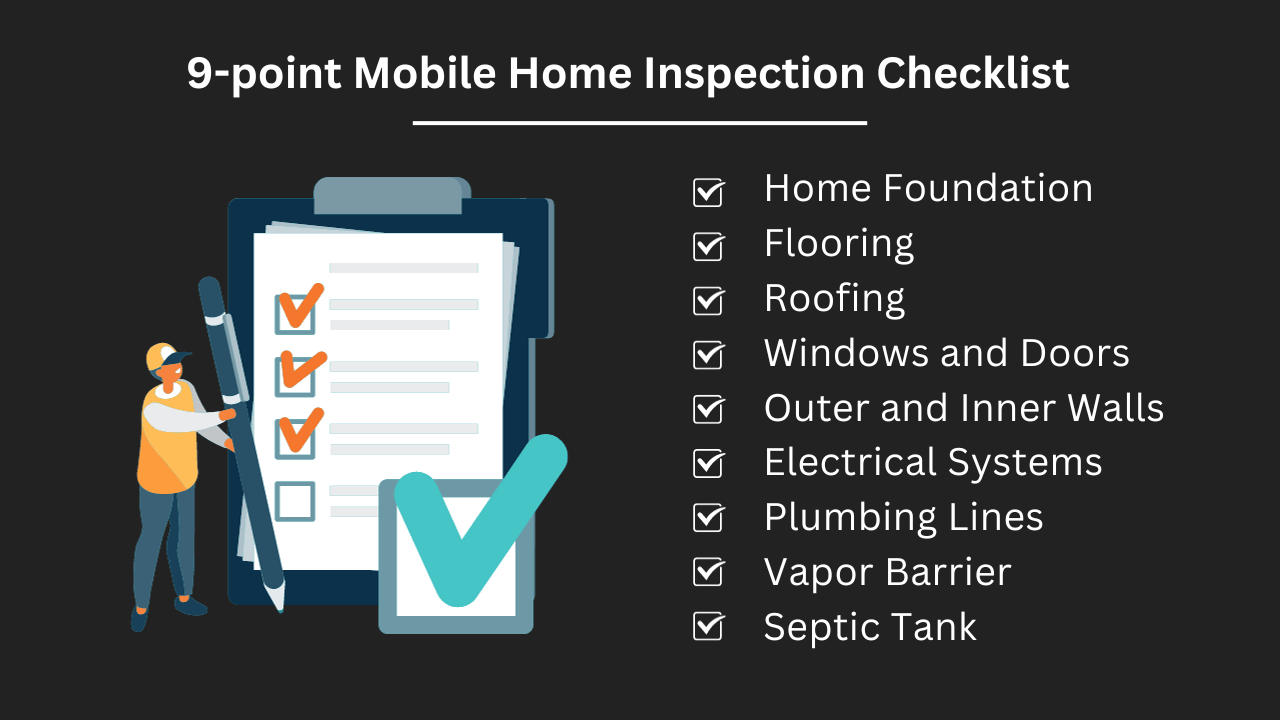
A mortgage inspection involves a licensed home inspector who looks at the following areas of the property:  

  • Home foundation 
  • Flooring 
  • Windows and doors 
  • Walls
  • Ceiling and roofing
  • Plumbing 
  • Electrical systems  
  • Vapor or moisture barrier 
  • Septic tank

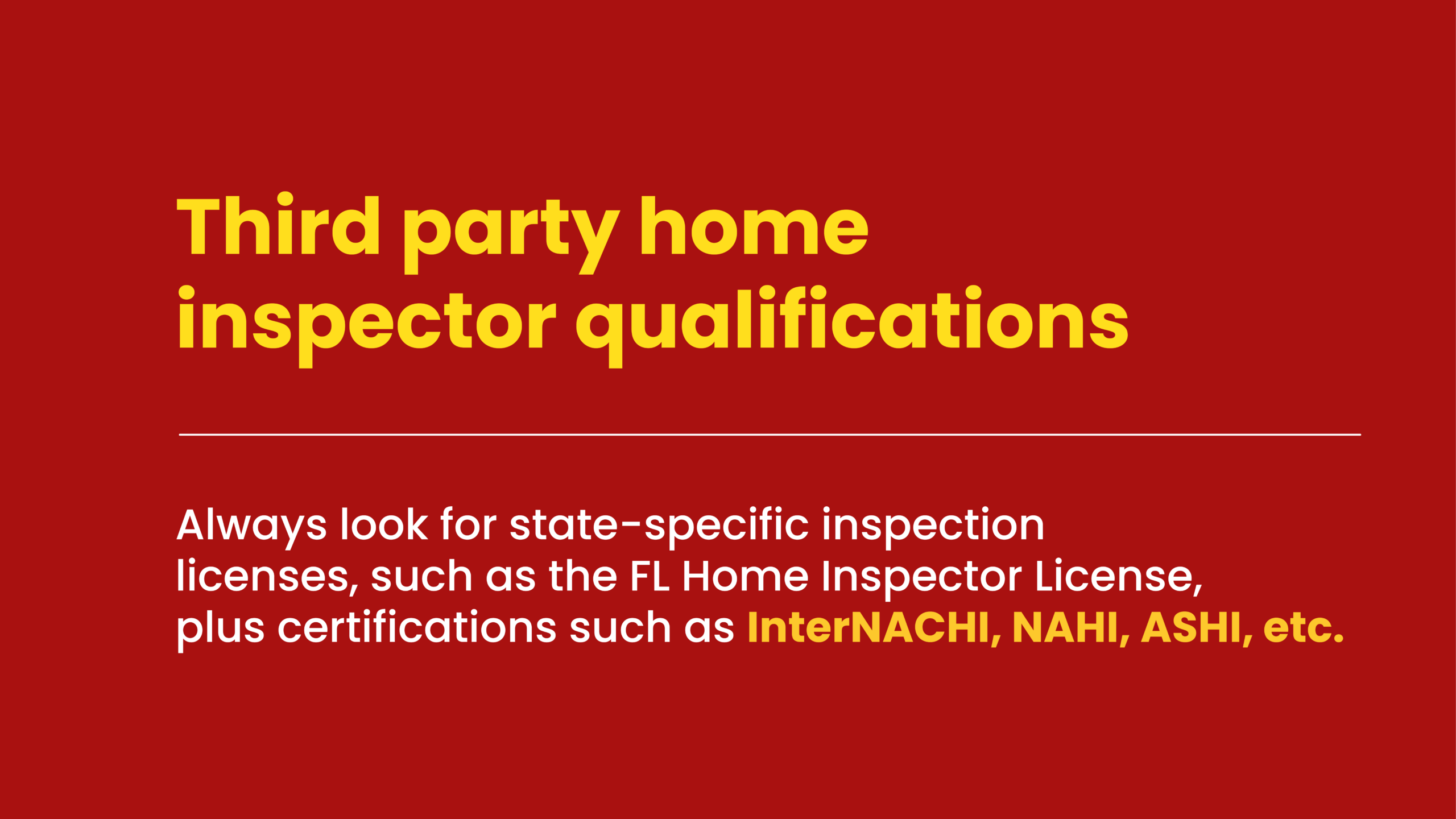
Note: When hiring an inspector for a conventional loan home inspection, we suggest you look for a state-specific license. Also, you should look for certifications such as the International Association of Certified Home Inspectors (InterNACHI), American Society of Home Inspectors (ASHI), etc.

How much does a conventional loan home inspection cost? 

A conventional loan inspection can cost you anywhere between $225 and $629. The actual will be determined by a lot of factors, the most important of which is the size of the property. 

Also, the inspection costs differ for different regions. 

For instance, the average cost of home inspection in Florida is $325. But it might not be the same in other states. 

Wondering how much you can expect to pay for a complete home inspection in Florida? 

You can go through our blog – How Much Is A Home Inspection In Florida

What if the inspection finds major defects that need extensive repairs?  

It is commonplace for home inspections to throw up significant damages that are otherwise hidden. And that’s more often the case with older homes. 

But that doesn’t mean your lenders will outrightly deny a mortgage. They will, however, require you to ensure that essential repairs are made and the home is up to order before closure. 

In fact, they may not approve the mortgage till all the problems are adequately addressed and repairs finished. 

This shouldn’t be a major concern when buying a home, as it’s the seller who’s required to bear the repair expenses. 

Nevertheless, if you’re looking to refinance your home, any potential issues that the inspection might find will have to be fixed at your own expense. 

What are the general conventional loan requirements? 

Apart from home inspection requirements, a conventional loan also has certain necessary conditions that have to do with your personal finances. 

In all, here are the conventional loan requirements in Florida as per Fannie Mae’s guidelines: 

  • A minimum credit score of 620 and a clean credit history. 
  • Two years of consistent employment and income. 
  • A minimum 20 percent down payment. 
  • A DTI ratio below 36 percent. 
  • Total loan amount not exceeding loan limits. 
  • Sufficient savings in the bank. 

You might also want to read – Mobile Home Inspection Checklist: Everything To Know About

Get a Thorough Home Inspection Plan and an Estimated Project Cost for Free!

Conclusion 

You see, the question as to is a home inspection required for a conventional loan or not is highly subjective and has no clear answer. 

For instance, although there’s no written rule about inspection, it is the only way you can meet the requirements of conventional lenders. 

Not to mention that you can also get a mortgage approved without any inspection at all, especially if you’re buying a newly constructed home. 

Nonetheless, it’s a smart move to get a property inspected to avoid any problems or delays with financing. 

Looking to get a conventional loan home inspection? 

You can get in touch with us!

We are Florida Property Group, a leading Southwest Florida inspection company with over a decade of experience in inspecting a diverse range of residential properties. From single-family homes to mobile homes to condos and more, you name it, and we’ve got you covered. 


Nate Standifer

Nate Standifer

Nate Standifer is co-founder of Florida Property Group and a Florida-licensed home inspector with 15+ years of experience across telecommunications, low-voltage electrical inspections, and residential property inspections. An InterNACHI Certified Professional Inspector®, he and the Florida Property Group team complete approximately 1,500 inspections annually across Bradenton, Sarasota, Lakewood Ranch, and surrounding Southwest Florida communities.

InterNACHI Certified • RASM Member • SUPRA Access

You’ll agree when we say that a home inspection is the most crucial test to understand a home’s robustness and longevity. 

In fact, be it purchasing a home or undertaking repairs and renovations, an inspection report is considered the benchmark for deciding the best course of action. 

And that’s exactly why an overwhelming majority of Florida homeowners go for a thorough home inspection despite it not being mandatory. 

But the one question that everyone looking for an inspection has on their minds is, how much is a home inspection in Florida?

This question has no straightforward answer though, as the actual amount you pay for home inspection services depends on multiple factors, including the type and scope of the inspection. 

However, we’ve compiled the average cost of home inspection that you can expect to pay for a typical inspection. Also, we’ve calculated the average costs for various home sizes and inspection types. 

So let’s have a close look and understand the nitty-gritty of home inspection cost. 

How much is a home inspection in Florida? 

The average cost of home inspection in Florida is $325. And this is very close to the national average, which, according to HomeAdvisor, is $342. 

Home inspection cost infographic

You can, however, expect to pay anywhere between $200 and $700 for a complete home inspection under the existing market conditions. Herein, the exact cost will be determined by the size of your property. 

Wondering how much a full home inspection will cost you? 

Well, here’s an average inspection cost chart based on the square footage of your home:

Size (in sq. ft.) Average cost for inspection
< 500 $225
501 – 1,000 $262
1,001 – 1,500 $300
1,501 – 2,000 $328
2,001 – 2,500 $350
2,501 – 3,000 $371
3,001 – 3,500 $402
3,501 – 4,000 $463
4,001 – 4,500 $500
4,501 – 5,000 $574
5,001 – 6,000 $629

Note: The total cost of home inspection in Florida is also determined by the type of inspection that you opt for. 

For instance, while the above chart lists the average cost of standard home inspections, this will definitely differ for services such as four-point inspections and wind mitigation inspections

So, let’s see what these different inspection services are and how much you’re likely to pay for each of them. 

What are the different kinds of home inspections and how much do they cost? 

A home inspection generally involves a thorough examination of your home from the inside out.

But even though these inspections are most commonly sought after by both owners and buyers, there are other types of inspections too. 

For instance, if you’re looking for home insurance, you’ll most likely need a four-point home inspection. Similarly, some inspection companies also provide custom services for specialized needs.

So, it is obvious that these different types of inspections will have separate charges. 

Now, for a clear understanding of pricing, we’ve delved deep into the various inspections and what determines their cost. And here’s what it looks like: 

1. Full home inspections 

A full home inspection is your typical inspection wherein a certified inspector looks at the exterior and interior components of the home. And this is an entirely non-invasive inspection involving close examination of the property to detect visual signs of damages or problems. 

To start with, a full home inspection will examine the exterior sections of your home, including the foundation, grading, outer walls, roofing, drainage system, etc. 

Thereafter, the inspectors will analyze your home’s interior elements, such as electrical lines, plumbing systems, HVAC units, fire safety instruments, etc. 

As you might already be aware, a complete home inspection isn’t obligatory. Nevertheless, people go for these inspections more often than not, thanks to the in-depth insights they offer about a home’s existing conditions. 

For instance, as a homebuyer, you’re likely to utilize an inspection contingency clause and get a home inspected before purchasing it. Also, if you are a homeowner, you’d surely go for an inspection from time to time. 

How much does a full home inspection cost in Florida? 

How much full inspection cost info

As we’ve mentioned in the above chart, you’re likely to pay in the range of $225 to $629 for a complete home inspection. 

Going by the national average size of single-family homes, which is approximately 2500 square feet, you can expect your home inspection charges to be between $350 and $371. 

However, if you go for an asbestos home inspection alongside a full inspection, you might have to pay an additional $230-$783. 

2. Four-point home inspection 

Another type of inspection that you can avail is a four-point home inspection. 

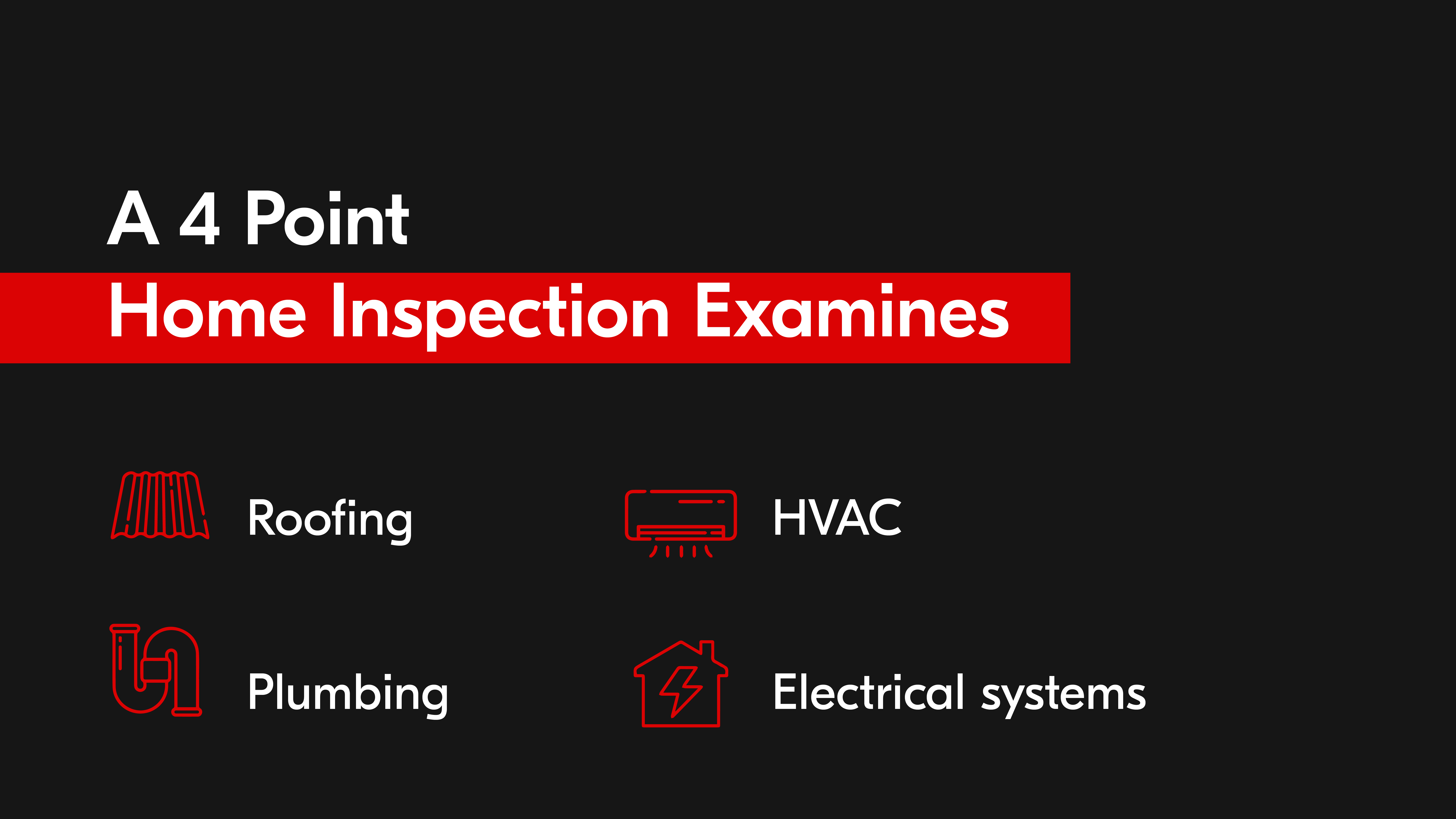
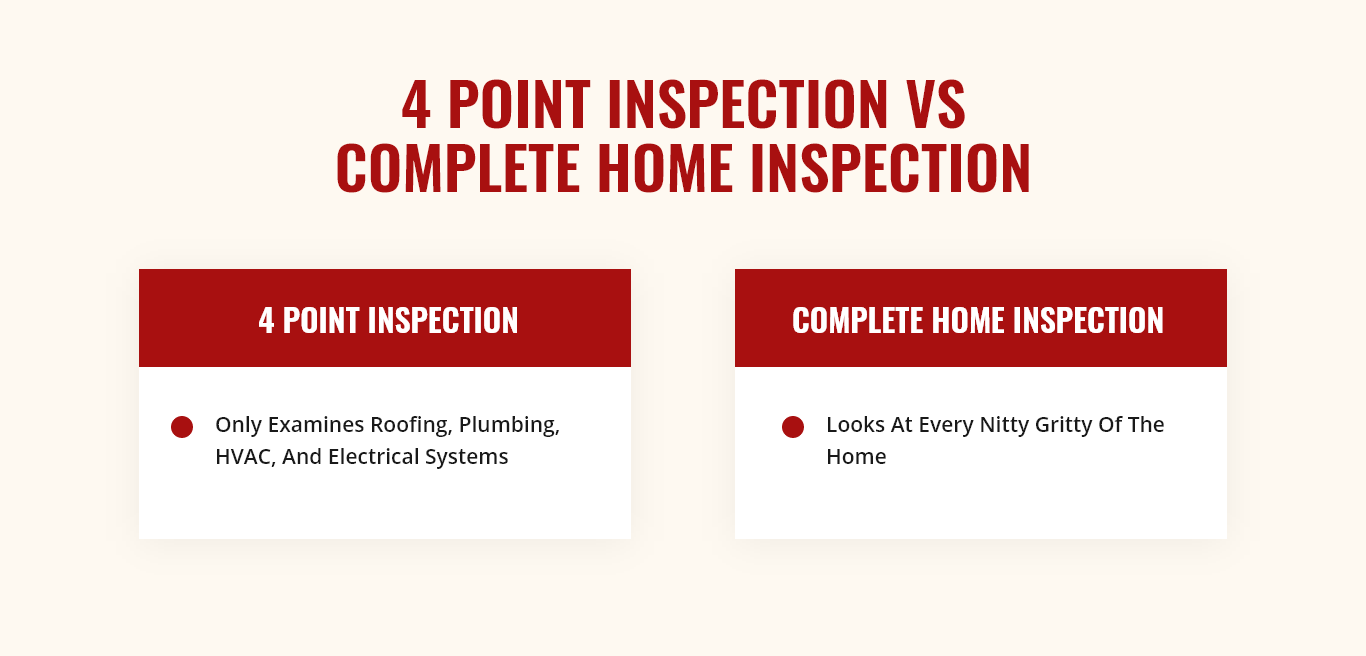
And if you’re wondering what is a 4 point home inspection, it examines the four main components of your home. This includes the roofing, plumbing, electrical, and HVAC systems, which are also examined in a full home inspection.

Now, although a four-point inspection isn’t mandatory, home insurance companies in Florida (and some other states) do require you to get one. 

For instance, if you’re looking to renew your existing home insurance coverage or avail a new policy, you’ll have to provide a four-point inspection report to the insurance company.

How much does a 4 point home inspection cost in Florida? 

4 point inspection cost

Talking about the cost, a four-point inspection will cost you far less than a complete home inspection. That’s because it examines only four areas of the home and not the entire property. 

And according to market estimates, the cost of a four-point inspection starts from $50 and goes up to $150. 

Also, depending on the square footage of your home and the extent of analysis required, this cost can go up. 

3. Wind mitigation inspection 

Like four-point inspections, a wind mitigation inspection is also a special-purpose inspection that looks at the wind resistance capabilities of a home. 

Also known as the windstorm mitigation inspection, it involves a close-up analysis of your home’s vital components, such as the roof, walls, doors, windows, etc. 

Herein, a certified inspector will determine whether or not your home can deter the severe losses resulting from strong hurricane winds. Further, they’ll also establish how safe the residents would be in such extreme weather conditions. 

Interestingly, wind mitigation inspections are neither legally required nor do the insurance companies mandate them. However, it can help you get a lower insurance premium and also value your home favorably during a sale. 

How much does a wind mitigation inspection cost in Florida?

As per the latest market estimates, a homeowner will pay in the range of $75 to $150 for a wind mitigation inspection. 

On average, you can expect to pay $100 for a complete wind mitigation examination of a standard single-family home. 

wind mitigation inspection cost

4. Specialized home inspection 

A specialized home inspection is usually conducted after a full home inspection. And it is typically done on the advice of your home inspector, who suspects certain underlying issues that need special attention. 

For instance, home inspectors might suggest you do an asbestos inspection if the property is old and they’ve got reasonable doubts about the presence of asbestos materials. 

In all, there are various home inspection services that you can avail, including asbestos, chimney, mold, foundation, pest, and pool inspections. 

How much does a special home inspection cost? 

special home inspection cost

The total cost of a special home inspection will depend on the specific area of the home that you get inspected. 

Here’s a complete breakdown of the average cost of various specialized home inspection services:

Inspection type Average cost 
Asbestos inspection $230 – $783
Chimney inspection $300 – $600
Foundation inspection $340 – $720
Sewer lines inspection $250 – $1340 
Septic tank inspection $200 – $900
Pool inspection $130 – $250
Lead-based paint inspection $250 – $700
Radon inspection $150 – $700
Termite inspection $230 – $930 
Mold inspection $350 – $500 

You might also want to read – Mobile Home Inspection Checklist: Everything To Know About.

What are the factors that determine the cost of home inspection in Florida? 

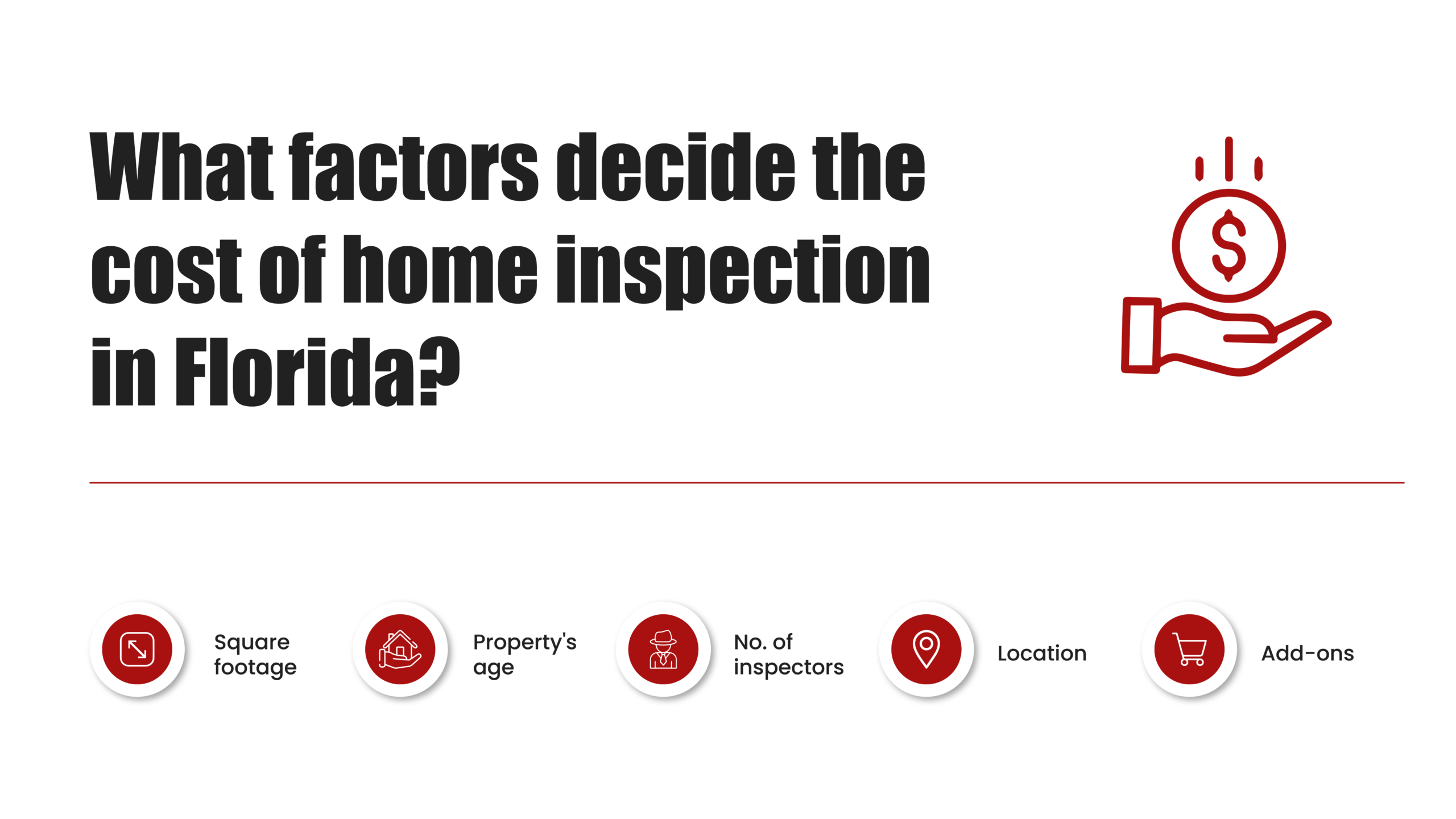
The total cost of home inspection is determined by various factors, including your home’s size, age, geography, etc. 

factors in home inspection cost

Here are some important factors that decide how much you pay for a home inspection: 

1. The size of your property 

The most important of all factors in determining the cost of inspection is the square footage of your home. 

Simply put, the larger your home, the more you’ll end up paying for an inspection. And this is for simple logic, as large areas need more time to inspect. 

As such, the first thing that a home inspector might ask you is the total square footage of your home, including areas such as the basement, porch, and attic. Also, they’ll ask you about the number of rooms, bathrooms, etc.

You can, on average, expect the inspection charges to be $0.50 per square foot of your home. 

2. Your home’s age

Another important cost determinant is the age of your home. That’s because the older your home is, the more expertise it’ll need. 

You see, newer homes are less likely to have serious or hidden defects. But that’s not the case with older homes, which sometimes test the limits of the inspectors. 

Moreover, it’s usually the old homes that have problems such as asbestos, lead, black mold, etc. 

So, the fact that closer and more detailed inspections are needed for old homes translates to a more expensive inspection bill. 

3. Number of inspection companies in your area 

Unusual as it might sound, the number of inspection firms operating in your locality will also determine the total cost of home inspection. 

It comes down to the basic economics of demand and supply. Meaning the more inspection companies in your area, the lesser the quote you can expect, and vice versa. 

4. Your location in Florida 

Which part of Florida you’re located in also decides the amount you pay for a home inspection. 

Just like the price of real estate varies in different regions, so does the cost of inspection. The reason is that the economics of inflation varies from place to place. 

For instance, home inspection cost in the Miami metropolitan area is way higher than the cost of inspection in cities such as Sarasota and Orlando. 

5. Add-on inspections 

Lastly, the total cost of home inspection in Florida will also depend on whether or not you go for add-on inspections. 

For instance, if you conduct a mold inspection along with a regular home inspection for a 2500-square-foot home, you can expect to pay at least $700-$800. 

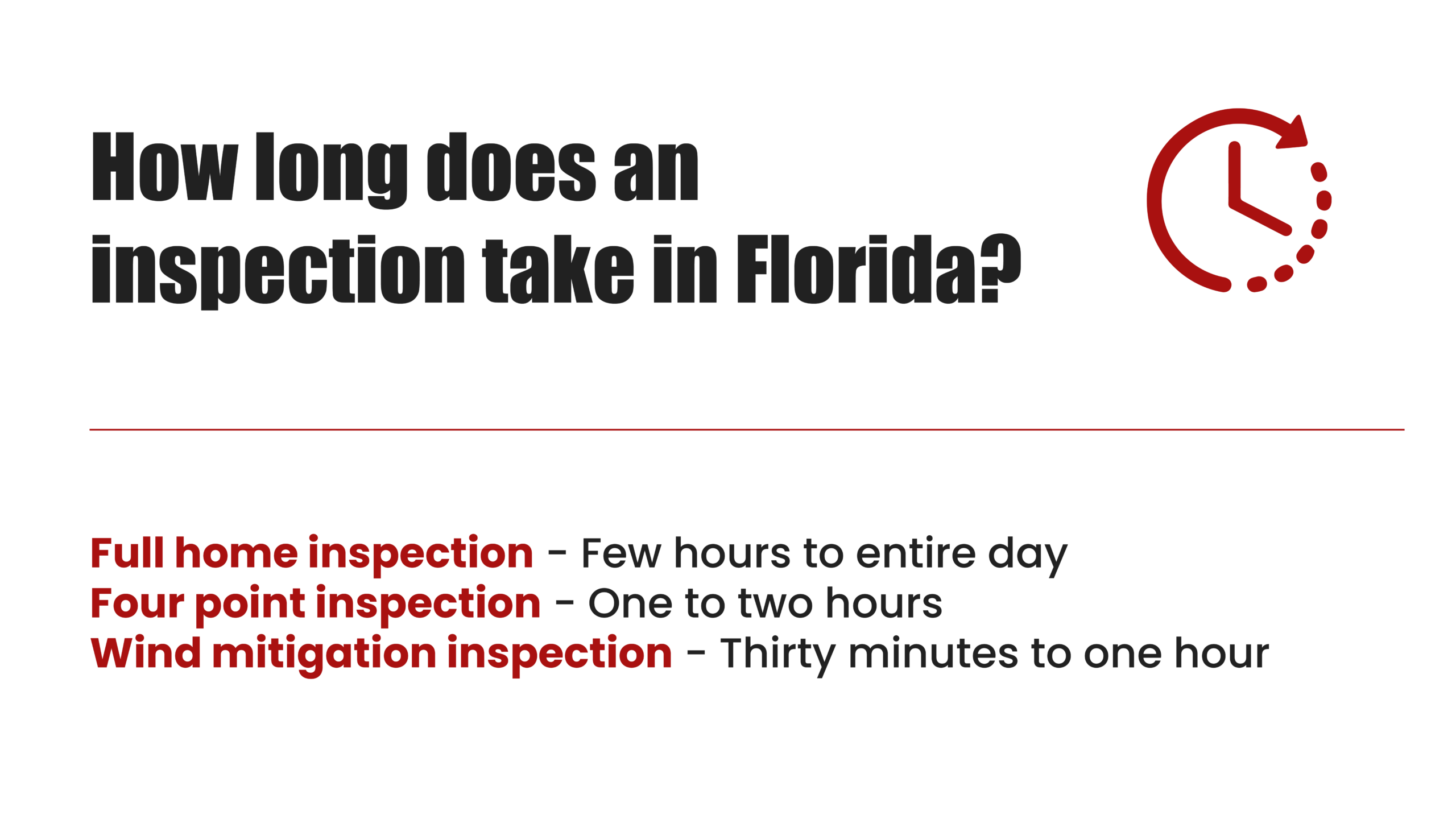
How long does a home inspection take in Florida? 

How long does a home inspection take in Florida? 

Like all things home inspection, the total time that inspectors will spend examining a home will depend on the type of services and the size of the property. 

For instance, a complete home inspection can take anywhere from a few hours to an entire day. Herein, the actual time is determined by the square footage of your home and the number of inspectors conducting the inspection. 

On the other hand, four-point and wind mitigation inspections don’t take any longer than a couple of hours. 

Always keep in mind that if an inspector is promising you a small time frame without looking at the total area, they’re most likely to miss out on hidden problems. 

Expert tip: We suggest you be present at the time of home inspection. Also, you should ask the inspectors any questions that you might have, albeit without disturbing their inspection process. 

Frequently Asked Questions (FAQs)

1. Who pays for a home inspection in Florida?

A home inspection is usually paid for by the homeowners if they’re conducting it prior to home renovation or maintenance. 

However, if you’re a homebuyer looking to conduct an inspection before finalizing the purchase deal, you’ll be paying for such inspections and not the existing owner/seller. 

2. What to do after a home inspection? 

After the completion of a home inspection, you’ll receive an inspection report detailing the findings. 

Now, if you’re the homeowner, you can use this report as a reference for undertaking essential repairs and improvements. 

Similarly, if you’re a buyer, you can bring the findings of the report to the existing owner/seller and ask them to undertake essential repairs. Also, this report can be the basis for you to walk away from the purchase deal. 

You might also want to read – When To Walk Away After Home Inspection? 

Get a Thorough Home Inspection Plan and an Estimated Project Cost for Free!

Conclusion 

As you can see, the question as to how much is a home inspection in Florida has no definitive answer. 

You can expect to pay $325, on average, for a regular home inspection of your single-family home. However, the actual cost will be determined by factors such as how big or old your home is, which part of Florida your home is located, etc. 

Our price chart can serve as a reference for the cost of home inspection in Florida. 

Looking for an exact home inspection quote for your property?

You can reach out to us!

We’re Florida Property Group, a highly seasoned Southwest Florida home inspection firm with over a decade of industry-wide experience. And we promise the most affordable home inspection quote on the market. 


Home Inspection Services Near Bradenton and Sarasota

Inspection pricing depends on the property’s size, age, construction and the additional services requested. Florida Property Group serves buyers and homeowners throughout Bradenton, Sarasota, Lakewood Ranch and surrounding Southwest Florida communities.

View our available inspection services or request an exact quote and schedule online.

Nate Standifer

Nate Standifer

Nate Standifer is co-founder of Florida Property Group and a Florida-licensed home inspector with 15+ years of experience across telecommunications, low-voltage electrical inspections, and residential property inspections. An InterNACHI Certified Professional Inspector®, he and the Florida Property Group team complete approximately 1,500 inspections annually across Bradenton, Sarasota, Lakewood Ranch, and surrounding Southwest Florida communities.

InterNACHI Certified • RASM Member • SUPRA Access

A complete home inspection is considered the gold standard to learn about the build quality and longevity of a home, among others. So much so that almost every homebuyer seeks to conduct an inspection before making a purchase. 

In fact, thorough home inspections are considered even more crucial when purchasing older homes since they’re more likely to have inherent problems. 

However, the one question that most real estate buyers have on their minds is this: do home inspections check for asbestos? 

This is especially true for buyers looking to purchase homes dating back to three or four decades since asbestos was common in construction back in the day. 

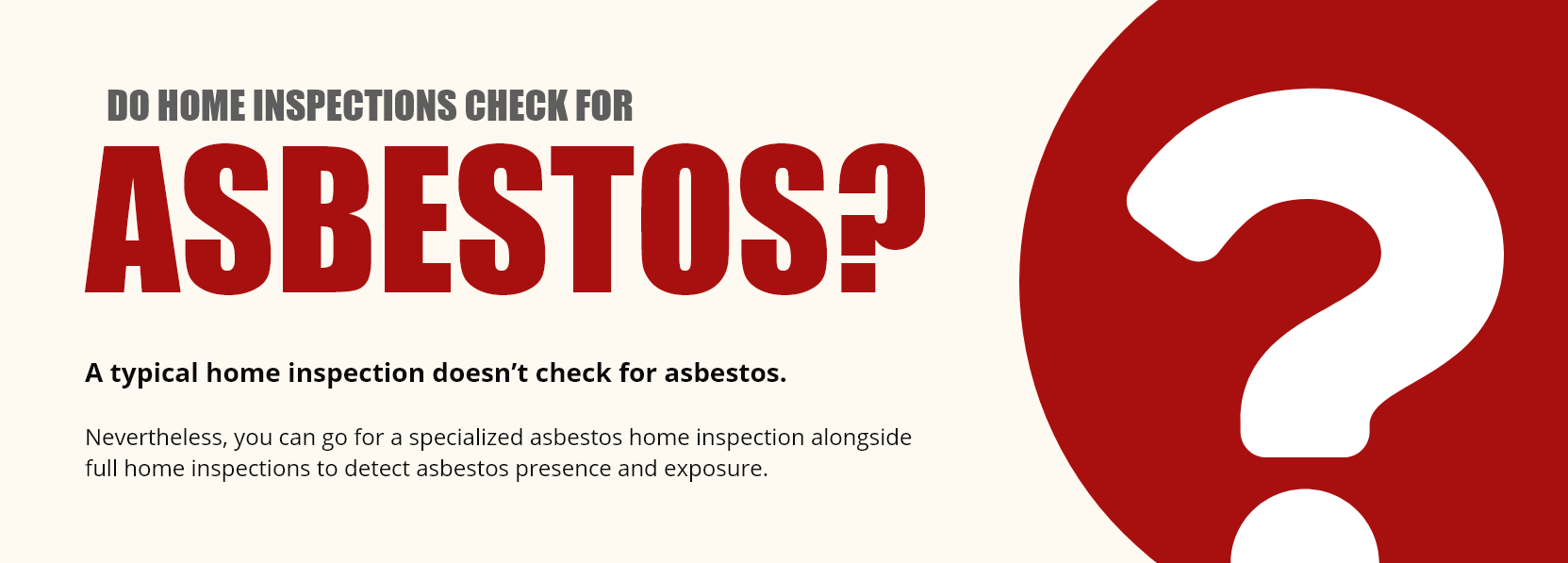
And a straightforward answer to the question is no, a pre-purchase home inspection doesn’t look for asbestos. 

But it isn’t that black and white either, as you can still go for an asbestos home inspection, a specialized inspection to detect asbestos, before purchase. 

So let’s have a look up close and see what home asbestos inspection is all about. 

Do home inspections check for asbestos or not? 

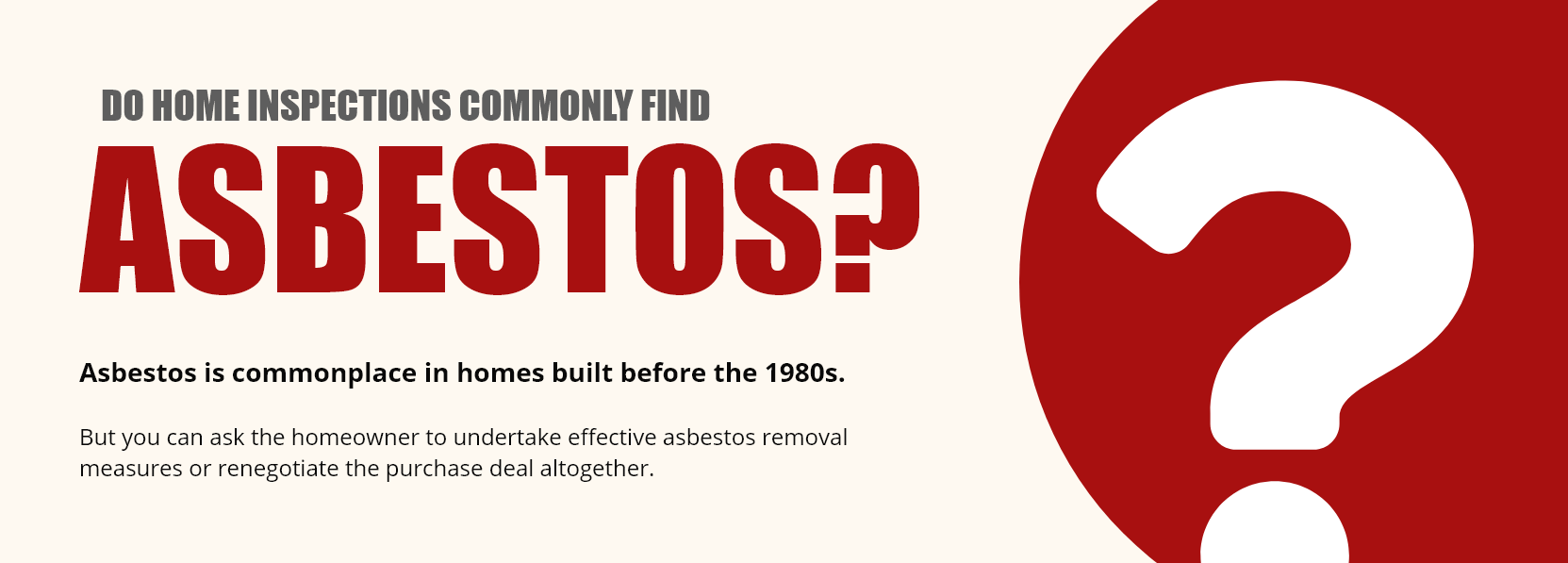
A major concern for homebuyers looking to buy older properties, particularly those built before the 1980s, is asbestos. That’s because although once commonly used in home building materials, long-term exposure to asbestos can pose serious health hazards. 

do home inspections commonly find asbestos

You see, in the old days, asbestos was used for fire resistance, thanks to the presence of non-flammable substances within it. As such, from flooring tiles to roofing shingles to textured paint to insulants to piping materials, just about everything had asbestos. 

However, the problem lies with asbestos fibers, which are released into indoor and outdoor air either over time or during home renovations and demolition. 

So what’s exactly the problem, you might wonder? 

Well, breathing in air with asbestos particles has been linked to severe health conditions ranging from common lung diseases to lung cancer to mesothelioma (a rare type of cancer). 

do home inspections check for asbestos

Unfortunately, a typical pre-purchase home inspection will not detect asbestos since spotting asbestos calls for special training, expertise, and license. 

Nonetheless, you can go for a full-fledged asbestos home inspection at the time of general home inspection to detect asbestos right away. 

Also, these home inspectors can help you determine whether or not the asbestos problem can be fixed. And if not, you can even walk away from the purchase deal after inspection

Note:An asbestos home inspection is not a substitute for a complete home inspection. Meaning even though such inspections help find asbestos traces in building materials, you still need a thorough inspection to determine the building’s structural integrity and remaining lifespan, among others.


Should you go for an asbestos home inspection? 

As we saw, your typical home inspection will not look for asbestos. 

So, you might find yourself asking if you should go for an asbestos inspection. After all, a separate inspection will only add to your bills. 

Well, we suggest you go for an asbestos inspection before purchasing an old home. That’s because not only will it give you a clear picture of asbestos presence, but also provide effective remedies if asbestos is found. 

over 50 percent of all homes can have asbestos

You can also ask your home inspection company questions such as ‘Do your home inspectors check for asbestos?’ 

And if they do, it might be a good idea to get an asbestos inspection done by them. In fact, this will be way more cost-efficient than hiring a separate inspector. 

Furthermore, you can request your inspection firm to collect samples from roofing and flooring, among others, and send them for lab-based asbestos tests. 

But why is it so important to check for asbestos? 

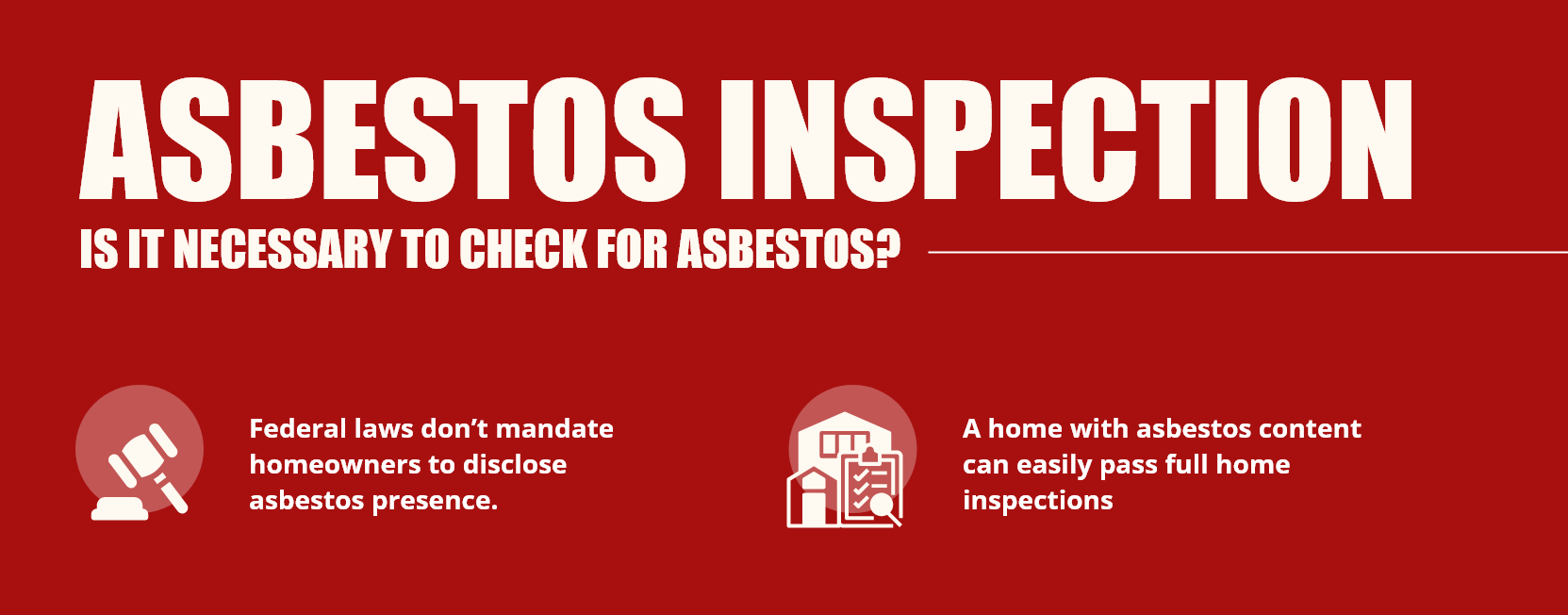
it is important to check for asbestos

The fact that some of the most serious health risks are linked to asbestos materials dissolving in the air makes asbestos inspection indispensable. 

But isn’t there any other way you can know if there’s asbestos in a home? 

Well, the short answer is no, you can’t. 

The reason is that Federal laws don’t make it mandatory for existing homeowners to disclose the presence of asbestos to potential homebuyers. 

Talking about Florida, the state laws do require owners/sellers to provide a complete picture of defects or hazards such as asbestos. However, it is not mandatory for them to complete the disclosure form, which means the chances of non-disclosure are still there. 

Similarly, a home containing asbestos can pass a pre-purchase inspection easily if its major structural and foundational systems are in good shape. So you’ll never know if the home contains asbestos. 

As such, a thorough inspection for asbestos detection is the only way you can be assured of safety and well-being. 

When should you conduct a home asbestos inspection? 

Asbestos is not something you should be worried about if the home is up to two decades old. And even if the home is much older, there’s a good chance that the existing owner has already mentioned the asbestos presence in the disclosure form. 

Also, it goes without saying that not all old homes have materials containing asbestos. 

Nevertheless, if you’re looking to purchase an old home with no mention of asbestos in the disclosure form, you should look for potential signs of asbestos. 

When should you conduct a home asbestos inspection?

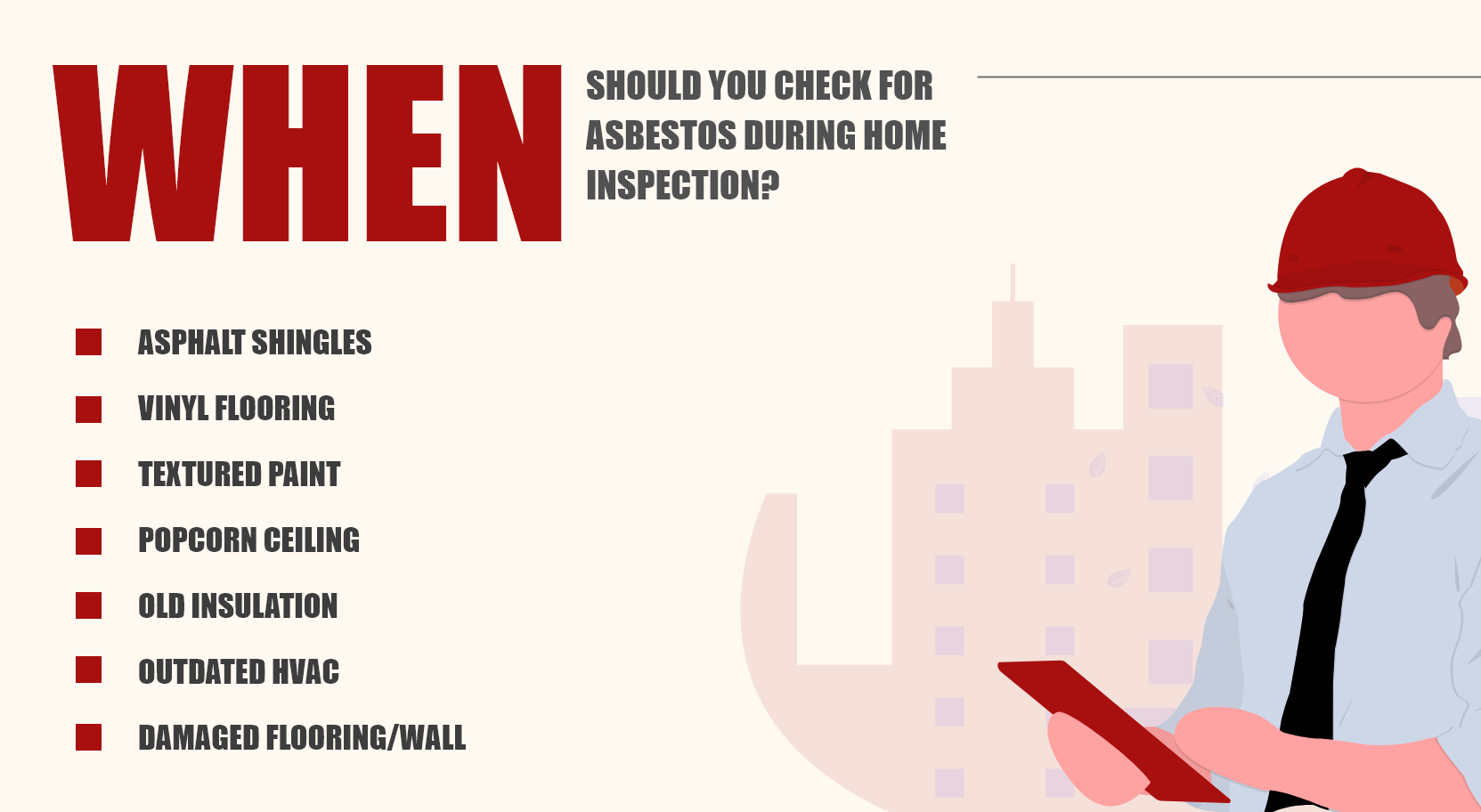
For instance, you can look for the following signs: 

  1. Old asphalt roofing shingles 
  2. Flooring made with vinyl 
  3. Textured paint 
  4. Popcorn ceiling 
  5. Old insulation system 
  6. Outdated HVAC system 
  7. Flooring or wall damages

It is important to note here that signs are not proof of asbestos presence. However, there are chances that asbestos might be detected in these materials. 

So, a secondary inspection conducted by a certified asbestos inspector will give you a surety and help you decide whether or not to buy the property. 

Asbestos found in home inspection: What should you do? 

It is possible to find asbestos during home inspection. But, the mere presence of asbestos doesn’t pose a health hazard. 

In fact, a lot of building materials made using asbestos are completely safe as they don’t release asbestos fibers unless disturbed in a major way. 

For instance, a wall containing asbestos may never release asbestos fibers unless you undertake some destructive measures such as drilling. 

Nonetheless, if you notice any signs of asbestos damage or fiber exposure, it’s best to remove all asbestos materials. 

here's what to do when Asbestos is found in home inspection

Here’s what you can reasonably ask the existing homeowner to do in such situations: 

1. Asbestos containment 

Containment is an efficient and affordable measure if the problem is not very widespread. For instance, if there’s a small damage leading to asbestos exposure in a limited area, containment can be the best remedy. 

Herein, the affected area is usually sealed off using special paints by a specialist. 

2. Asbestos removal 

Asbestos removal is a sophisticated procedure done by licensed asbestos removal firms. They adhere to the Florida Asbestos Removal Program to get rid of asbestos-containing materials entirely. 

Also, these firms will sanitize and ventilate the home after asbestos removal and safety despite the contaminants as per local and state laws. 

You should go for asbestos removal if the exposure is no longer confined to a small area and has spread to large parts of the home. 

What if the homeowner refuses to undertake asbestos containment/removal? 

If a homeowner is unwilling to undertake essential asbestos containment or removal before selling the property, it is reasonable to ask for a renegotiation of the purchase deal. 

In such a situation, you can adjust your new offer for the projected cost of asbestos containment or removal. 

You might also want to read – Mobile Home Inspection Checklist: Everything To Know About.

Frequently Asked Questions (FAQs) 

1. Do home inspectors check for asbestos? 

A regular home inspector doesn’t check for asbestos. That’s because they’re neither licensed for asbestos testing nor are they required to conduct such a test. 

Nevertheless, asbestos testing is conducted by licensed asbestos home inspection firms, which are separate from other home inspection companies. 

Note: It is possible for a home inspection firm to also be licensed for asbestos inspection. And if so, they can legally check for asbestos in a property. 

2. Will a home inspection find asbestos? 

An asbestos home inspection need not always detect asbestos. 

You see, although old homes are most likely to have materials containing asbestos, that is not always the case. Meaning it is highly likely for an old home to pass an asbestos test with flying colors. 

Also, even if a home inspection finds asbestos, it’s not hazardous unless asbestos fibers are exposed to the air. 

3. How much does an asbestos test cost? 

asbestos home inspection cost

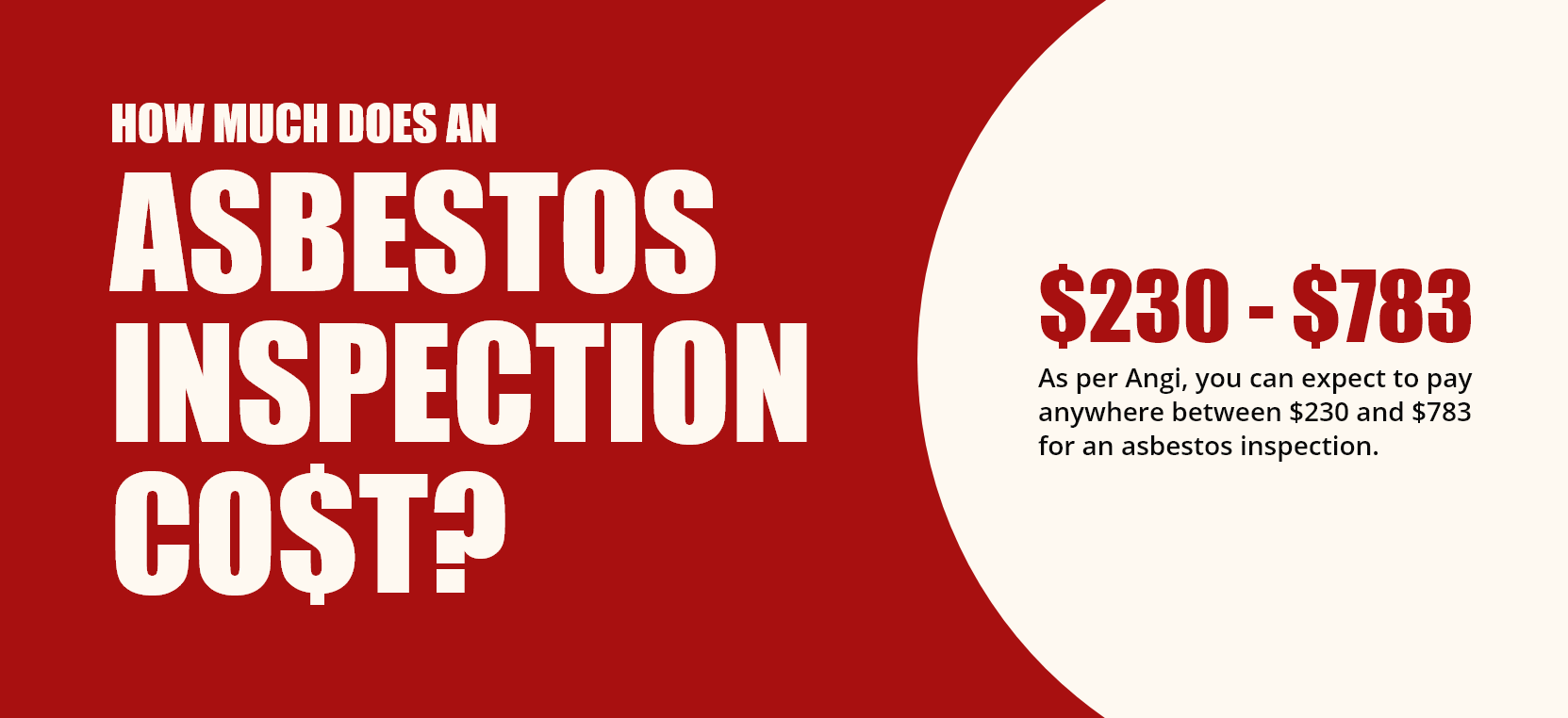
According to Angi, the national average cost of asbestos home inspection is $483. 

However, you can expect to pay in the range of $230 to $783, depending on the size of the property and the extent of tests involved. 

Not to mention, this cost can also go up to $1200 in some cases where samples are difficult to collect and test. 

4. Is it worthwhile to invest in a home asbestos inspection? 

Investing anywhere from a few hundred to a thousand dollars on asbestos inspection is completely worthwhile. More so if you’re looking to buy a property worth hundreds of thousands. 

As we discussed earlier, there are various ways a property owner can hide asbestos presence from you. Also, even if a home passes major structural integrity and safety parameters during an inspection, the chances of asbestos presence are still there. 

So, it is in your best interest to get an asbestos inspection conducted by a licensed firm. 

5. How much does asbestos removal cost? 

The asbestos removal cost ranges between $450 and $6000. Herein, the actual cost is determined by the removal method and the amount of asbestos that needs to be removed. 

For instance, if the asbestos exposure is minimal, you can go for containment measures, which will cost you in the lower range of the price. 

Nevertheless, full-scale asbestos removal is usually expensive as it involves complex abatement and disposal methods. 

In all, you can expect to pay $2197, on average, for asbestos removal. 

6. Does asbestos impact a home’s resale value? 

Yes, it sure does. 

You see, the very presence of asbestos in building materials is seen as a major red flag by homebuyers. 

And given the dangers involved with asbestos, buyers either ask homeowners to undertake asbestos removal or try to renegotiate the deal altogether. 

You might also want to read – Third Party Inspection For New Home: A Complete Guide

Get a Thorough Home Inspection Plan and an Estimated Project Cost for Free!

Conclusion 

As you can see, typical home inspections don’t check for asbestos. And for obvious reasons, as asbestos inspection is a different domain and calls for separate licenses and skillsets. 

Nonetheless, it is a good idea to go for an asbestos home inspection as it can give you unparalleled peace of mind. 

Remember, an asbestos inspection is never a replacement for complete home inspections, as you need the latter to determine a home’s safety and longevity. Asbestos checks can, however, complement your overall inspection procedure and shed light on the presence of potential hazards. 

Looking to conduct a full home inspection? 

You can get in touch with us!

We are Florida Property Group, a seasoned Southwest Florida home inspection company with over 10 years of experience and unmatched expertise. And we’ve covered all your inspection requirements at the most cost-efficient rates. 


Nate Standifer

Nate Standifer

Nate Standifer is co-founder of Florida Property Group and a Florida-licensed home inspector with 15+ years of experience across telecommunications, low-voltage electrical inspections, and residential property inspections. An InterNACHI Certified Professional Inspector®, he and the Florida Property Group team complete approximately 1,500 inspections annually across Bradenton, Sarasota, Lakewood Ranch, and surrounding Southwest Florida communities.

InterNACHI Certified • RASM Member • SUPRA Access

My goal – is to ensure, after reading this blog, you don’t have to search for “What is a home inspection?” anymore!

For centuries, prospective buyers have sought insight into properties unseen with the help of trusted advisors.

In the Middle Ages, the local blacksmith may have accompanied you inside the thatched cottage to ensure the roof was sound and the floors steady. In the New World, you’d enlist the town carpenter or mason to assess fireplaces and foundations of a homestead before staking your claim.

Today, we rely on a trained or licensed home inspector to be our discerning set of eyes. Armed with gadgets and equipment, they dive deep into a home’s nooks and crannies to assess electrical, plumbing, structure, and more. A home inspector report becomes our faithful guide, illuminating the bounty and flaws of the abode in question.

Yes, though tools and technology have advanced, the innate yearning to know a home’s true nature before commitment remains.

On this note, I aim to help you understand anything and everything about home inspections. In this blog, I will not just be discussing what is a home inspection and what is the cost of a home inspection, but almost every before and after detail, along with choosing the ideal home inspector.

Let’s get started.

What is a home inspection?
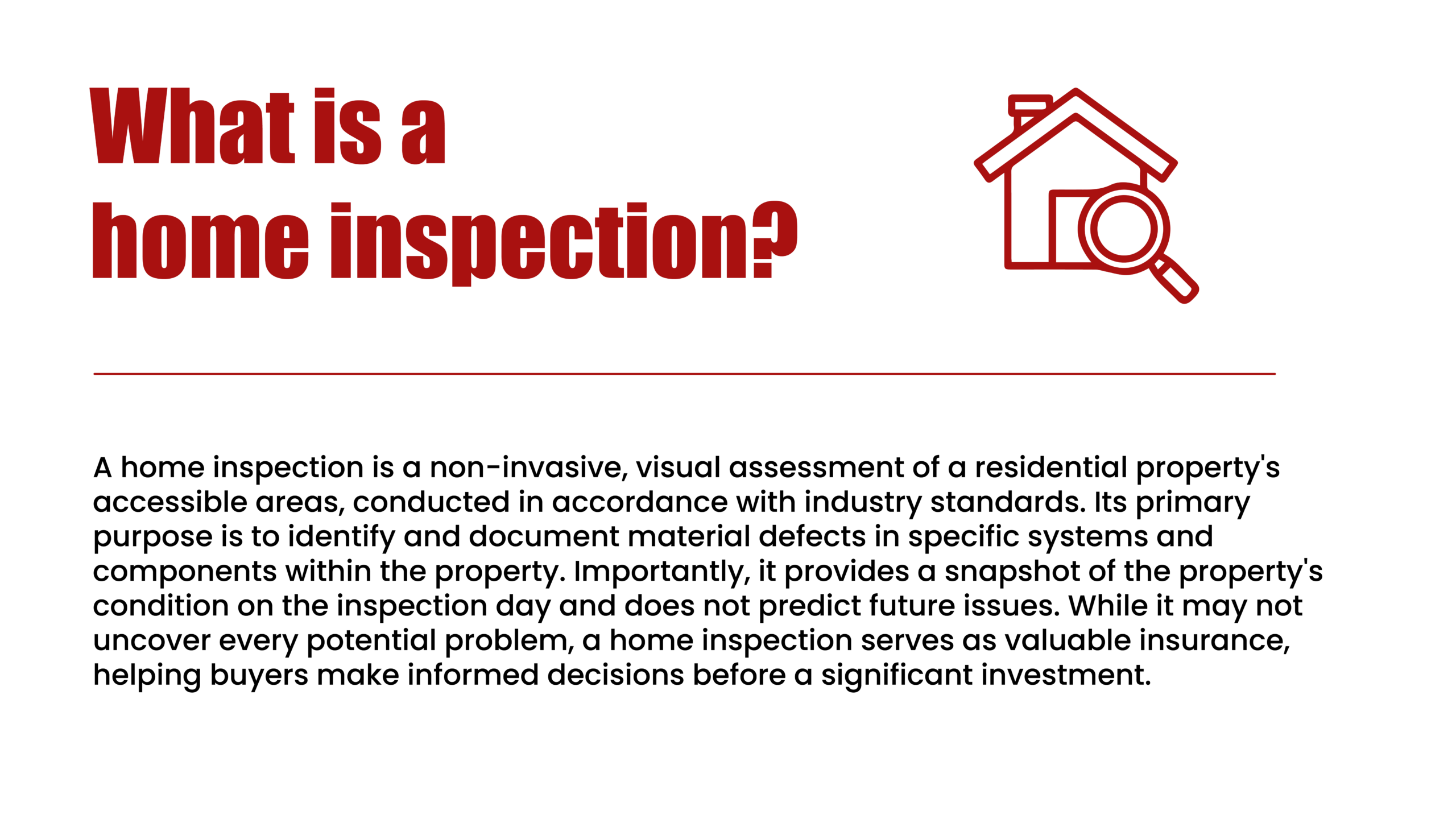
An in-depth, technical and factual answer to what is a home inspection

According to the International Association of Certified Home Inspectors, a home inspection is a non-invasive, visual assessment of a residential property’s accessible areas. The objective of this inspection is to bring to light the defects within specific systems and components that you may find in InterNACHI’s Standards of Practice documentation.

In addition to the home inspection definition, we need to understand that:

  • The observations that the inspector makes at the time of inspection (or on the inspection day) are what will be documented in your home inspection report and not any prediction of future conditions.
  • The inspection will not reveal every possible inspection that exists or ever did, but only the material defects that the inspector finds on that day.

What a home inspection can do for you is massive. It lets you know what you’re getting into before you sign and helps save you big time in the long run. Consider it cheap insurance on one of the biggest purchases of your life. Approach it with patience and an eagerness to learn. Inspections help good folks like you make informed choices.

Who is a home inspector?
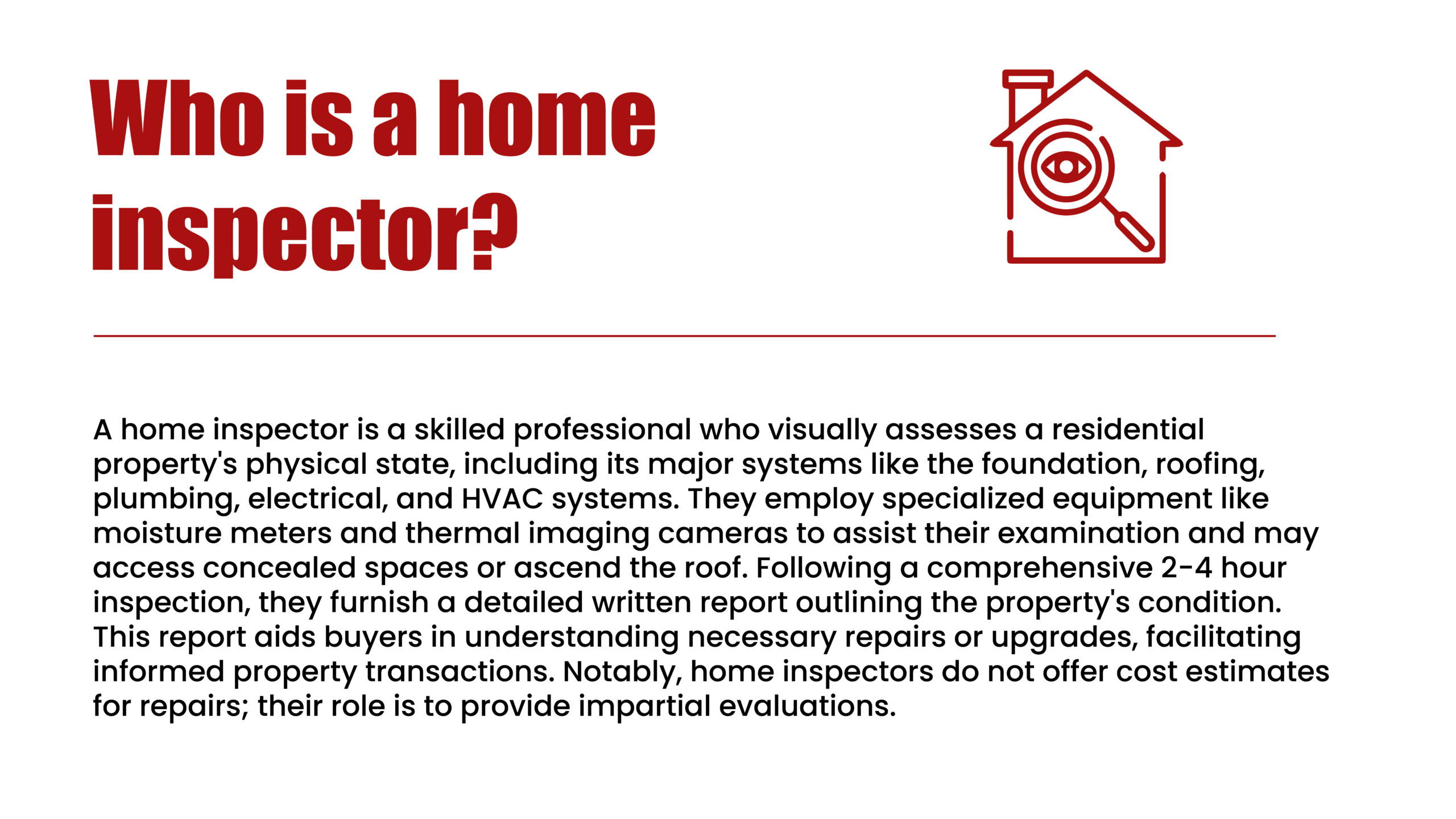
Explanation of who a home inspection is, along with discussing their roles and limitations.

A home inspector is a professional who visually examines the physical condition of a house or apartment. Their job is to identify defects, issues, and safety hazards in the home’s major systems and components such as the foundation, roof, plumbing, electrical, heating and cooling systems, and more.

Home inspectors use specialized tools like moisture meters, outlet testers, and thermal imaging cameras to aid in their analysis. They will open up access panels, crawl through small spaces, and even go up on the roof. After completing a 2-4 hour inspection, the home inspector provides a detailed written report summarizing the condition of the home.

This helps buyers understand any repairs or upgrades that may be needed and informs negotiations or decisions regarding the property. While inspectors evaluate the property’s condition, they do not provide cost estimates for repairs. Their role is to be the eyes and ears, providing an unbiased assessment to enable the buyer to make an informed purchase.

Some backdrop on home inspection and home inspectors

It was over three decades ago that the home inspection industry took shape, born out of a need voiced by real estate agents. As buyers uncovered defects after closing, agents found themselves liable. To remedy this, professional home inspectors stepped in. Their role became protecting buyers by thoroughly evaluating properties pre-sale.

These inspectors require expertise across all construction systems – plumbing, electrical, structural, HVAC and more. They must have a keen eye to catch subtle faults while also clearly communicating findings. Nuance is vital as overstating issues may unjustly hinder a sale, while understating them leaves the buyer in trouble post-closing.

One might presume inspectors and agents harbor resentment. But statistics show otherwise, with over 92% of realtors advocating for inspections. Far from being adversaries, agents appreciate thorough reports that help avoid future disputes over undetected defects. However, they understandably favor working with qualified professionals who provide reliable assessments.

When performed diligently by an ethical inspector, few services are more valuable to home buyers than a pre-sale inspection. By shedding light on the property’s true condition, inspectors empower buyers to make sound investments. In doing so, they benefit all stakeholders in the real estate transaction. The home inspection has rightly become an indispensable part of the process.

Home Inspection Exclusions and Limitations
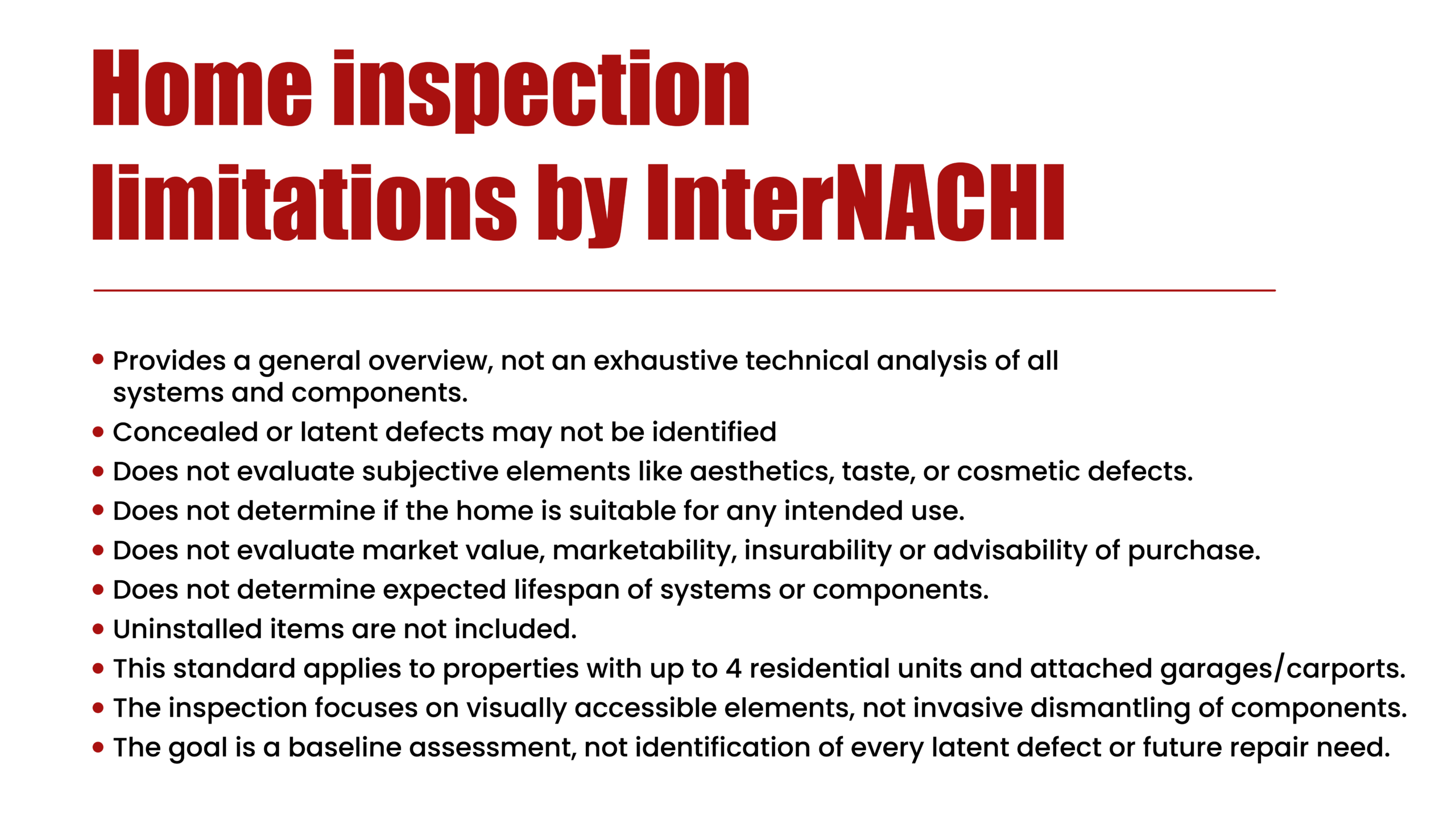
Bullet-wise reperesentation of the home inspection limitations laid down by InterNACHI

Now, there are certain limitations and exclusions for home inspections that we must know of. These have been laid down by InterNACHI.

Limitations

  • The inspection provides a general overview, not an exhaustive technical analysis of all systems and components.
  • Concealed or latent defects may not be identified during the inspection.
  • The inspection does not evaluate subjective elements like aesthetics, taste, or cosmetic defects.
  • It does not determine if the home is suitable for any intended use.
  • The inspection does not evaluate market value, marketability, insurability or advisability of purchase.
  • The inspection does not determine expected lifespan of systems or components.
  • Uninstalled items are not included in the inspection.
  • This standard applies to properties with up to 4 residential units and attached garages/carports.
  • The inspection focuses on visually accessible elements, not invasive dismantling of components.
  • The goal is a baseline assessment, not identification of every latent defect or future repair need.

Exclusions
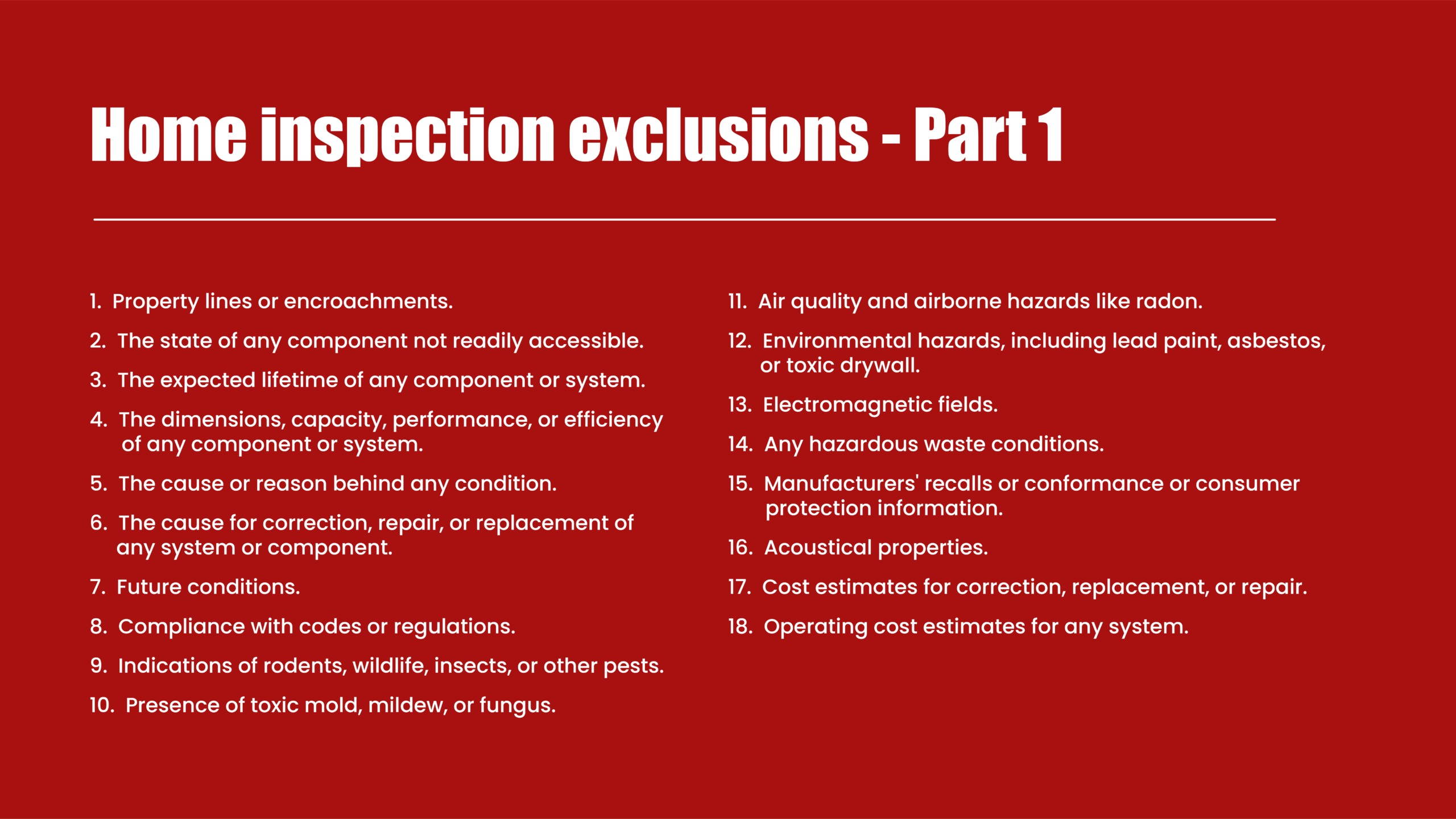
Bullet-wise representation of part 1 of the home inspection exclusions laid down by InterNACHI

Home inspection exclusions – part 1

The inspector has no obligation to ascertain:

  1. Property lines or encroachments.
  2. The state of any component not readily accessible.
  3. Expected lifetime of any component or system.
  4. The dimensions, capacity, performance, or efficiency of any component or system.
  5. The cause or reason behind any condition.
  6. Cause for correction, repair, or replacement of any system or component.
  7. Future conditions.
  8. Compliance with codes or regulations.
  9. Indications of rodents, wildlife, insects, or other pests.
  10. Presence of toxic mold, mildew, or fungus.
  11. Air quality and airborne hazards like radon.
  12. Environmental hazards including lead paint, asbestos, or toxic drywall.
  13. Electromagnetic fields.
  14. Any hazardous waste conditions.
  15. Manufacturers’ recalls or conformance, or consumer protection information.
  16. Acoustical properties.
  17. Cost estimates for correction, replacement, or repair.
  18. Operating cost estimates for any system.
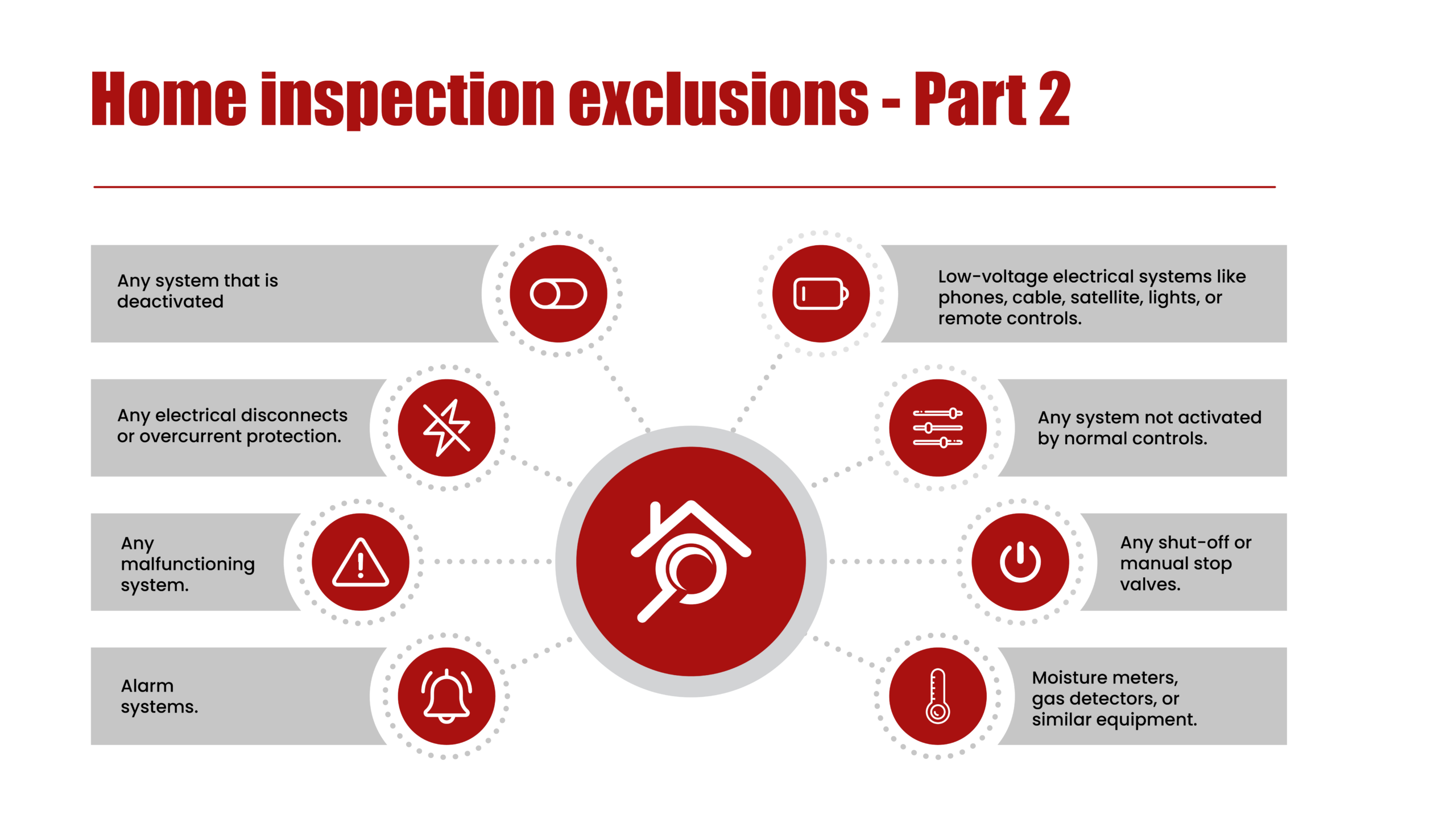
Graphical representation of part 2 of the home inspection exclusions laid down by InterNACHIHome inspection exclusions – part 2

They have no duty to operate:

  1. Shut-down systems.
  2. Any malfunctioning system.
  3. Low-voltage electrical systems like phones, cable, satellite, lights, or remote controls.
  4. Systems not activated by normal controls.
  5. Any shut-off or manual stop valves.
  6. Any electrical disconnects or overcurrent protection.
  7. Alarm systems.
  8. Moisture meters, gas detectors, or similar equipment.
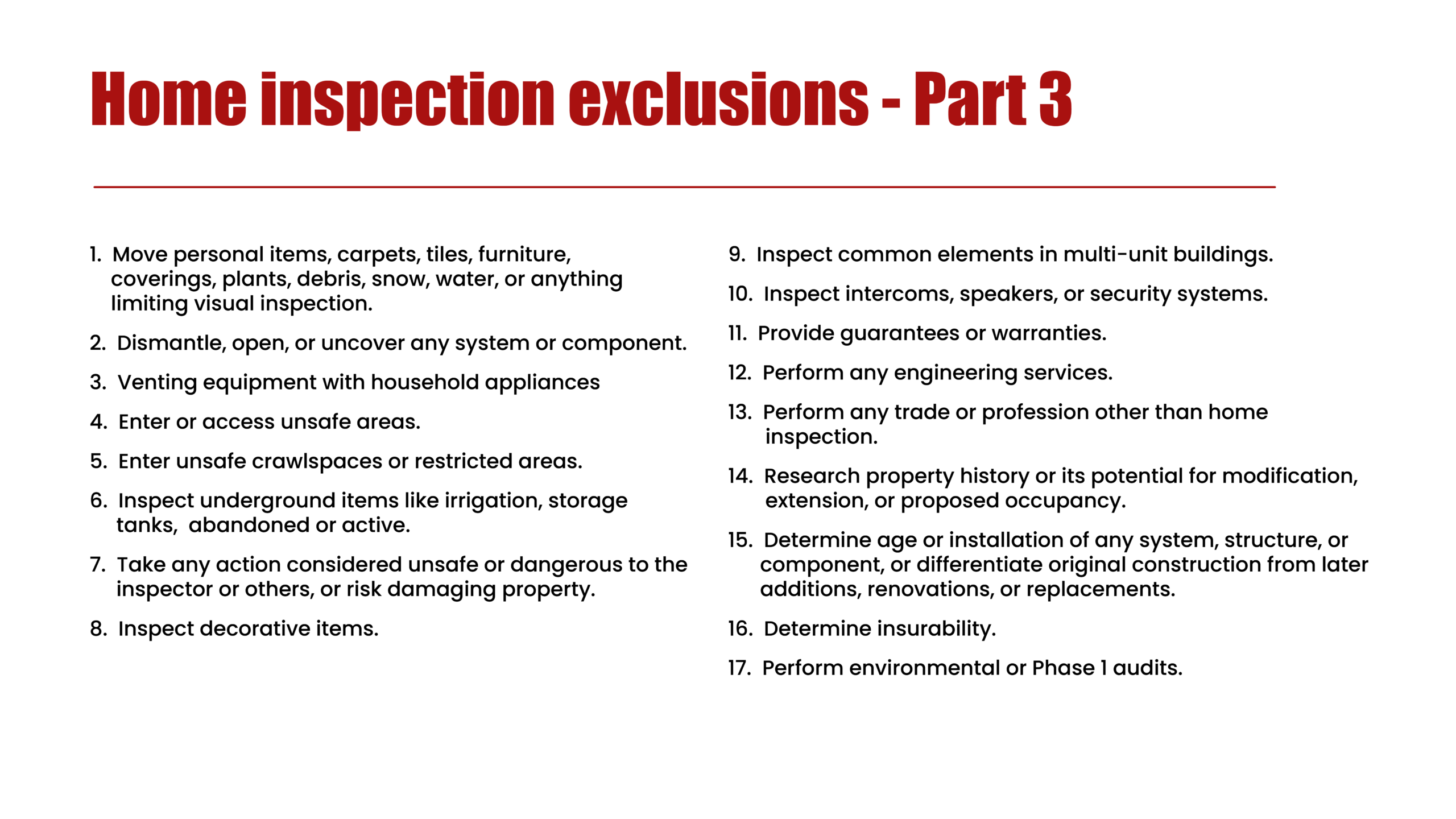
Bullet-wise representation of part 3 of the home inspection exclusions laid down by InterNACHI

Home inspection exclusions – part 3

Further, the inspector has no duty to:

  1. Move personal items, carpets, tiles, furniture, coverings, plants, debris, snow, water, or anything limiting visual inspection.
  2. Dismantle, open, or uncover any system or component.
  3. Venting equipment with household appliances
  4. Enter or access unsafe areas.
  5. Enter unsafe crawlspaces or restricted areas.
  6. Inspect underground items like irrigation, storage tanks, abandoned or active.
  7. Take any action considered unsafe or dangerous to the inspector or others, or risk damaging property, like walking on roofs, climbing ladders, entering attic spaces, or encountering pets.
  8. Inspect decorative items.
  9. Inspect common elements in multi-unit buildings.
  10. Assess intercoms, speakers, or security systems.
  11. Provide guarantees or warranties.
  12. Perform any engineering services.
  13. Perform any trade or profession other than home inspection.
  14. Research property history or its potential for modification, extension, or proposed occupancy.
  15. Determine age or installation of any system, structure, or component, or differentiate original construction from later additions, renovations, or replacements.
  16. Determine insurability.
  17. Perform environmental or Phase 1 audits.

Now, we gradually move toward the home inspection checklist, i.e., what do home inspectors look for during the assessment.

What does a home inspection cover?
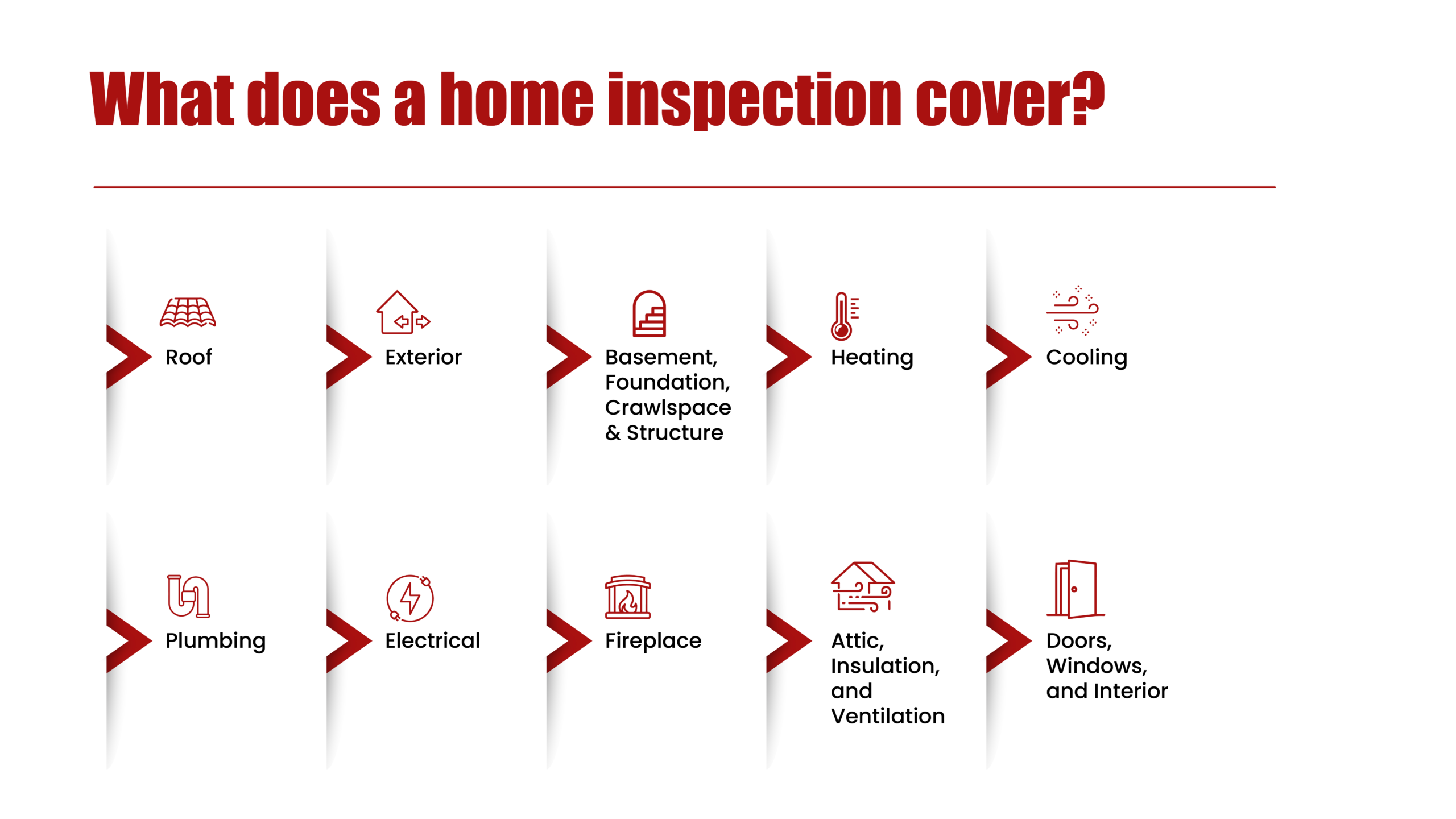
What does a home inspection cover? Different elements mentioned

This section is more like a house inspection checklist. I will mention and explain what’s covered, as in what does a home inspector check.

Roof
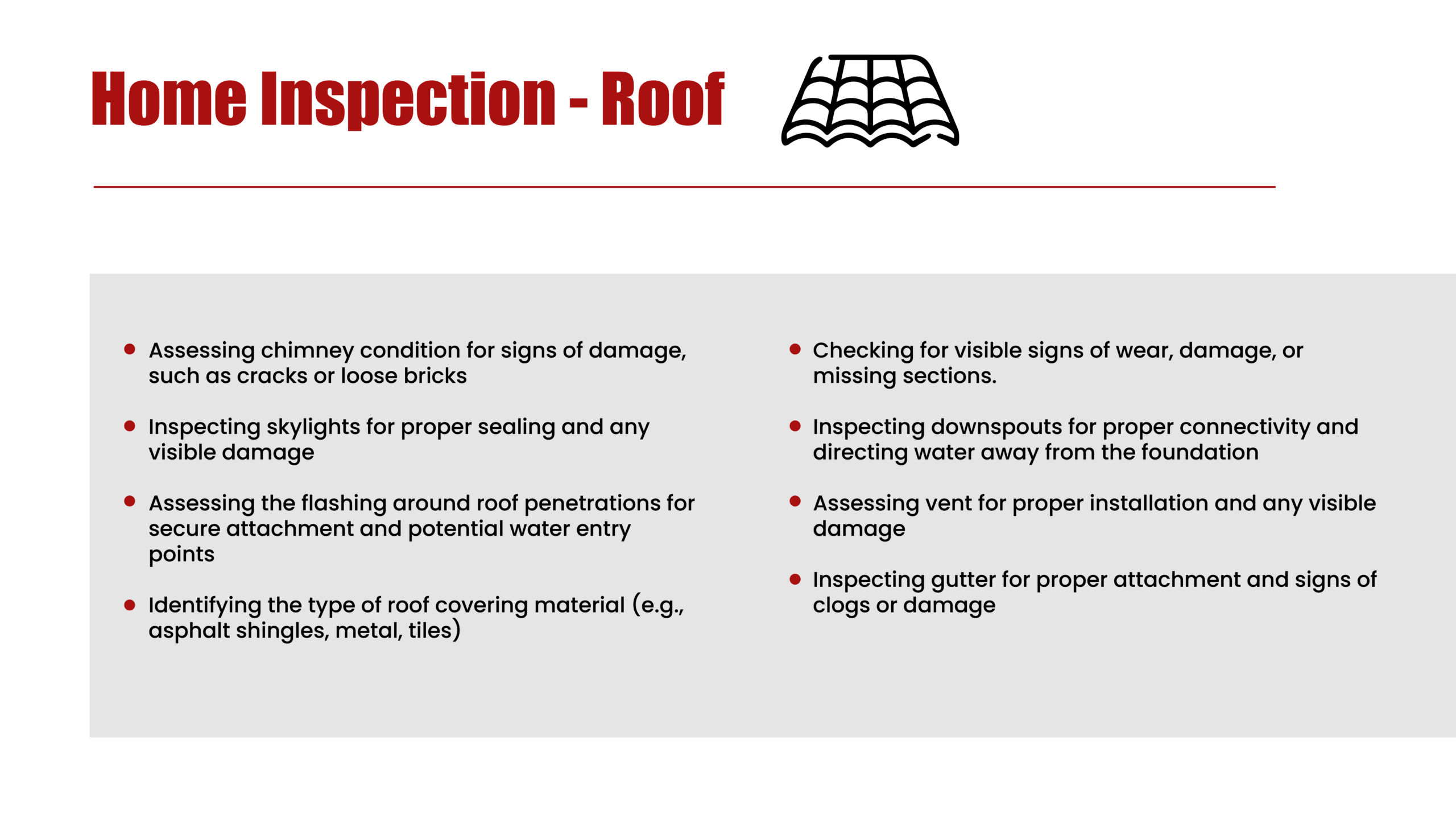
Bullet-wise mention of different points that come under roof inspection when speaking of home inspection

While carrying out the roof inspection, the inspector will focus on visually examining the:

  • Chimney
  • Skylights
  • Flashing
  • Roof covering
  • Downspouts
  • Vents
  • Gutters

They will either do this from the ground level or eaves. Further, the inspector will write down the type of roof covering materials present and also describe them properly in the report. In case there is any evidence of active roof leaks which is detected, that will be reported too.

However, the inspector has no obligation to:

  • Inspect underground drainage pipes
  • Predict the roof’s service life
  • Warranty or certify the roof
  • Walk on sloped roof surfaces
  • Move insulation, walk on unsafe areas, or inspect attachments like antennae
  • Confirm the proper installation of roof covering materials.

As I mentioned above, this inspection of the roof is not to warranty it but to actually identify any visible evidence of roof leaks or damage, so the inspector can note it.

Exterior
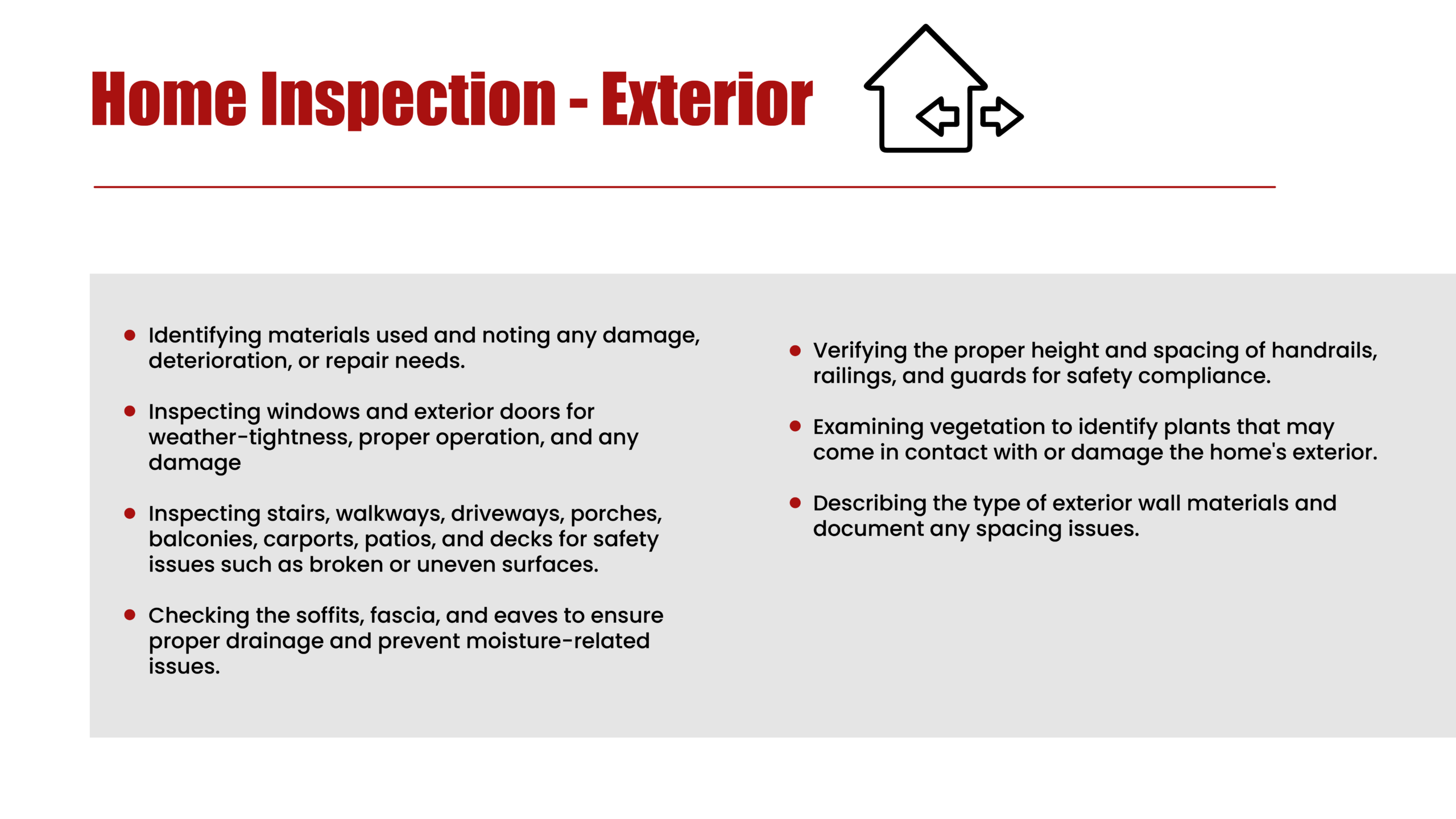
Explanation of what all elements come under the "exterior" head of a home inspection.

Next, we have the external components in the inspection phase. Here, the inspector will assess the condition of the walls, railings, doors, windows, porches, and vegetation surrounding the house.

  • The inspector will check the wall coverings to identify what materials are used. They will also note down any damage, deterioration, or other issues that require repair.
  • Windows and exterior doors are analyzed for weather-tightness, proper operation, or any damage.
  • To check for safety issues like broken or uneven surfaces, the inspector will also check out stairs, walkways, driveways, porches, balconies, carports, patios, and decks.
  • To ensure no moisture issues exist, the soffits, fascia, and eaves are assessed for proper drainage.
  • For proper height and spacing, the inspector checks the handrails, railings, and guards. Also, the vegetation is examined to identify the plants either coming in contact with or damaging the homes’ exterior, i.e., through moisture intrusion.
  • Further, the inspector describes the type of exterior wall materials and notes spacing issues with intermediate balusters, spindles, and rails.

While you might have figured that the inspection is thorough and in-depth, there are a few components that don’t make the cut, such as fences, recreational equipment, and lighting. On top of that, the inspector also excludes identifying geological issues on the house and underground systems like wastewater treatment, utilities, and irrigation.

Basement, Foundation, Crawlspace & Structure
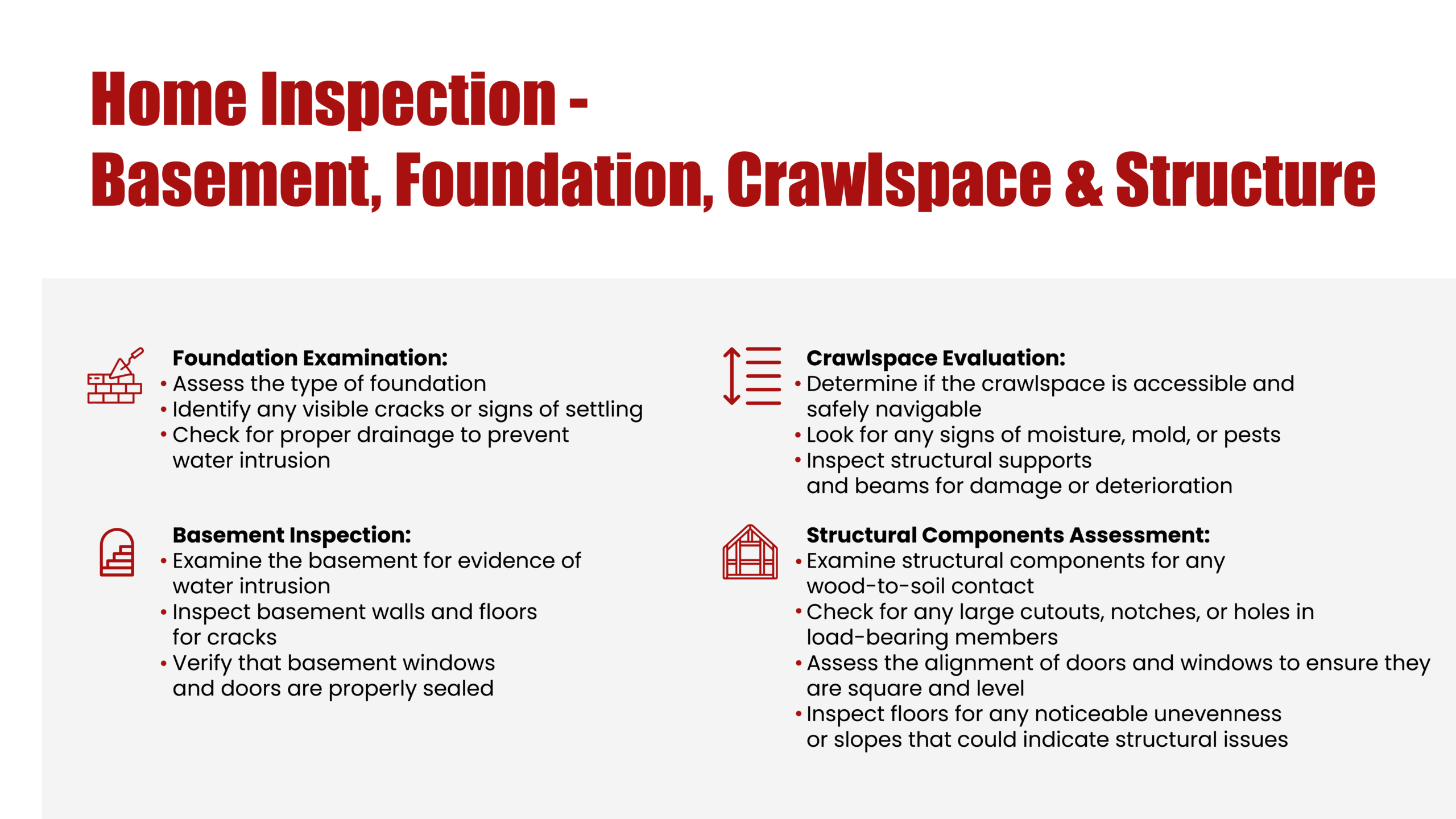
Bullet-wise display of what exactly comes under basement, foundation, crawlspace & structure assessment, with icons displaying each of the 4 main heads.

Here, the inspector will examine the foundation, the basement, the crawlspace, and the structural components. The home inspector should provide details on the type of foundation and how to access any underfloor spaces. It’s important to keep an eye out for potential structural issues and flag anything suspicious, such as:

  • Observed wood touching soil
  • Evidence of water intrusion, like leaks or moisture damage
  • Cracks in sheetrock walls or bricks
  • Doors or windows that appear out of square or not level
  • Floors that are uneven or sloped

The inspector should also note any questionable framing like large cutouts, notches, or holes drilled in structural members. However, an inspector doesn’t need to:

  • Squeeze into inaccessible crawlspaces
  • Move stored items or debris
  • Operate sump pumps with hard-to-reach floats
  • Evaluate if foundation bolts, floor joists, or other supports are adequate
  • Provide architectural or engineering assessments

The focus should be on visually identifying defects or areas of concern. That way, the inspector can advise to get a professional evaluation done if any serious issues are suspected.

Heating
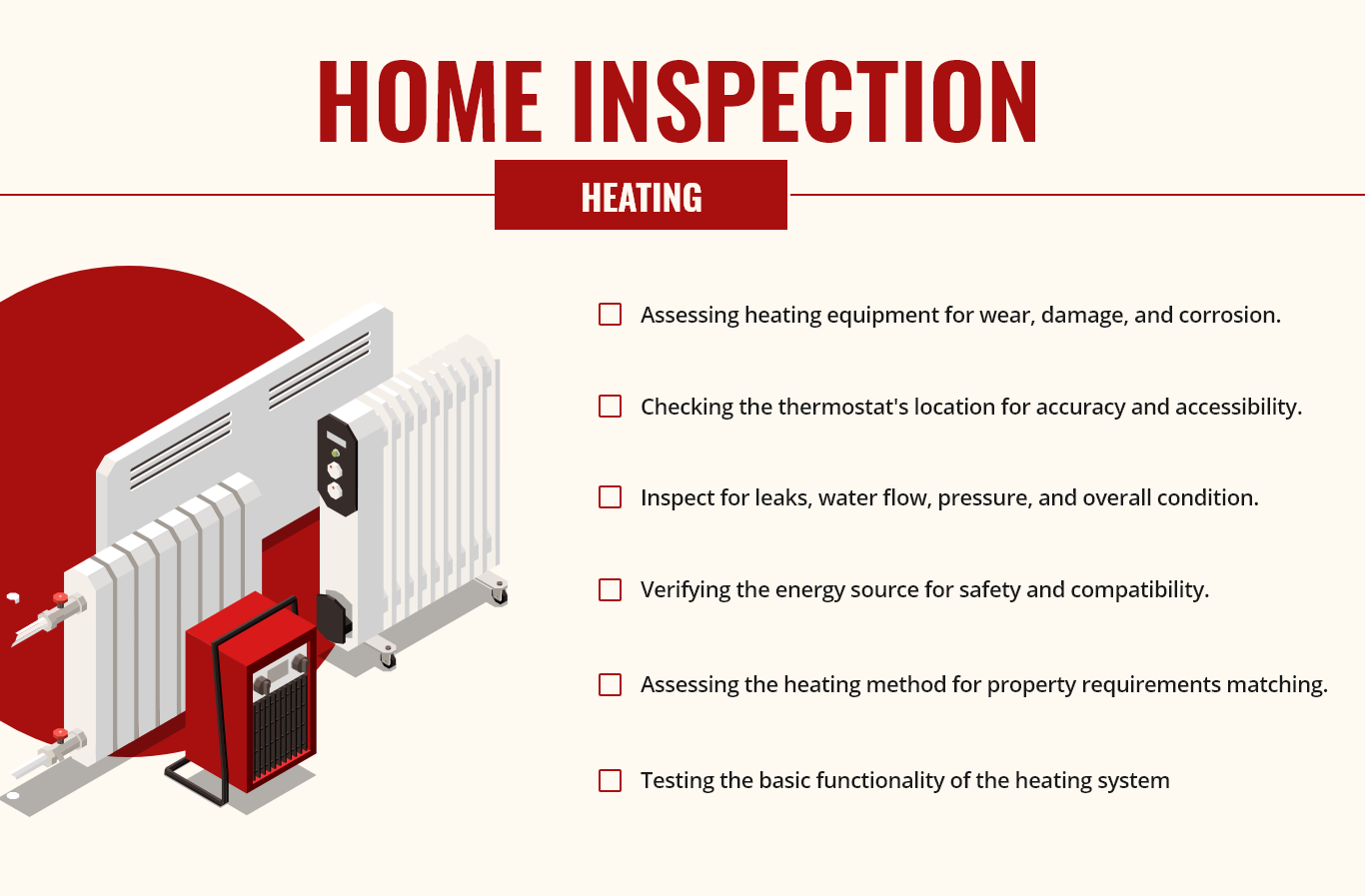
Stating the different heating elements checked when conducting a home inspection

The inspector inspects the heating system by examining the equipment, thermostat location, energy source, and heating method. The inspector notes any issues with the system failing to operate or being inaccessible.

However, inspectors are not required to fully evaluate the technical specifications of the system like uniformity of temperature or flow, supply adequacy, combustion air calculations, or calibrations.

They do not test heat pumps in extreme weather, activate pilot lights, override thermostats, or inspect fuel supply systems. The focus is on basic operation, accessibility, and visible components. Safety issues like ambient conditions, fuels, or ignition are left to specialty technicians. In short, inspectors check basic functions but not comprehensive technical performance.

Cooling
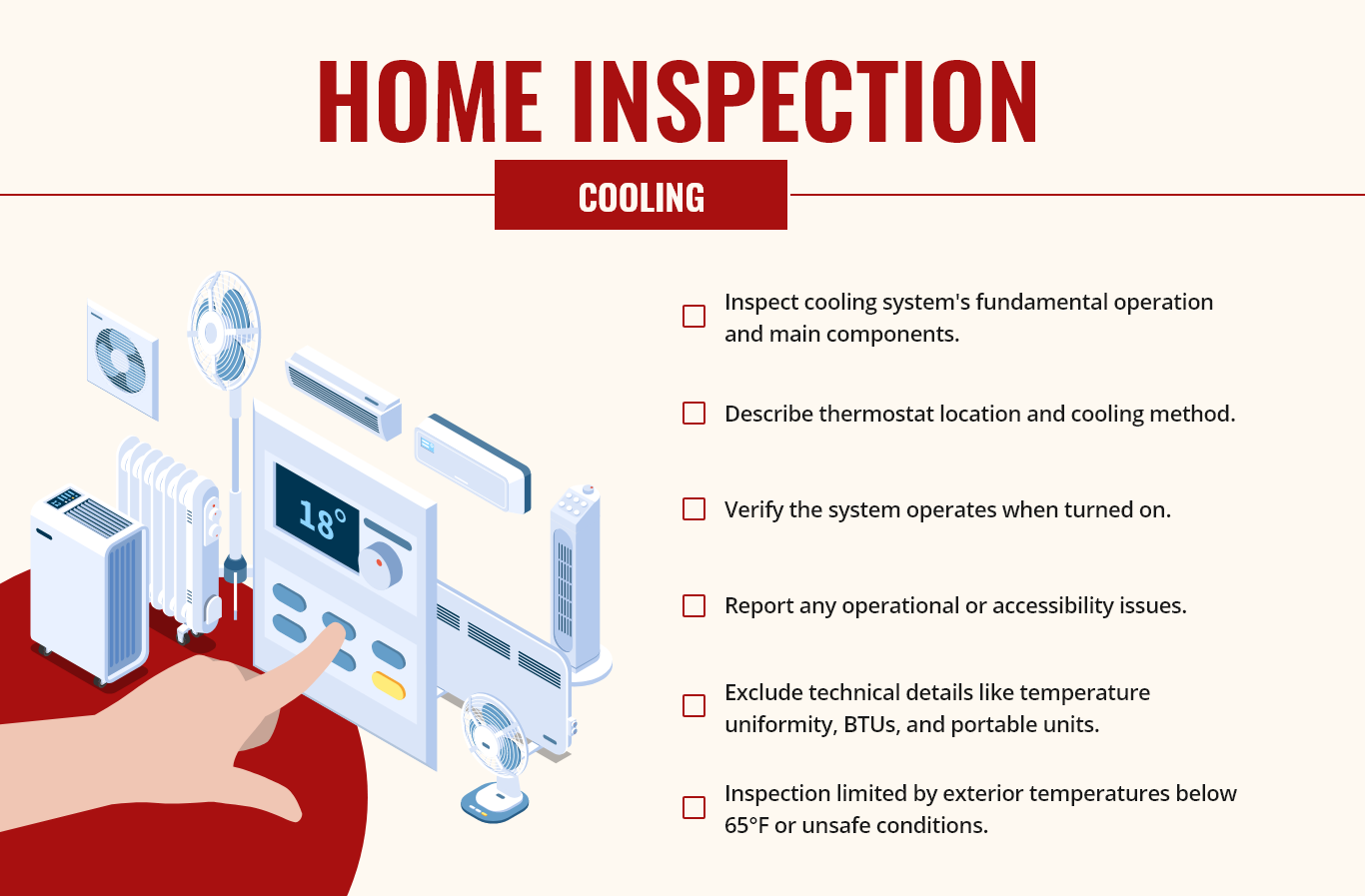
Stating the different cooling elements checked when conducting a home inspection and what all is excluded

The cooling system inspection focuses on the system’s basic operation and main components. The inspector will describe the thermostat location and cooling method, and check that the system runs when turned on.

They will report any issues with operation or accessibility. However, they do not evaluate technical details like temperature uniformity, airflow, BTUs, or cooling adequacy. Portable units and electronic air filters are also excluded.

Furthermore, inspection may be limited by exterior temperatures below 65°F or other unsafe conditions. Also, calibrations, setbacks, clocks, electrical current, coolant fluids, and leakage are not inspected. The end goal is to assess the cooling system’s basic function, not provide a comprehensive technical evaluation.

Plumbing
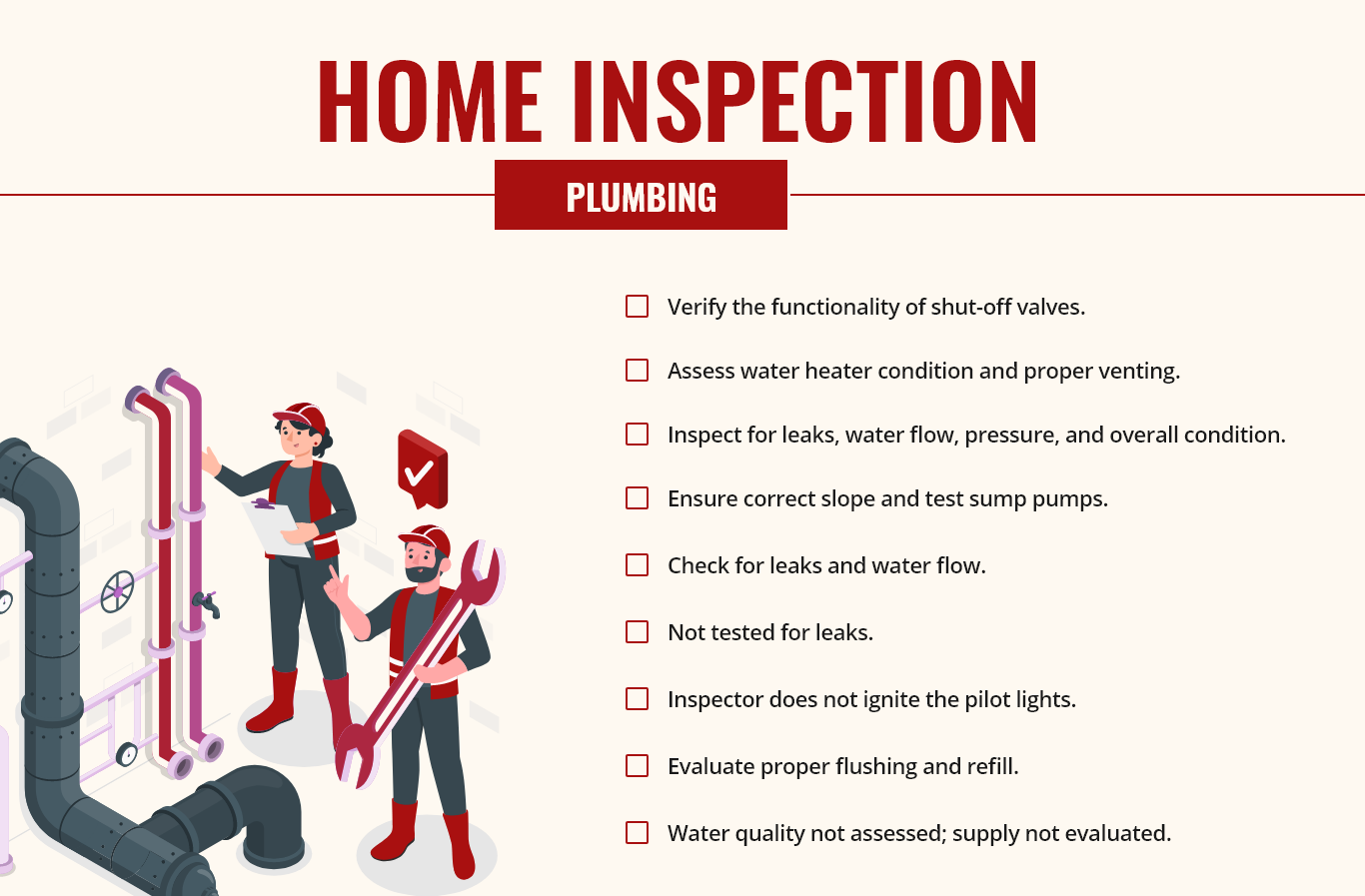
Stating what is included and what is excluded during assessing the "plumbing" in home inspections

The inspector should look at several key things:

  • The main water and fuel shut-off valves – Do they work properly?
  • Water heater and venting – Is the water heater in good shape and properly vented?
  • Pipes and fixtures – Check for leaks, adequate water flow and pressure, and overall condition.
  • Drains and sump pumps – Make sure drains have the right slope and aren’t clogged. Sump pumps should be tested.
  • Running water through fixtures – This checks for leaks and water flow.
  • Flushing toilets – Does the toilet flush properly and fill back up with water?

There are some limitations on what an inspector can check:

  • They don’t test shower pans for leaks, ignite pilot lights, evaluate water quality/supply, or inspect interior flues.
  • Safety valves, interior valves, and anti-siphon devices aren’t tested.
  • Extensive disassembly isn’t performed to inspect internal components.

The goal is to spot visible issues and make sure key plumbing components (interior plumbing) are in working order. This gives you a general sense of the system’s condition without exhaustive testing and further helps identify potential problems so repairs can be made before move-in.

Electrical
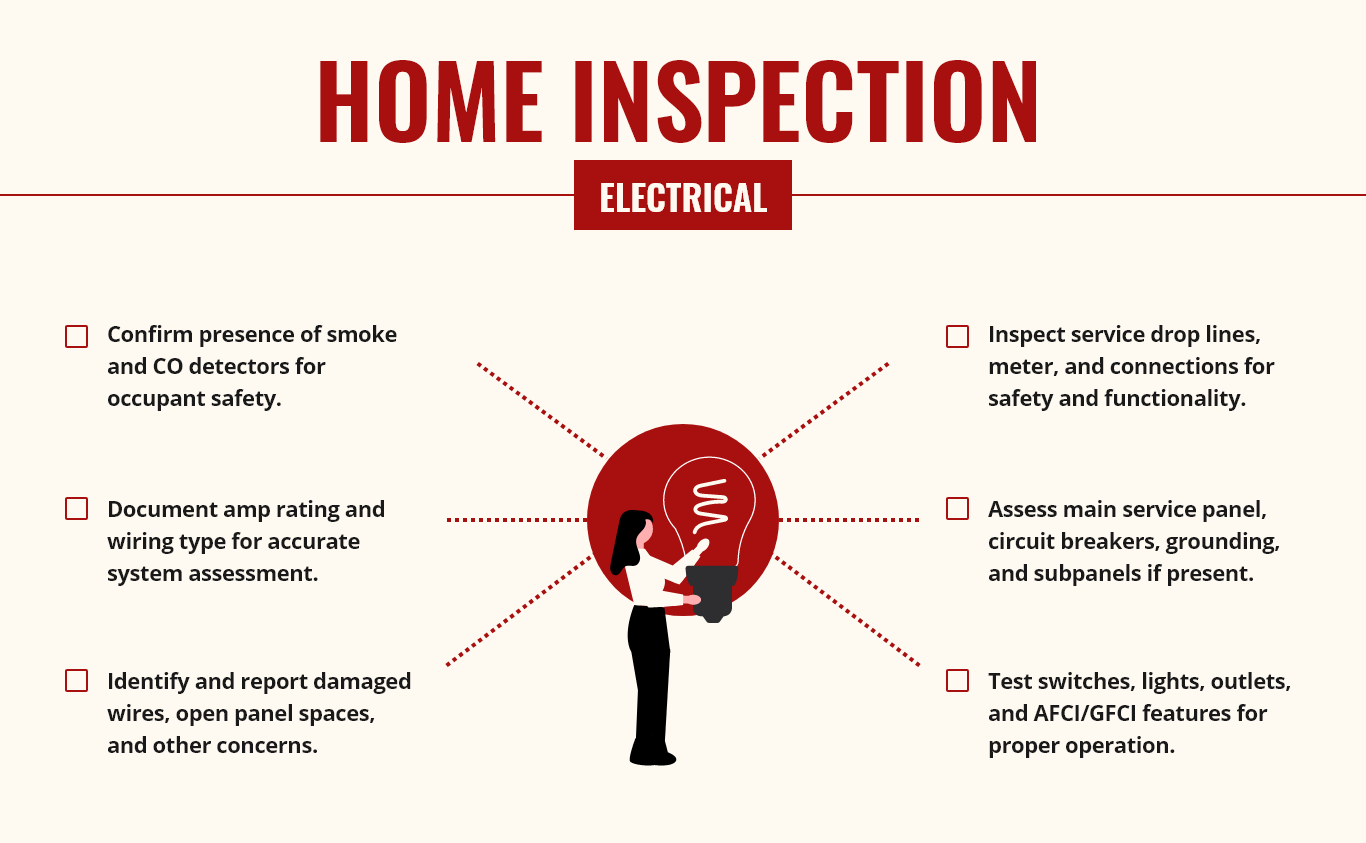
Graphical and bullet-wise representation of "Electrical" elements being assessed in a home inspection

The inspector has a big job ahead of them when examining your electrical system. Here’s an overview of what they will look at:

  • Outside, they will check the:
  1. Service drop lines from the utility pole
  2. Overhead service wires
  3. Where the wires attach to your house
  4. The service head, gooseneck, and drip loops
  5. Service conduit and wires running to the electric meter
  6. The meter itself and its base
  7. The main shut-off switch for the service wires
  • Inside, the inspector looks at:
  1. The main service panel, any subpanels
  2. All the circuit breakers and fuses
  3. They make sure the system is properly grounded
  • They will test:
  1. A sample of switches, lights, and outlets
  2. Any outlets with safety features like AFCI or GFCI
  • They will check that required smoke and CO detectors are present
  • The inspector notes:
  1. The amp rating on the main service disconnect if labeled
  2. The type of wiring used in the system
  •  Any issues found like:
  1. Damaged wires
  2. Open panel spaces
  3. Aluminum wiring
  4. Problems with outlets
  5. Missing detectors

But they won’t do everything like open closed panels, test shut-off equipment, inspect emergency power sources, low-voltage systems, electrical de-icing tapes, swimming pools wiring, etc. Their focus is assessing the main system and key components as outlined. Let them know of any special systems to check. Overall, the aim is to ensure your electrical wiring system is safe and working properly.

Fireplace
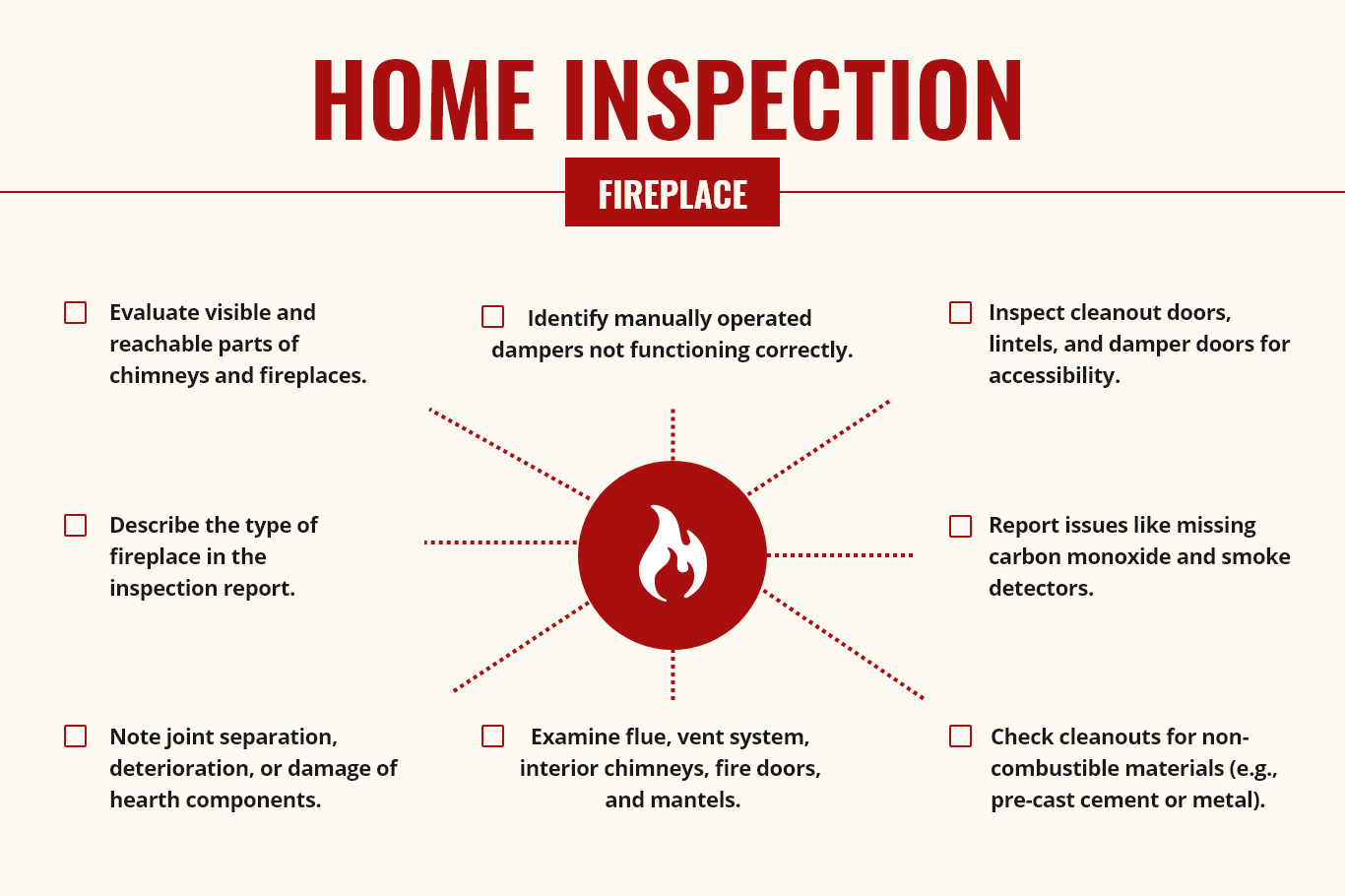
Mentioning what exactly is being checked in a fireplace during home inspections

There are several key aspects that an inspection of fireplaces will include. To start with, it is the visible or easily reachable parts of the chimneys and fireplaces that the inspector evaluates. Next, the cleanout doors and frames, lintels above fireplace openings, and damper doors (if they can be opened and closed manually and are readily accessible) are also a part of the inspection. The inspector will also describe the type of fireplace in the report.

There could be issues that may require correction, so they will be reported. Such as:

  • Absence of carbon monoxide and a smoke detector in the room the fireplace is
  • Manually operated dampers not functioning properly
  • Joint separation, deterioration, or damage of the hearth, hearth extension, or chambers.
  • Cleanouts that aren’t made of non-combustible materials such as pre-cast cement, or metal.

However, there are certain tasks that the inspector isn’t obligated to carry out, including inspecting the flue or vent system, examining the interior of chimneys or flues, fire doors, screens, seals, gaskets, or mantels.

Further, the inspector won’t:

  • Determine the need for a chimney sweep
  • Operate gas fireplace inserts, light pilot flames
  • Assess installation appropriateness
  • Inspect automatic fuel-fed devices, combustion or make-up air devices, heat-distribution assists, draft adequacy
  • Perform smoke tests

Dismantling or removing components and conducting a National Fire Protection Association (NFPA)-style or Phase I fireplace and chimney inspection are also not within the scope of this inspection.

Attic, Insulation, and Ventilation
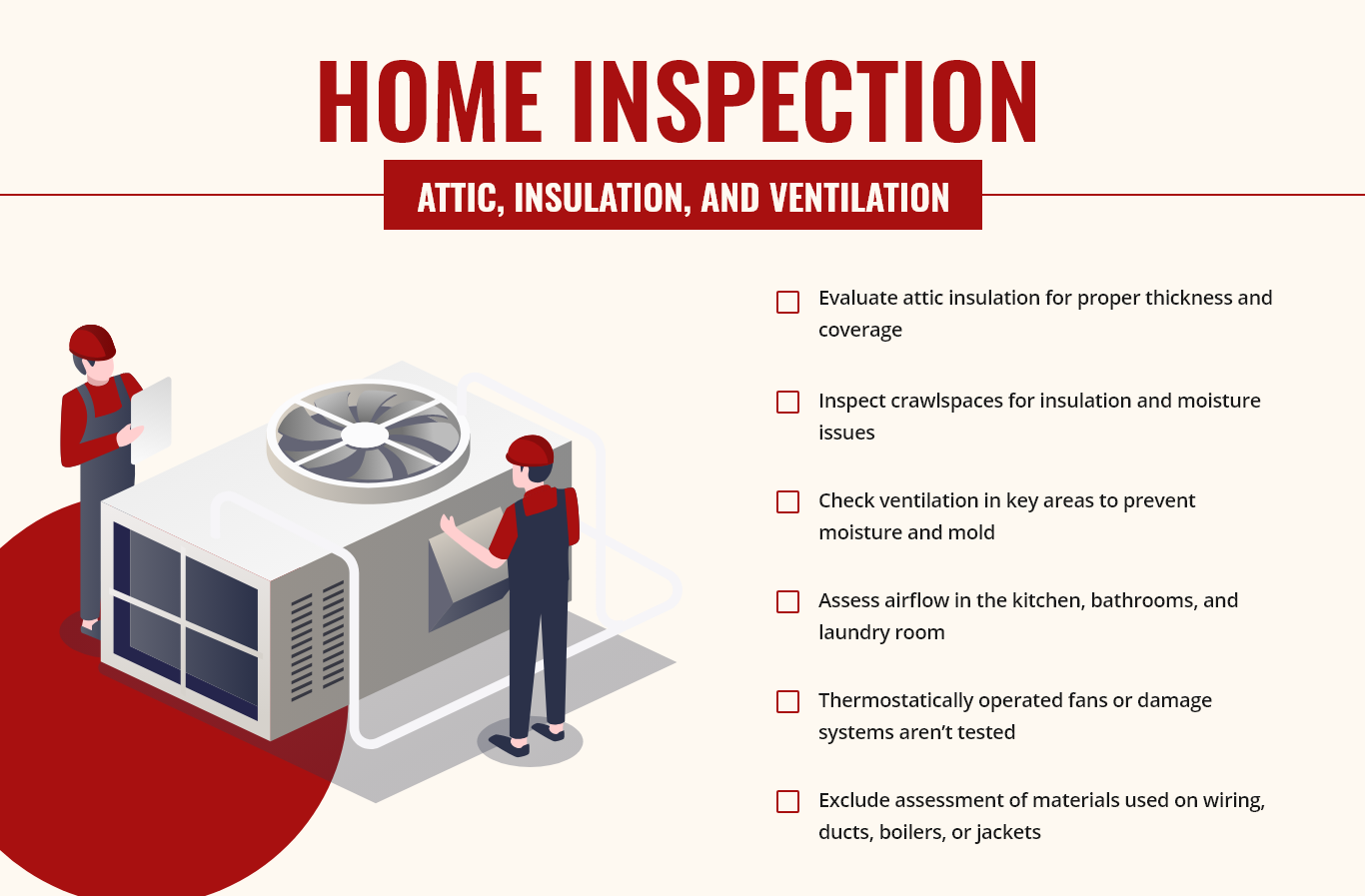
Graphical and point-wise depiction of attic, insulation and ventilation elements being checked during a home inspection

The home inspector will examine the insulation and ventilation in areas like the attic, crawlspaces, and foundation. They will look at the amount and thickness of insulation in the attic and note any deficiencies. The inspector will also check the ventilation in places like the kitchen, bathrooms, and laundry room to ensure proper airflow and prevent moisture/mold issues.

However, their work is limited in some respects. They will not enter unsafe attics or crawlspaces, disturb existing insulation/vapor barriers, or damage any systems. Also, the inspector will refrain from testing thermostatically operated fans or assessing materials used on wiring, ducts, boilers, or jackets. The goal is to provide an overall assessment of insulation and ventilation in the less visible areas of the home without causing any damage in the process.

Doors, Windows, and Interior
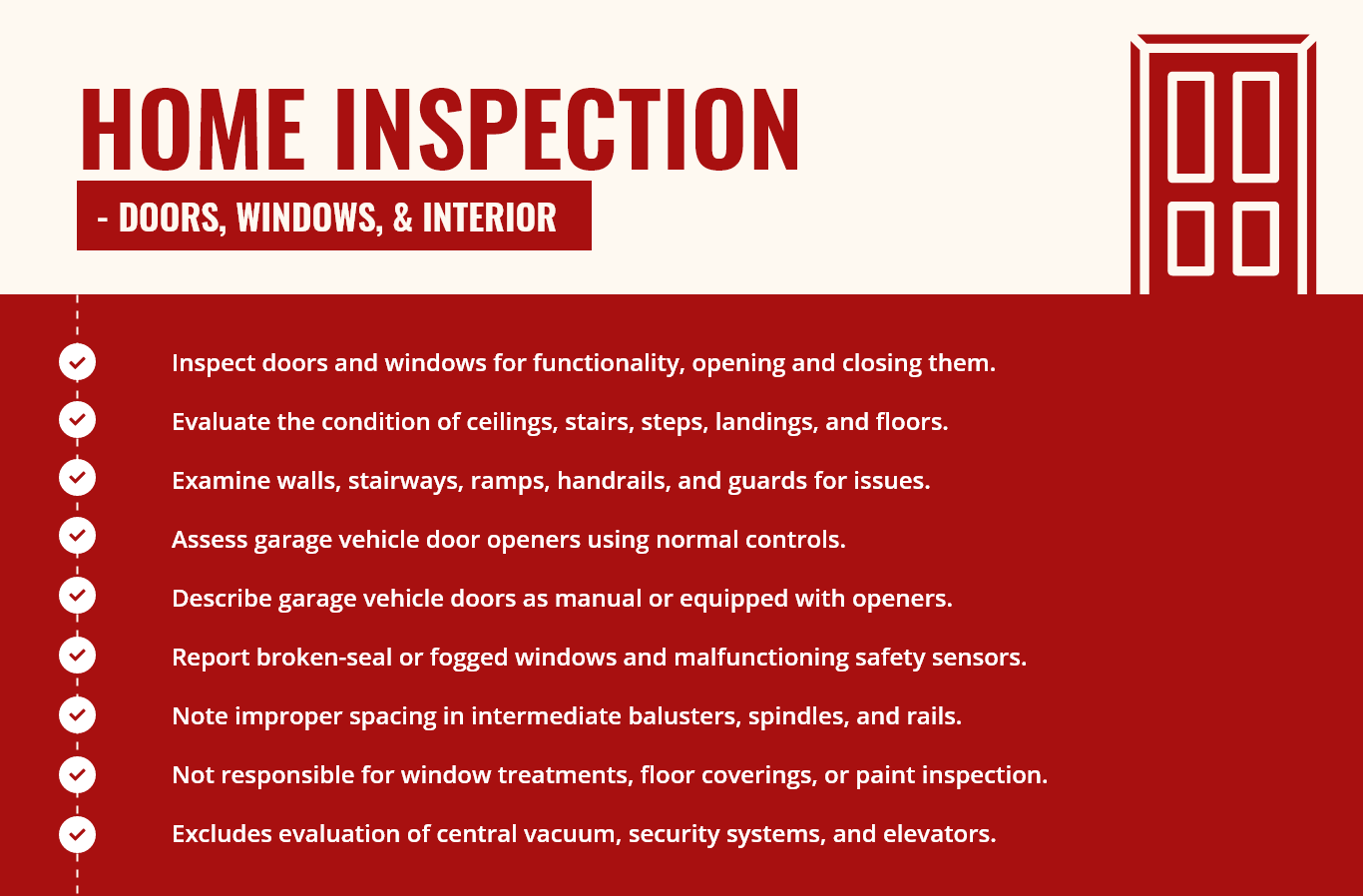
Bullet-wise description of what's being inspected under "doors, windows and interior" in a home inspection

You must be thinking that I have already mentioned doors and windows earlier, so why am I restating them? It’s because earlier, they were included in the external components. And here, we will take the interior or the inner elements into consideration.

The inspector shall check the functionality of doors and windows by opening and closing a good number of them. Next, they will figure out the condition of:

  • Ceilings
  • Stairs
  • Steps
  • Landings
  • Floors
  • Walls
  • Stairways
  • Ramps
  • Handrails
  • Guards

On top of this, they will also examine the garage vehicle door openers using the default or normal controls. Then, the inspector will give a description of the garage vehicle doors, basically specifying if they are manually operated or equipped with a garage door opener.

The inspector will report any issues that they find and require correction. This includes noting:

  • Any broken-seal windows or fogged ones
  • Malfunctioning photo-electric safety sensors
  • Improper spacing between intermediate balusters, spindles, and rails for steps, stairways, guards, and railings

Then again, there are few things which the inspector is not responsible for, such as inspecting:

  • Window treatments
  • Floor coverings
  • Paint
  • Central vacuum systems
  • Wallpaper
  • Security systems
  • Fastening of various household items
  • Safety glazing
  • Pools, spas, or fountains
  • Remote controls
  • Small appliances
  • Items not permanently installed
  • Elevators

Further, they shall also not take part in moving covering such as rugs or carpets, furniture, or any stored items for the inspection of concealed floor structures. They will not inspect or operate equipment in the garage unless otherwise specified, nor will they verify or certify the operation of garage door safety features. They won’t assess security bar release mechanisms or operate systems requiring special keys or codes.

Note:

I understand if this has become a little too technical for you. But trust me; if you have this guide and knowledge, you’d be in a far better position than someone who just knows the basics or maybe nothing at all; plus, you can speak confidently with any inspector that you are looking to hire).

How much does a home inspection cost?
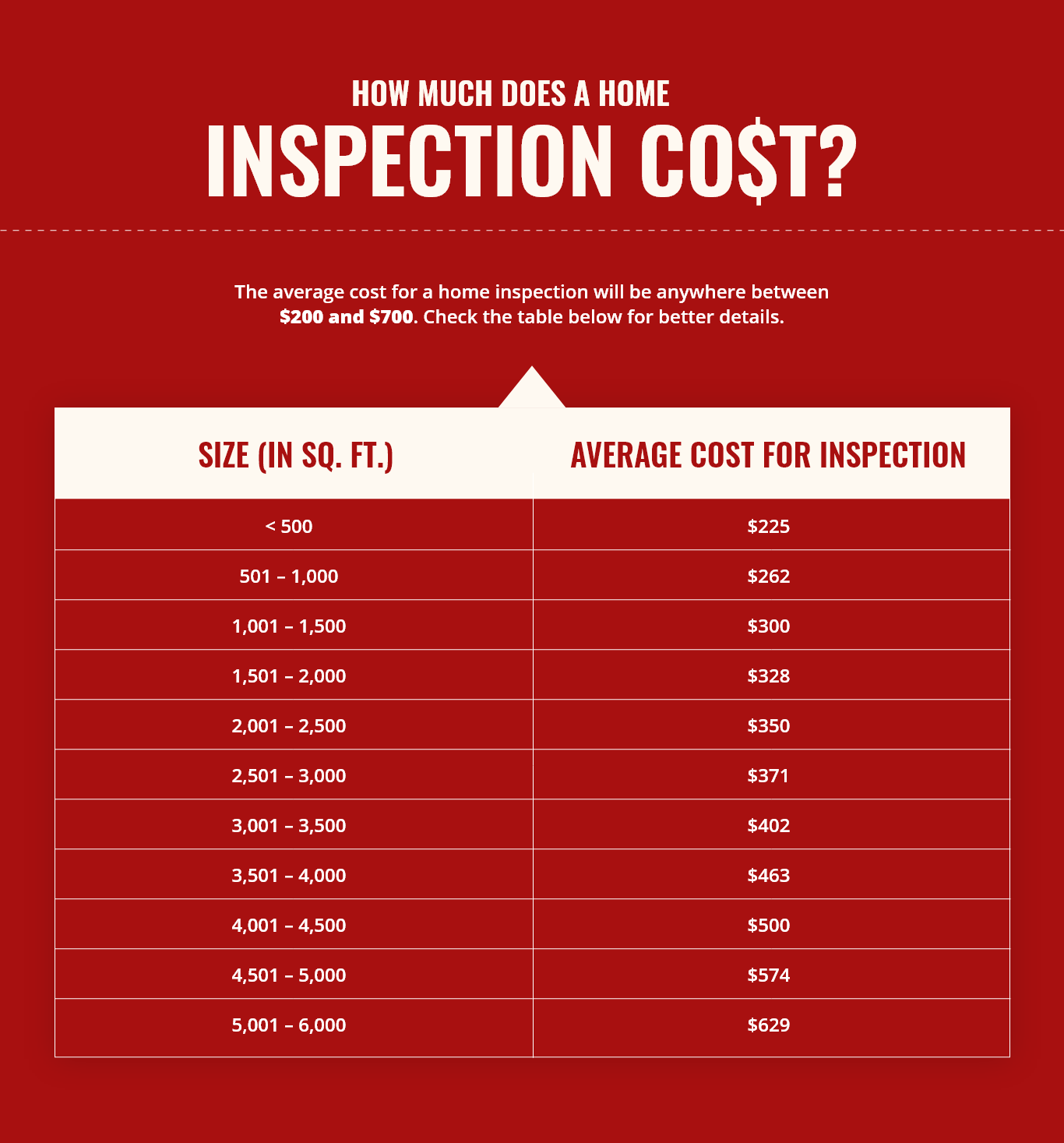
Tabular and accurate description of the average home inspection cost in Florida

The home inspection price varies based on the location and the size of your home. But to give you an average, you can expect the typical home inspection cost to be anywhere between $200 and $700.

Here is the average full home inspection cost you can expect based on your home size.

Size (in sq. ft.) Average cost for inspection
< 500 $225
501 – 1,000 $262
1,001 – 1,500 $300
1,501 – 2,000 $328
2,001 – 2,500 $350
2,501 – 3,000 $371
3,001 – 3,500 $402
3,501 – 4,000 $463
4,001 – 4,500 $500
4,501 – 5,000 $574
5,001 – 6,000 $629

Along with understanding how much are home inspections, you also need to know who pays for the home inspection. In a typical case, it is always the buyer who pays for a home inspection. This allows them to choose their own independent home inspector to conduct a thorough inspection of the property. Paying for the inspection gives the buyer more control and ensures there is no conflict of interest with the inspector being chosen by the seller. It allows them to gain unbiased professional insight into the condition of the home. The results of the inspection then inform the buyer’s decision on whether to move forward with the purchase, ask for repairs, or walk away.

In some cases, a seller may pay for an inspection up front to reassure buyers and speed up the sale. However, this means the buyer does not choose the inspector, so they may want to bring their own certified specialist as well for an unbiased second opinion.

When is a home inspection required?
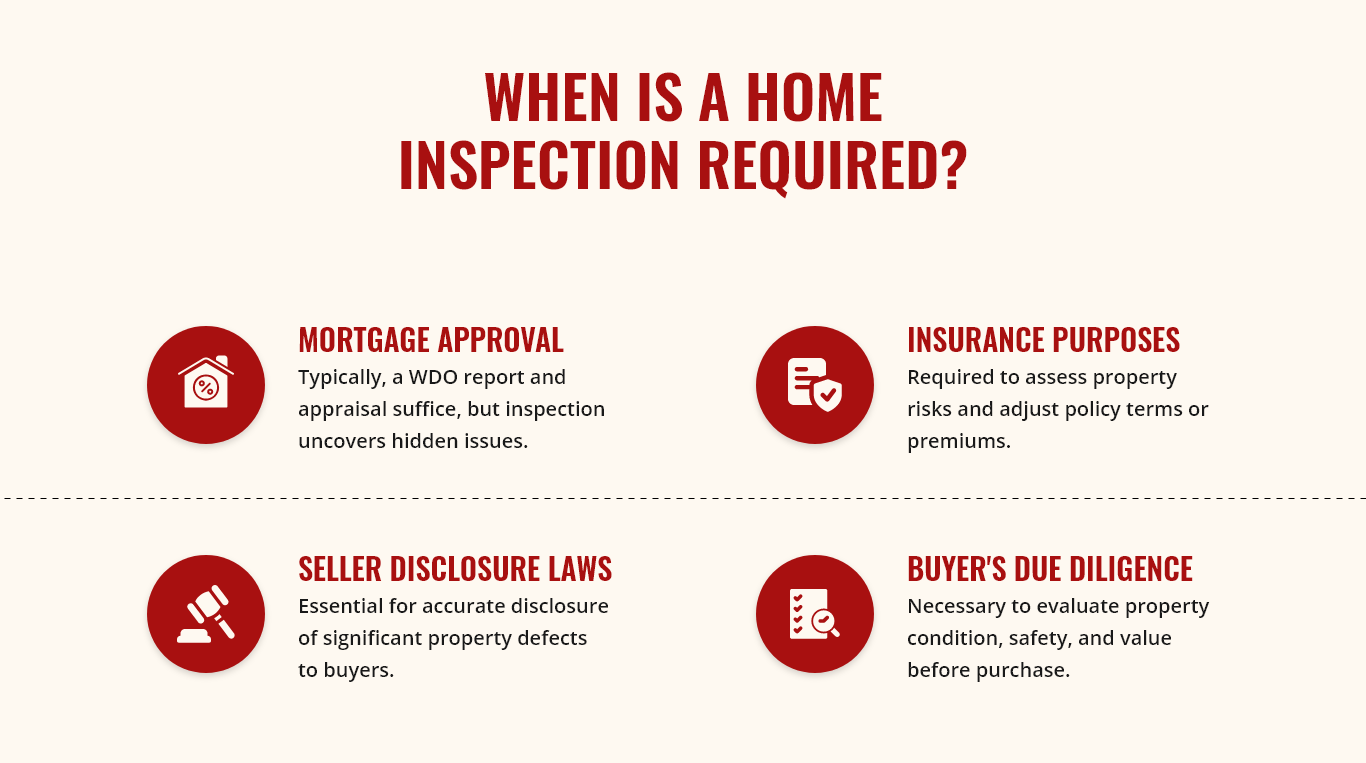
Explaining 4 important points or reasons when a home inspection could be required.

Is a home inspection required generally?

No. But should you get it? A big fat “YES”.

A home inspection, like most say, provides you with peace of mind. You know when to walk away, when to negotiate, etc. But in this section, I’ll just point out a few scenarios where a home inspection may be required.

Mortgage approval

When buying a home, the mortgage lender typically only requires a wood-destroying organisms (WDO) report and an appraisal report, not a full home inspection. The organisms report checks for termites, fungi, and other pests that could damage the structure, while the appraisal estimates the property’s market value to ensure the mortgage loan amount is justified. These help the lender mitigate risk.

However, a home inspection looks at all the home’s major systems and structure, uncovering issues an appraisal may miss. So while not mandated, an inspection is highly recommended for buyers to fully understand the condition and value of the property before finalizing the purchase. It can reveal defects that could affect safety or require price negotiations.

For the buyer’s protection, a thorough inspection beyond what the lender requires provides peace of mind about the home’s quality and flagship issues to address.

Insurance purposes

Insurers may require an inspection when you purchase a policy with a new company, renew your existing policy, or make substantial changes to your home like renovations or additions. A home insurance inspection (as they say) helps the insurer evaluate the risks associated with insuring your specific property.

They will check the roof, siding, foundation, electrical systems, and more. The goal is to make sure your home is properly maintained and not prone to damage. After the inspection, your insurer may adjust your policy terms or premiums based on their assessment.

So it’s a good idea to make any needed repairs before the inspector arrives. That way, you reduce the chance of issues being flagged that could lead to higher rates or even cancellation.

Seller disclosure laws

Florida law requires a homeowner and real estate agent to disclose any significant property defects to potential buyers, even if those defects may not be readily visible during a showing.

While the state does not mandate the use of a specific disclosure form, the Florida Association of Realtors provides a Seller’s Property Disclosure Form that sellers can utilize. This aims to notify buyers of current problems with the home or surrounding area before they finalize their purchase.

Even without a standard form, sellers have an obligation under Florida law to disclose known defects that could impact the value or habitability of the property. Proper disclosures protect buyers and help avoid disputes down the line.

So, if you are a home seller and find this to be tiresome, a home inspection can help you identify and disclose these issues accurately.

Buyer’s due diligence

A home inspection is highly recommended for all home purchases to help the buyer (which is you) fully evaluate the condition of the property. While a home inspection is not legally required in most cases, it is an important part of your due diligence before finalizing a home purchase.

The inspection allows you to have a qualified, licensed home inspector thoroughly evaluate the home’s major systems and components like the roof, plumbing, electrical, HVAC system, and structure. This professional evaluation helps identify any repairs needed or issues that may affect the home’s safety and value.

Conducting a home inspection protects your interests and provides peace of mind about the home’s overall condition before closing.

How to prepare for a home inspection?
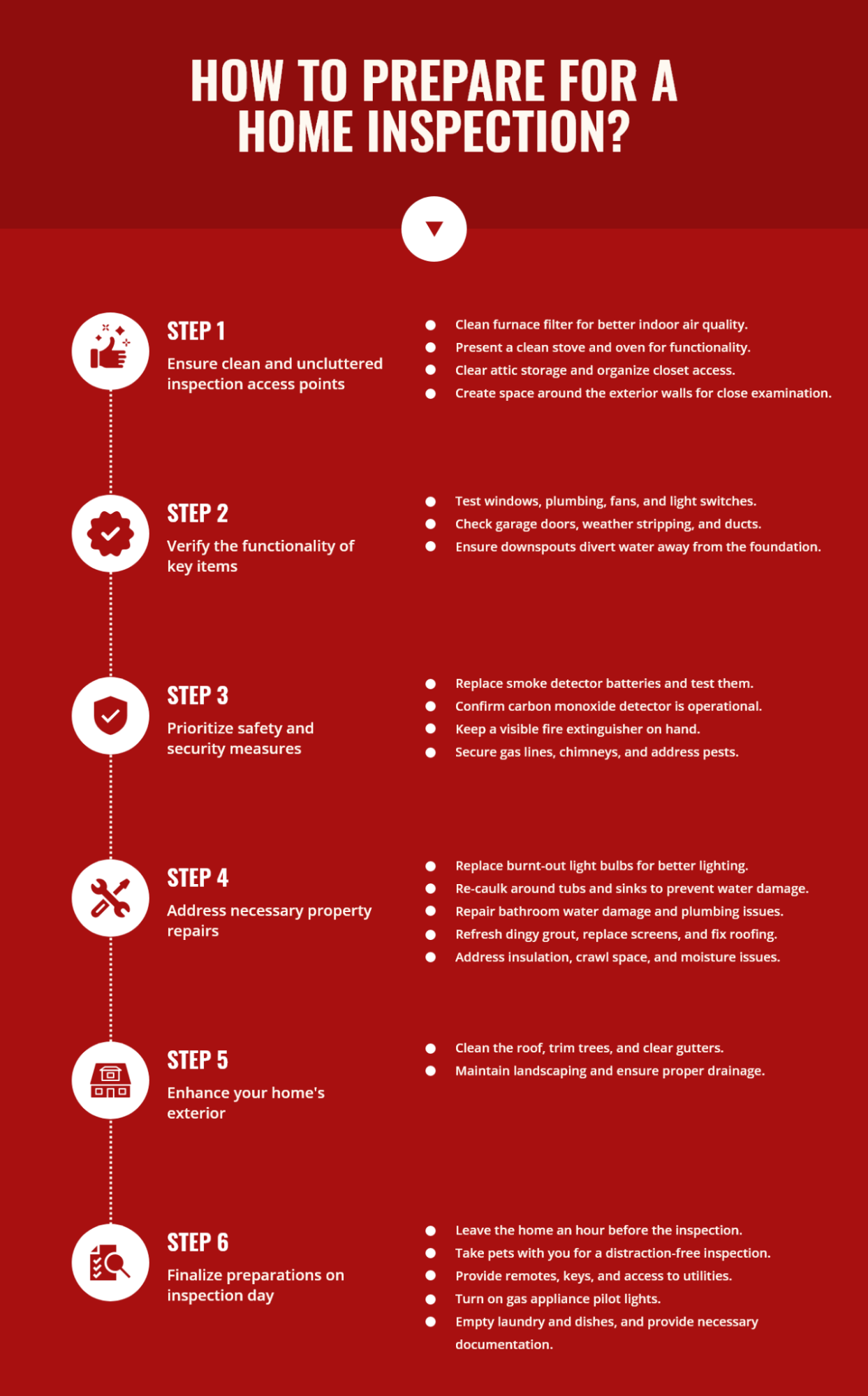
Graphical, step-wise and bulletin-style description of the 6 important steps to follow in order to prepare for a home inspection - for sellers.

Getting ready for a home inspection is a pivotal part of selling a home. A well-prepared home can help the inspection process go smoothly and increase the likelihood of a successful sale. In this guide, we’ll walk you through a comprehensive checklist to ensure you’re well-prepared for your upcoming home inspection. These steps will not only simplify the inspection process but also enhance your chances of receiving a favorable report.

Step 1: Ensure clean and uncluttered inspection access points

Prior to the inspector’s arrival, it’s vital to have all inspection access points clean and free from clutter. A neat and organized space eases the inspector’s job and leaves a positive impression. Here are the key tasks:

Furnace filter maintenance: Ensure that your furnace filter is clean and in good working order. A clogged filter can affect indoor air quality.

Stove and oven care: Present a clean stove and oven. This not only improves their appearance but also optimizes their functionality.

Attic storage: If your attic serves as an access point, remove any stored items, providing unobstructed access for the inspector.

Closet organization: Organize closets that lead to the attic or crawl space. The inspector should have clear access without any clutter.

Exterior perimeter: Outside your home, clear a 4 to 6-inch space around the perimeter to allow the inspector to closely examine the exterior walls.

Step 2: Verify the functionality of key items

To prevent any unpleasant surprises during the inspection, test the functionality of items that the home inspector will likely scrutinize.

Window check: Open and close all windows, checking their locks and seals. Address any malfunctioning locks or seals.

Plumbing evaluation: Flush all toilets and run all faucets to identify potential leaks or drainage problems. These are common inspection areas.

Fan functionality: Ensure that all ceiling and bathroom fans are in working order. Malfunctioning fans can raise concerns among potential buyers.

Light switches: Test all light switches to confirm they work correctly. Promptly replace any non-functioning switches.

Garage doors: Operate the garage doors both manually and with the remote. Test the reverse safety setting to ensure safe operation.

Weather stripping: Inspect door weather stripping for integrity. Replace or repair it if it’s worn or damaged.

Downspout efficiency: Confirm that downspouts effectively divert water away from your home’s foundation. Proper drainage is essential.

Heating and cooling ducts: In the crawl space, ensure that heating ducts are properly connected. Also, verify that fan ducts are correctly venting from the attic.

Step 3: Prioritize safety and security measures

Addressing these aspects not only ensures a secure environment but also showcases your home in the best light.

Smoke detectors: Replace batteries in smoke detectors and test their functionality. Safety is a top priority, and functional smoke detectors are imperative.

Carbon monoxide detector: Ensure that the carbon monoxide detector is operating correctly. It’s a crucial safety measure.

Fire safety: Have a readily accessible fire extinguisher in a visible and easily reachable location.

Gas lines and chimneys: Securely cap gas lines and chimney entry points. This prevents unwanted intrusions and maintains safety.

Pest control: Proactively deal with any pest issues by exterminating bugs or rodents. A pest-free home is more appealing to potential buyers.

Step 4: Address necessary property repairs

These repairs will upgrade the overall condition of your property, leaving a positive impression on potential buyers.

Lighting upgrades: Replace any burnt-out light bulbs throughout your home. Adequate lighting can make spaces appear more inviting.

Caulk and sealing: Re-caulk around bathtubs and sinks where needed. This helps prevent water damage and keeps these areas looking fresh.

Bathroom repairs: Address any water damage in your bathrooms, whether it’s peeling paint or damaged tiles. A well-maintained bathroom is a selling point.

Plumbing maintenance: Unblock any drain clogs to ensure that water flows smoothly down drains. A plumber can help if you encounter persistent issues.

Grout refresh: Revitalize dingy grout in your tiled areas. Clean, fresh grout can significantly improve the appearance of kitchens and bathrooms.

Window and screen updates: Replace torn window screens and repair cracked windows. These repairs enhance your home’s exterior appearance.

Roofing care: Repair or replace any missing roofing materials. A sound roof is essential for a positive inspection outcome.

Insulation check: Address damaged or missing insulation in the attic and crawl space. Proper insulation is important for energy efficiency.

Crawl space covering: Cover the crawl space with a 6 mm plastic sheeting. This helps prevent moisture issues and promotes a healthier environment.

Step 5: Enhance your home’s exterior

First impressions matter, and the exterior of your home is the first thing potential buyers see. Sprucing up the exterior surfaces can significantly impact the inspection process. Here are exterior home improvements to consider:

Roof maintenance: Sweep debris off the roof, or if necessary, pressure wash it to remove stubborn stains. A clean roof improves your home’s curb appeal.

Tree trimming: Trim trees that hang over or are close to the roof line. This prevents potential damage and ensures safety.

Gutter cleaning: Clear debris from your gutters to ensure they function correctly. Proper drainage is essential for the integrity of your home.

Landscaping: Remove debris around the A/C compressor, downspout drainage, and foundation vents. Ensure the soil slopes away from the home for effective water runoff.

Step 6: Finalize preparations on inspection day

On the day of the inspection, there are some last-minute preparations to keep in mind to ensure a smooth process:

Early departure: Plan to leave your home at least an hour before the scheduled inspection time. This allows the inspector to work without interruption.

Pet care: Take your pets with you when you leave for the inspection. This eliminates any potential distractions and ensures their safety.

Remote accessibility: Leave remotes for the garage door, ceiling fans, lights, and other relevant items. This enables the inspector to test these features easily.

Key accessibility: Leave keys for gates, outbuildings, and electrical boxes in a designated location for the inspector’s use.

Pilot lights: Turn on the pilot light for gas-fired appliances, including the water heater. This ensures they can be tested during the inspection.

Utilities on: Confirm that all utilities, including water, gas, and electricity, are turned on for the inspector’s access.

Laundry and dishes: Empty the washer and dryer of any laundry and remove dishes from the sink and dishwasher.

Documentation: Leave a sketch or clear identification of the well or septic tank’s location for the inspector’s reference. Additionally, provide any paperwork related to maintenance, repairs, or insurance claims to demonstrate your home’s well-maintained history.

So, here it is. a 6-step process for every seller out there to prepare for a home inspection. While I could have ignored this section, but I wanted to cover as much as I could. This was a do-it-yourself checklist which will help you prepare before the buyer arrives with their home inspector.

Why home inspections are important?
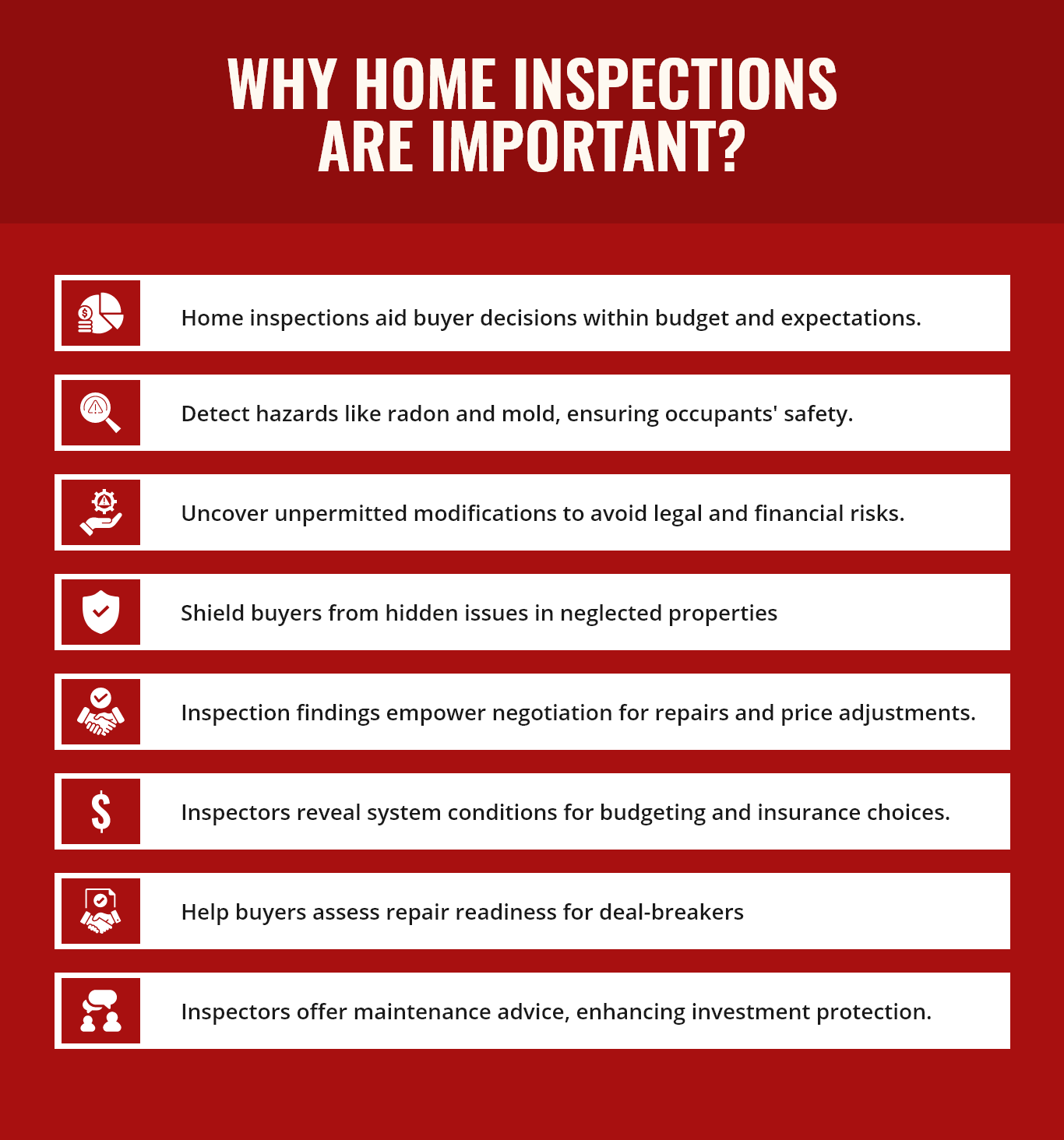
Mentioning the 8 extremely important reasons why home inspections are important

There are quite a few reasons for you to get a home inspection done. I’ll lay down what I believe is important and have seen through years of my experience as a certified home inspector.

Informed decision making

Home inspections are a cornerstone of informed home buying. They provide prospective buyers with a detailed assessment of a property’s condition, which is invaluable in making sound decisions. Armed with this information, buyers can confidently evaluate whether the investment aligns with their expectations and budget. Moreover, if unexpected issues are uncovered during the inspection, it offers buyers a crucial opportunity to reconsider their purchase or negotiate with the seller.

Safety assurance

One of the primary reasons for a home inspection is to ensure the safety of the property’s future occupants. Inspectors can identify potential hazards such as radon gas, carbon monoxide leaks, and mold infestations. These issues can have serious health implications and may require costly remediation. Buyers can include contingencies in their purchase contracts to address these safety concerns, protecting themselves and their families from hidden dangers.

Since safety is the point of discussion here, I wanted to share a short “Did You Know?”:

As per a journal on National Institutes of Health (NIH), falls are the leading cause of accidents among the elderly aged 65 years and above. Furthermore, it is the leading cause of death by accident, and observations reveal that environmental factors play a key role in the probability of falls in the homes of the elderly.

Legal compliance

Home inspections can uncover unauthorized additions or installations that may not comply with local building codes and regulations. This information is vital as it can impact the property’s overall value, tax assessments, and insurance coverage. Properties with unpermitted modifications may carry legal and financial risks for buyers. Understanding these issues upfront allows buyers to make informed decisions and potentially negotiate with the seller to rectify any compliance issues.

Protection for special cases

Foreclosed properties or homes sold in a short sale often come with their own set of challenges. Many of these properties have been vacant for extended periods, leading to neglect and potential problems like mold growth or missing components. Home inspections act as a shield for buyers, revealing these hidden issues and enabling them to assess the true cost and effort required to make the property habitable. This knowledge prevents buyers from getting caught off guard by costly surprises.

Negotiation leverage

The inspection report serves as a potent tool during negotiations. Buyers can use the findings to request repairs, negotiate a lower purchase price, or seek credits from the seller. Realtors play a crucial role in guiding buyers on how to navigate these negotiations effectively, leading to a successful real estate purchase. Having a clear understanding of the property’s condition empowers buyers to advocate for their interests and secure a better deal.

Financial planning

Home inspectors provide insights into the age and condition of major systems within the property, including plumbing, heating, cooling, and essential equipment like water heaters. Understanding the remaining lifespan of these components is vital for long-term financial planning. It informs buyers about potential future expenses, allowing them to budget accordingly and make informed choices regarding home insurance coverage and warranties. This foresight prevents financial surprises down the road.

Identify deal-breakers

Home inspections help buyers determine their willingness to tackle necessary repairs or improvements. By understanding the extent of the property’s issues, buyers can assess whether they are prepared for the additional financial and time commitments required to bring the property to their desired condition. If the inspection reveals deal-breaking problems, buyers have the option to walk away from the purchase or renegotiate with the seller.

Educational value

Home inspectors serve as valuable sources of knowledge about the property. They offer practical advice on how to maintain and care for the home, which can save buyers thousands of dollars in the long term. From tips on regular maintenance tasks to guidance on energy efficiency improvements, this educational aspect of the inspection ensures that buyers are well-prepared to protect and enhance their investment.

Home inspection questions which are important to answer

How long does a home inspection take?

Answer: A typical home inspection usually takes around 2 to 4 hours, depending on the size and condition of the property. Larger or more complex homes may take longer to inspect thoroughly.

How to find a home inspector?

Answer: Here, check these steps out:

  1. Ask for Recommendations: Start by asking for recommendations from friends, family, and your real estate agent. They can provide valuable insights based on their experiences.
  2. Online Reviews: Check online resources for customer reviews of local home inspectors. Websites like Yelp, Google Reviews, and Angie’s List can offer a wealth of feedback from previous clients.
  3. Better Business Bureau (BBB): Visit the Better Business Bureau (BBB) website to look for home inspectors in your area. This can help you identify inspectors with a good track record and any potential complaints.
  4. State or County Licensing Agency: Depending on your location, home inspectors may or may not be required to have a license. If licensing is necessary, verify the inspector’s credentials with your state or county licensing agency.
  5. Local Real Estate Associations: Contact local real estate associations or boards for recommendations. They often have a list of reputable home inspectors they work with regularly.
  6. Online Directories: Use online directories or databases specific to home inspectors. Websites like the American Society of Home Inspectors (ASHI) or the International Association of Certified Home Inspectors (InterNACHI) offer directories of their members.

Once you have a list of potential home inspectors, you can then proceed to evaluate and select the one that best fits your needs based on their qualifications, experience, and reputation.

Should the seller be present during a home inspection?

Answer: In general, it’s best for sellers not to be present during a home inspection. When buyers hire an inspector, it’s to ensure an unbiased evaluation of the property. Sellers’ presence can unintentionally interfere, inhibiting open communication between buyers and inspectors. This might lead to suspicion or discomfort for buyers and hinder the sale. Moreover, sellers may become emotionally attached and defensive when hearing potential issues, making the process uncomfortable. Buyers need the freedom to explore the property, envisioning their future there, which is challenging with the seller present. The key is for sellers to prepare the home, make it accessible, and then step aside, allowing inspectors to do their job. It fosters a smoother, more transparent process that benefits both parties.

What are the things that fail a home inspection?

Answer: During a home inspection, several issues can lead to a failed assessment. These include roof damage, such as missing shingles or water damage, electrical problems like non-functioning components or frayed wires, plumbing issues such as leaks or malfunctioning heaters, presence of pests like termites or vermin, and mold, often associated with water damage.

What happens if a house fails inspection?

Answer: If a house fails a home inspection, it means that the inspector has identified significant issues with the property. In such cases, buyers typically have a few options. They can request a price reduction or credit from the seller to cover the cost of repairs. Alternatively, they may ask the seller to make the necessary repairs before proceeding with the purchase. Lastly, if the issues are too severe or the seller is unwilling to address them, the buyer can choose to walk away from the deal and look for a different home that meets their criteria and is in better condition.

What are the different types of home inspections?

Answer: The following are some common types of home inspection:

  1. Buyer home inspection
  2. Seller home inspection
  3. Pre-purchase home inspection
  4. Pre-listing home inspection
  5. New home inspection
  6. Maintenance inspection
  7. 4 point home inspection (commonly for insurance purposes)
  8. Wind mitigation inspection (for insurance and safety)

Then, there are specialized home inspections as well, which further help homebuyers understand the situation and make an informed choice.

Specialized home inspection types:

  1. Mold Inspection
  2. Roof Inspection
  3. Lead-Based Paint Inspection
  4. Radon Inspection
  5. Pool Inspection
  6. Electrical Inspection
  7. HVAC Inspection
  8. Plumbing and Sewer Inspection
  9. Foundation and Structure Inspection
  10. Soil Inspection
  11. Pest Inspection
  12. Termite Inspection

What happens after home inspection takes place?

Answer: After a home inspection takes place, the inspector compiles a detailed report outlining their findings. This report is typically shared with the prospective buyer or homeowner. The report will highlight any issues or deficiencies discovered during the inspection, along with recommendations for repairs or further evaluations. Buyers can use this information to negotiate with the seller for necessary repairs or price adjustments.

What fixes are mandatory after a home inspection?

Answer: Mandatory fixes after a home inspection can vary depending on local regulations and the terms of the purchase agreement. Typically, issues related to safety, structural integrity, and code violations are considered mandatory fixes. This may include problems with electrical systems, plumbing, roofing, or foundation. Cosmetic issues are usually not mandatory but can be negotiated between the buyer and seller.

What is a 4 point home inspection? And how is it different from a standard home inspection?

Answer: A 4-point home inspection is a limited-scope inspection that focuses on four main areas: HVAC (Heating, Ventilation, and Air Conditioning), electrical, plumbing, and the roof. This type of inspection is often requested by insurance companies for older homes to assess the condition of critical systems. It differs from a standard home inspection, which is more comprehensive and covers a broader range of components and areas in the house, including appliances, structural elements, and overall condition. The 4-point inspection is quicker and less detailed, primarily assessing the four specified systems for insurance underwriting purposes. If you want to learn more about 4 point home inspection, check out this blog: https://www.flpg.net/what-is-a-4-point-home-inspection/

What is a home inspection contingency? How does it relate to the inspection process?

Answer: A home inspection contingency (also known as a “due diligence” contingency) in a purchase agreement is a critical clause that allows the buyer a specified period, typically a few weeks, to conduct various inspections, including a home inspection, to evaluate the property’s condition thoroughly. It’s a safeguard for buyers, giving them the option to back out of the contract without penalties if they discover significant issues during this period.

Regarding the inspection process, the due diligence contingency is closely related because it grants the buyer the opportunity to hire a home inspector. If the inspector uncovers material defects, structural problems, or other issues, the buyer can request repairs or negotiate a lower purchase price based on the inspection report’s findings. Without this contingency, buyers may be bound to the contract regardless of the property’s condition, potentially exposing them to unforeseen costs and risks.

What are home inspectors not allowed to do?

Answer: Home inspectors are not allowed to offer services beyond the scope of their inspection, engage in renovations or repairs on the inspected property, cause any damage to the home, inspect specialized systems like pools or hot tubs, or test systems already indicated as non-functional by the seller. They cannot diagnose the causes of problems they find, provide advice, or offer estimates for repairs. Home inspectors must maintain objectivity and only provide factual information related to the components relevant to the inspection. Their role is limited to assessing the condition and safety of the property without having involvement in additional services or decisions.

What is the primary purpose of a home inspection, and how does it relate to determining a property’s value?

Answer: A home inspection serves as a comprehensive examination of a property’s condition and safety. It is typically conducted by a certified home inspector to identify any existing issues or potential problems within a home. While the primary goal of a home inspection is to provide buyers with a clear understanding of a property’s condition, it also indirectly affects the determination of a property’s value.

When a home inspector uncovers material defects, such as structural issues, plumbing or electrical problems, asbestos, mold, or other issues, it enables buyers to make informed decisions about the property. These findings can impact negotiations between buyers and sellers, potentially leading to price adjustments or repairs. In essence, the inspection report can influence the perceived value of the property, and it can be a crucial factor in the final sale price.

Who is a home appraiser? And how are they different from home inspectors?

Answer: A home appraiser is a professional who assesses the monetary value of a property, typically for the purpose of a real estate transaction. They consider various factors, including the property’s condition, location, comparable sales, and market trends, to determine its market value.

In contrast, a home inspector evaluates a property’s physical condition and safety. They examine the structure, systems (such as plumbing, electrical, and HVAC), and overall maintenance of a home. The primary goal of a home inspector is to identify any issues or defects that may need attention or repair, helping potential buyers make informed decisions about the property’s condition. While both professionals play crucial roles in real estate transactions, their focus and expertise differ significantly.

Why is it important to hire a certified or licensed appraiser when conducting a home appraisal? What appraisal methods do they typically use?

Answer: I am no appraiser. While I shouldn’t be picking this question up, but my research came across this question quite a few times. So, not only did I read about it more, but I also talked to one of my friends, who knows some of them personally. Here is my learning.

Hiring a certified or licensed appraiser during a home appraisal process will ensure an accurate valuation of the property. These professionals are trained to provide an unbiased and well-informed assessment of a property’s worth, which is essential for both buyers and lenders.

Appraisers employ various appraisal methods, including the comparison approach, cost approach, and income approach. The comparison approach, widely used in residential real estate, involves assessing the property’s value by comparing it to recently sold properties (comparable home prices) with similar characteristics. They consider factors such as size, location, lot size, and condition.

Appraisers also take into account local building codes and regulations when evaluating a property’s compliance with safety and legal standards, ensuring a comprehensive assessment of its value. Through these standardized approaches, they provide reliable valuations that protect both buyers and lenders from overpaying or lending more than a property’s worth.

What are Material Defects? How they can impact a home’s inspection report?

Answer: Material defects refer to significant issues or flaws within a property that can have a substantial impact on its safety, functionality, or value. These defects are typically structural or safety-related problems that may include issues with the foundation, roof, electrical systems, plumbing, HVAC, or the presence of hazards like asbestos or mold. Material defects can also encompass problems like termite infestations or severe water damage.

The presence of material defects can significantly influence a home inspection report by highlighting critical concerns that need immediate attention. Such findings can lead to negotiation between buyers and sellers for repairs or price adjustments. Failing to address material defects can affect the property’s marketability and potentially result in safety issues or costly repairs for the new owner.

What are the key components of a home that a home inspector examines for structural issues, and how do they affect the inspection report?

Answer: Home inspectors thoroughly assess various key structural components of a property to identify any issues that may compromise its safety or integrity. These components typically include the foundation, walls, roof, floors, and structural supports. Inspectors look for signs of structural damage, such as cracks, shifts, or weaknesses in these areas.

The findings related to structural issues significantly impact the inspection report, as they are essential for buyers to make informed decisions. Structural problems may necessitate costly repairs or impact the property’s long-term durability. In the inspection report, specific details about the nature and extent of structural issues are provided, enabling buyers to gauge the severity and decide whether to negotiate with the seller for repairs or adjustments in the purchase price. Addressing these concerns promptly is crucial to ensure the safety and value of the property.

How do cosmetic issues like peeling paint and cosmetic defects factor into a home inspection, and can they affect a property’s value?

Answer: Cosmetic issues, such as peeling paint or minor cosmetic defects, are indeed in consideration during a home inspection, but their impact on a property’s value is generally limited compared to structural or safety-related problems. While these issues may not directly affect the safety of occupants, they can influence the property’s overall appeal to potential buyers. Homebuyers can use cosmetic defects as negotiation points, requesting repairs or price adjustments to address these concerns. So, while they matter, cosmetic issues are usually secondary to more critical inspection findings.

What are some common problems related to the heating and cooling system, plumbing, and electrical work that a home inspector looks for during an inspection?

Answer: While already discussed, here is the answer in short.

Heating and Cooling System:

  • Inefficient HVAC Systems: They check if the heating, ventilation, and air conditioning (HVAC) systems are functioning efficiently. Inefficiencies can lead to higher energy bills.
  • Faulty Thermostats: Inspectors verify if thermostats are working correctly to maintain comfortable indoor temperatures.
  • Blocked Vents: Blocked or dirty vents can hamper airflow, impacting the system’s performance.
  • Safety Concerns: They ensure that heating systems, like furnaces or boilers, are safe and free from potential fire hazards.

Plumbing:

  • Leaks: Inspectors search for any visible leaks in plumbing fixtures, pipes, or connections, as these can lead to water damage.
  • Water Pressure: They assess water pressure to ensure it meets acceptable standards and is consistent throughout the property.
  • Drainage Issues: Proper drainage is critical to prevent water accumulation around the foundation, which can lead to structural problems.

Electrical Work:

  • Faulty Wiring: Inspectors look for signs of faulty or outdated wiring that could pose safety hazards, such as electrical fires.
  • Overloaded Circuits: Overloaded circuits can trip breakers or cause electrical problems.
  • Safety Devices: They check the functionality of safety devices like GFCIs (Ground Fault Circuit Interrupters) in areas prone to moisture.

A thorough inspection of these critical systems helps buyers like you make informed decisions and plan for any necessary repairs or upgrades to ensure the safety and functionality of the property.

When should one consider a re-inspection, and what are the potential consequences of waiving an inspection in a home purchase?

Answer: A re-inspection should be considered when significant repairs or renovations have been performed on a property after the initial home inspection. It ensures that the previously identified issues get adequately addressed and that the property is now in the expected condition. Additionally, if the inspection report indicates any material defects or structural problems, a re-inspection is advisable to verify that the necessary repairs took place.

Waiving an inspection in a home purchase can have potential consequences. Buyers who choose to skip the inspection may save time and money upfront, but they also risk purchasing a property with undisclosed defects or issues. This decision could lead to unexpected repair costs down the line or affect the property’s overall value. I will recommend to proceed with an inspection to ensure a transparent and informed real estate transaction.

How involved should I be during the home inspection process?

Answer: Just partnering up with a top-tier home inspection group won’t do. You have to be hypervigilant in this case.

Why so?

Check out this image below.
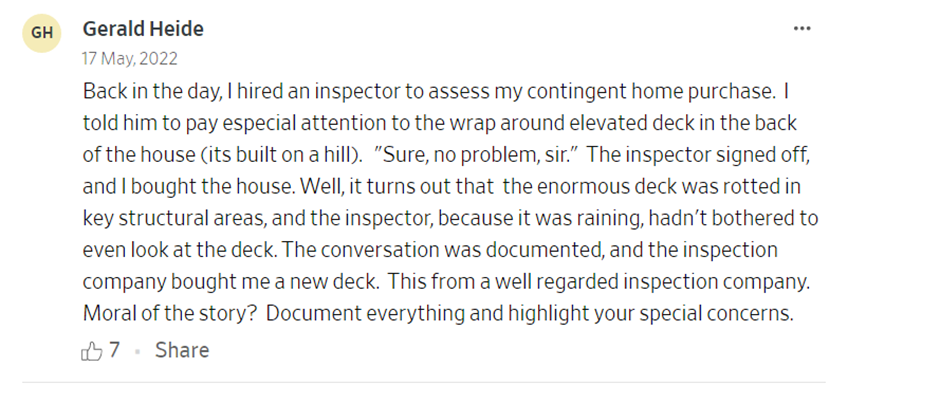
One of the comments on a Wall Street Journal blog showing that a person named Gerald Heide shares their bad or unfortunate experience with a home inspector, who was popular and was from a well-regarded inspection company.

I was going through a home inspection article on Wall Street Journal. I just scrolled through to check the comments and found someone having a not-so-great experience with a well-reputed inspection company. Therefore, during the home inspection process, you should be on your toes and not have a setback just because a certified specialist is by your side.

Get a Thorough Home Inspection Plan and an Estimated Project Cost for Free!

Final Words

Before proceeding, here is what we covered in this blog today.

  • What is a home inspection?
  • Who can do home inspections/who does home inspections?
  • What is checked in a home inspection?
  • Understood home inspector report
  • How does a home inspection help buyers?
  • What is the cost of a home inspection?
  • When is a home inspection required?
  • How to prepare for a home inspection?

And many more questions. Now comes the most important question.

Are you actively looking for a home inspection?

If so, I would be more than thrilled to understand your home inspection requirements and help you out in the process. I am an InterNACHI-certified home inspection specialist with over a decade of experience in the industry.

My entire team follows the Standards of Practice laid down by InterNACHI, which will give you the assurance that, more than anything, your safety and the home inspection process will be taken care of when availing our home inspection services.

Our team provides home inspections in

  • Hillsborough County
  • Manatee County
  • Sarasota County
  • Desoto County

The areas include Bradenton, Sarasota, Riverview, Ruskin, Sun City, Palmetto, Parrish, Ellenton, Lakewood Ranch, Anna Maria Island, Bradenton Beach, Myakka City, Arcadia, Venice, North Port, and everywhere in between.

Here is the communication means:

Phone – (941) 900-3342

Email: hello@flpg.net

Thanks for reading the blog until here, if you did. I hope I was able to value-add and that the blog was worth your time.

Good day!

Sources

InterNACHI:

  1. https://www.nachi.org/sop.htm
  2. https://www.nachi.org/foreclosure-inspections.htm

Thumbtack: https://www.thumbtack.com/

Better Rate Mortgage: https://betterratemortgage.com/do-mortgage-lenders-require-home-inspections/

Bankrate: https://www.bankrate.com/insurance/homeowners-insurance/insurance-inspection/

Orsatti and Associates, P.A.,: https://www.orsattilaw.com/real-estate/sellers-disclosure-obligation-for-property-defects-in-florida/

Zillow: https://www.zillow.com/learn/prepare-for-home-inspection/

Investopedia: https://www.investopedia.com/financial-edge/0511/10-reasons-you-shouldnt-skip-a-home-inspection.aspx

Investopedia:

  1. https://www.investopedia.com/articles/mortgages-real-estate/08/home-inspection.asp
  2. https://www.investopedia.com/terms/h/home-inspection.asp

Nationwide: https://www.nationwide.com/lc/resources/home

State Farm: https://www.statefarm.com/simple-insights/residence/what-a-home-inspector-checks-for-and-whats-not-included

Home City: https://www.homecity.com/blog/should-sellers-be-present-at-the-home-inspection/

Wall Street Journal: https://www.wsj.com/articles/waiving-a-home-inspection-the-aftermath-11652455361#comments_sector

National Association of Realtors: https://www.nar.realtor/home-inspections

National Institutes of Health: https://www.ncbi.nlm.nih.gov/pmc/articles/PMC1580222/

Kaplan: https://www.kapre.com/resources/home-inspection/home-inspectors-help-people


Nate Standifer

Nate Standifer

Nate Standifer is co-founder of Florida Property Group and a Florida-licensed home inspector with 15+ years of experience across telecommunications, low-voltage electrical inspections, and residential property inspections. An InterNACHI Certified Professional Inspector®, he and the Florida Property Group team complete approximately 1,500 inspections annually across Bradenton, Sarasota, Lakewood Ranch, and surrounding Southwest Florida communities.

InterNACHI Certified • RASM Member • SUPRA Access
Buying a new home can be both exciting and overwhelming. 

And for obvious reasons, as while you’re thrilled about your brand-new abode, there’s also a fair share of doubt about its structural quality and strength, among others. 

But what if we told you that there’s a reliable way to skip all the doubts and be 100 percent sure about a property? 

Yes, that’s possible; all you’ve got to do is get a third party inspection for new home by certified home inspectors. 

Whether you’ve already put in an offer to buy a new home or you’re planning on buying one, third party inspections are invaluable. That’s because, with one such inspection, you can acquaint yourself with the property’s true condition from the inside out. 

And with a detailed idea about the home, you make informed decisions about the purchase. 

However, for starters, what is a 3rd party home inspection, and more importantly, how does it help new home buyers? 

Well, let’s have a look up close and understand it in detail. 

What is a third party inspection for new home? 

Home inspections are commonplace when it comes to purchasing an older property. In fact, a contingency clause in these purchase deals even allows buyers to legally get an inspection and even walk away after home inspection in some cases. 

Nevertheless, you can also get a new home inspected before finalizing the deal and making the payment. And this is where third party inspections come into the picture, providing you with in-depth insights into the newly constructed home. 

3rd party home inspection

You see, a new home already undergoes rigorous inspections at regular intervals during construction by both the builders as well as the local county inspectors. This is done to ensure that the under-construction home meets safety and quality requirements in the building codes. 

A 3rd party home inspection, at the same time, is conducted after the construction is complete and when you’re about to close the purchase deal. 

Herein, inspectors follow a similar inspection procedure to examine the various components of the home as they’d in an older home. Also, they’ll provide you with a comprehensive inspection report detailing their findings about aspects such as construction quality, expected longevity of the home, etc. 

What do third party inspections involve in newly constructed homes? 

New as it might sound, a 3rd party home inspection is not different from a regular home inspection. Meaning one such inspection will involve an up-close analysis of the very same elements of newly constructed homes. 

What do third party inspections involve in newly constructed homes infographics

And although inspections in different parts of the country might have certain unique requirements, a lot of new home inspection aspects are common and include: 

  1. Home foundation inspection.
  2. An analysis of the foundation walls and slabs. 
  3. Underground plumbing inspection (both indoors and outdoors). 
  4. Inspection of overground plumbing rough-in. 
  5. Electrical rough-in examination. 
  6. A thorough inspection of final plumbing and electrical systems. 
  7. Doors and windows framing inspection. 
  8. A whole-house insulation review. 
  9. A detailed certificate of occupancy inspection.

Is a third party inspection for new home necessary?  

A third party inspection is not mandatory, which means you can buy a new home and start living in it even without getting it inspected. 

Nonetheless, we suggest you go for one such inspection, as it will give you a clear idea of potential problems that either already exist or might arise in the future. 

A third party inspection for new home is not mandatory

You see, although a local county/municipal inspector examines the home during construction, there are chances that they may miss out on detecting certain code lapses. Similarly, you can’t discount the fact that some problem areas might be overlooked during these inspections. 

Remember that county/municipal officials only check for building code compliance, and they do not conduct a thorough quality check, among other things. 

A third party inspection can turn out to be your savior in these circumstances, looking at every nitty-gritty of the construction and coming out with pin-pointed findings. 

Also, these inspections provide neutral reports, which serve as a guide for both parties to fix existing problems and prevent them from recurring in the future. 

As such, it makes sense to spend a few hundred dollars on a new home inspection before closing to safeguard your investment worth hundreds of thousands of dollars.

What problems does a 3rd party home inspection seek to detect? 

Even though old homes tend to have more issues, newly constructed homes aren’t immune to problems either. So, while you might think that a new home is completely safe and sound, this need not be the case. 

For instance, a lot of times, builders or contractors tend to complete projects hurriedly so as to meet their deadlines. And this can lead them to make certain mistakes, rather inadvertently. 

 home inspector can help you detect underlying problems in the new home

A qualified home inspector can help you detect underlying problems in the new home, which typically includes: 

1. Structural issues 

It is often said that structural problems in a home arise due to the building’s aging. And even if it results in faulty construction, the common belief is that it’s only detected after years when signs such as cracks start to appear. 

However, none of it is entirely true, as structural issues can be detected both during the construction and right after the construction is complete. All you need is a seasoned home inspector to detect these issues and suggest full-proof measures to effectively fix them. 

2. Mold 

Believe it or not, a newly built home can have mold too. 

In fact, there have been various instances of black mold detection in new homes, a rare possibility that can be the worst nightmare for homebuyers. 

So, by getting a new home inspected, you can detect the slightest presence of mold and ask the builder to take effective mold eradication measures. 

3. Inconsistent grading 

A lot of times, construction companies end up grading the site building site incorrectly. And this can have a significant impact on the home’s structural systems. 

Thorough home inspections on new construction are your best bet to detect these inconsistencies in grading and seek reliable fixes. 

4. Faulty electrical wirings 

Another common problem in newly built homes is faulty electrical wiring. Worse, these faults are hard to notice by bare visual examination as wires are mostly concealed under the walls. 

A home inspector analyzes the wirings using sophisticated and non-invasive technologies such as infrared thermography to detect faults and suggest remedies. 

5. Leaky plumbing systems

A leak in the plumbing system can be so insignificant that you wouldn’t notice it for months until it manifests in the form of moisture, wet walls, or seepage. 

A 3rd party home inspection can detect these hard-to-detect plumbing faults and let you know about the problems that they might cause in the future. 

6. Insulation problems 

Inadequate insulation can cause huge problems in the long run. From cold floors to damp walls to increased energy bills, the problems arising out of insulation woes are endless. 

Thankfully, a complete home inspection can help you detect insulation issues in a newly constructed home before they become problematic. 

7. Improper HVAC installation 

An improperly installed HVAC system is not only inefficient but also leads to increased utility expenses. Moreover, a faulty installation can significantly increase the drag on HVAC units and can even cause HVAC failure. 

While the HVAC system in a new home may seem to be in tip-top shape, a third party home inspector detects these installation faults and brings them to your notice. 

You might also want to read: What is a home inspection? (all questions answered)

Why hire a third party home inspector? 

Now that you’re aware of the importance of 3rd party home inspection for newly built homes, you might wonder why you should only hire a third party inspector

And the reason is very simple: third party inspectors are neutral and thus likely to offer you an unbiased opinion on the inspection’s findings. Also, this makes third party inspectors acceptable to builders who’re assured that the inspection company or team doesn’t have special interests. 

A lot of times, the builders may suggest a list of home inspectors, or they themselves might offer to conduct an inspection. But it is possible for such inspectors to have an understanding with the builders wherein they’d try to underplay certain issues. 

As such, the unbiased nature of a 3rd party inspector comes in handy to understand the true extent of problems lurking in a new home. 

What are the third party home inspection requirements? 

When it comes to hiring a third party home inspector, the minimum requirement that you should look for is their license. 

For instance, if you’re looking for a home inspector in Florida, you should check if the inspection company and individual inspectors are licensed to carry home inspections in the state. 

Furthermore, you should look for certifications that the inspection firms or the inspectors carry. That’s because these certifications are a sign that the firm is an acclaimed one with seasoned inspectors. 

When it comes to hiring a third party home inspector

For instance, if a 3rd party home inspection firm carries certifications from renowned institutions, you should definitely consider hiring them. 

In all, you should look for the following certifications in particular:

  • The American Society of Home Inspectors (ASHI) 
  • The National Association of Home Inspectors (NAHI) 
  • The International Association of Certified Home Inspectors (InterNACHI)

How much does a 3rd party home inspection cost? 

According to estimates from the US Department of Housing and Urban Development, a 3rd party home inspection cost for a single-family home can range anywhere from $300 to $500. 

Meaning while the true cost will be determined by the size of the home and the scale of the project, you can expect to pay in the above price range. 

3rd party inspection cost

Should you be present at the time of third party inspection? 

Home inspectors usually don’t mind you being present at the time of inspection unless you interfere with their work. In fact, the inspectors might even encourage you to be present so that they can point out certain issues and their concerns in real-time. 

Also, you can ask your inspectors questions regarding the inspection process and the areas under examination, among others. However, you should make sure not to question them while they’re working. 

Purchasing a home is indeed one of the biggest transactions you’re about to make, and home inspectors understand it. 

And towards that end, inspectors ensure that they cooperate with you and acquaint you with potential problems and their solutions. 

You might also want to read – Mobile Home Inspection Checklist: Everything To Know About.

Get a Thorough Home Inspection Plan and an Estimated Project Cost for Free!

Conclusion 

As you can see, a third party inspection for new home can detect problems lurking below the surface before they become big. Also, it can suggest to you, as well as the builder, the best course of action to address the problems effectively. 

Not to mention the fact that 3rd party inspections are completely unbiased in nature, which means you can rest assured to find the true extent of problems. 

In fact, its neutral nature makes these inspections completely worth the investment. More so, for a few hundred dollars, you’re able to safeguard your property worth hundreds of thousands. 

Looking for one such 3rd party home inspection for new build property? 

You can get in touch with us!

At Florida Property Group, we’re seasoned experts with over a decade of experience in inspecting single-family homes, among other properties. Meaning whatever your home inspection requirements are, we’ve got them all covered. 


Nate Standifer

Nate Standifer

Nate Standifer is co-founder of Florida Property Group and a Florida-licensed home inspector with 15+ years of experience across telecommunications, low-voltage electrical inspections, and residential property inspections. An InterNACHI Certified Professional Inspector®, he and the Florida Property Group team complete approximately 1,500 inspections annually across Bradenton, Sarasota, Lakewood Ranch, and surrounding Southwest Florida communities.

InterNACHI Certified • RASM Member • SUPRA Access

It’s usually said that all-inclusive home insurance is a prerequisite for homeowners. And rightly so, as an insured home prevents big-ticket expenses in unforeseen events such as fires, floods, storms, thefts, etc. 

Simply put, insurance coverage can be your source of overall well-being and peace of mind. 

But things aren’t that simple when it comes to insuring your home. That’s because insurance companies in Florida call for a mandatory 4 point home inspection before they can provide any insurance coverage or renew existing ones. 

So what is a 4 point home inspection, and what does it cover? 

And more importantly, how is one such inspection different from full home inspections

Well, let’s dive right in and find out. 

What is a 4 point home inspection in Florida? 

As the name suggests, a 4 point inspection covers the four most critical aspects of your home, namely roofing, plumbing, electrical, and HVAC systems. 

Herein, a certified Florida home inspector carries out an extensive analysis of the above four areas of your residential property. And this includes extensive tests and assessments before the inspectors can compile a report detailing their findings. 

what includes in 4 point inspection

Now, the inspection report typically details the condition of these four facets and verifies the following: 

  1. If these systems are in optimum condition. 
  2. If these systems need repairs (small or big). 
  3. If these systems need to be replaced entirely. 

Note: All residential properties in Florida need to undergo a 4 point inspection for an insurance cover, including single-family homes and condominiums, among others. 

What is the purpose of a 4 point inspection in insurance? 

As we discussed earlier, insurance companies across the state have a very clear policy wherein they mandate a 4 point inspection for all insurance applications. 

Meaning whether you want a new insurance policy after buying a home or you’re simply looking to renew your home insurance, an inspection is necessary. 

But have you ever wondered why your insurer needs an inspection report in the first place? 

You see, not only are the areas such as roofing, plumbing, HVACs, and electrical wirings very crucial, but they’re also too expensive to repair. And to that end, a thorough inspection report helps insurance firms calculate the extent of their liability in the event of damage. 

For instance, Florida-based insurance companies are usually quite selective in renewing or providing new coverage to residential properties dating four years or older. That’s because there’s a good chance these homes have underlying issues with HVACs or electrical systems, among others. 

Also, the companies are wary that problems might emerge in the future, even if there are no issues at present. 

So, an inspection report helps these companies analyze the financial risks involved in providing insurance coverage to your home, both at present and in the foreseeable future.

Bonus: Apart from insurance companies, 4 point home inspection also comes in handy for homebuyers investing in a property. The report helps you decide whether or not the property is worth investing in. 

You might also want to read – When To Walk Away After Home Inspection

What is involved in a 4 point home inspection?

Now that you’ve seen what is a 4 point home inspection, you might well wonder what it involves.  

To put it simply, a 4 point inspection is all about roofing, plumbing, HVAC, and electrical inspection. 

However, it is essential that you’re aware of the nitty gritty of these inspections. 

After all, a detailed understanding of what an inspector might look for will allow you to review and fix the underlying issues beforehand. Also, it’ll give you an upper hand in seeking insurance coverage as your home inspection report will assure the insurer of minimal financial risks. 

So let’s have a look up close at what is included in a 4 point home inspection

1. Roofing inspection 

You’ll agree when we say that roofing is indeed one of the most essential aspects of your home. That’s because apart from being a vital component of the home’s structural system, the roofing also influences overall resilience and efficiency. 

As such, it’s not surprising why roofing tops the list of 4 point home inspection checklists.

Now, when inspecting the roofing system of a home, the inspectors look for possible issues that can pose dangers to the structure and safety risks to occupants. Herein, they analyze factors such as the roof’s age, signs of damage or degradation, leakages, etc. 

Also, the inspectors will work to detect signs of mold and mildew in the roofing. 

Not to mention, a roofing inspection might even involve analyzing the energy efficiency of the shingles as it has a direct impact on the HVAC systems. 

Bonus: You can fix your roofing and pass the inspection. Here’s how: 

4 steps to pass roofing inspection infographics

Apart from quick and favorable insurance coverage, a safe and sound roofing system is also essential for your overall safety. 

And you can ensure both by detecting and fixing the following issues before a roofing inspection: 

A. Replace aging roof shingles

If your roofing is older than 20 years, there are chances of curls, cracks, and even missing shingles. So, we suggest that you replace your shingles with a solid and efficient roofing system. 

B. Replace or repair degrading roofing 

It is common for older roofs, as well as roof shingles not properly installed, to show signs of degradation. And even if these signs show up at concealed locations, it doesn’t take long before the roofing inspector detects and flags them in their report. 

Meaning you should look for such signs beforehand but also fix them by either replacing the shingles or repairing them if the problems are minor. 

C. Fix leakages 

Leakages can occur due to various reasons ranging from cracks to poor design. However, it is important to get them fixed in time for a seamless experience with insurance companies. 

D. Fix faulty roofing structure (if any) 

The structure of your roofing goes a long way to ensure safety during adverse weather conditions. And although less likely, it is possible that a faulty installation may cause issues with the roof structure. 

Insurance companies take structural issues very seriously, and to that end, we suggest you fix them before reaching out for insurance. 

2. Plumbing inspection 

Another major area of 4 point home inspection is the plumbing system of your home. 

You see, a broken or leaking plumbing system can damage the building’s other vital areas, such as walls, floors, etc. So, your home inspector will be very watchful when inspecting the plumbing. 

The inspectors, in particular, look at the material with which the plumbing lines or pipes are made, along with signs of aging. Also, they look for leakages and try to determine the extent of damage it has caused or is likely to cause.

In short, the inspection will determine how robust your plumbing is and how likely it is for the system to break or burst.   

For instance, a plumbing line made of polybutylene pipes carries more risks of bursting compared to traditional plumbing. And that’s exactly why a lot of insurance companies deny coverage to homes with polybutylene lines. 

Moreover, even if an insurer covers your home, they’ll not cover any water damage. 

So, in such a situation, a plumbing inspection gives an idea to the insurance firms about the extent of risks involved in providing you with coverage. 

You might like to read: Do home inspections check for asbestos?

3. HVAC (heating, ventilation, and air conditioning) system inspection

The HVAC system in your home is crucial as the indoor climate hinges on its effectiveness and quality of installation, among others. 

It also goes without saying that the HVAC system is expensive and, thus, an area of attention for insurance companies. 

Now, HVAC issues such as aging systems and faulty installation are common in homes. And not only does this lead to other problems, such as dust build-up and deteriorating air quality, but it also leads to costly fixes. 

As such, a home inspector carries out a two-faceted analysis of the HVAC system, namely: 

A. Functionality of the HVAC units 

The inspectors typically start an HVAC inspection by looking at the functioning of the units and determining how effective the overall system works. 

For instance, an inspector can look at the levels of heating and cooling along with the effectiveness of ventilation systems. Also, they can try to detect faulty or broken-down components of the system.  

They’d then compare these findings with that of a standard residential HVAC to pinpoint the underlying issues. 

B. System’s age and installation quality

Another thing that inspectors examine during an inspection is the age of the HVAC system and the quality of workmanship. 

Firstly, the age and condition of the system allows them to determine how long it will last you without causing any problem.

Secondly, the installation quality lets the inspections predict how often you’d need to maintain the system. 

Note: Your fireplace, window air conditioners, oil furnaces, etc., are not usually not considered as part of the primary HVAC system. 

Pro tip: If your HVAC system is older than 20 years, we suggest you replace it with a new and more efficient system. 

4. Electrical system inspection

A crucial part of the 4 point home inspection checklist, electrical system inspection ensures overall occupant safety, apart from helping insurance companies decide on coverage.

To start with, an electrical inspection involves examining whether or not the wirings and panels are installed properly and meet local code requirements. In fact, a code violation or improper installation, notwithstanding its scale, will prompt the inspectors to mark it as a failed system.

Furthermore, an electrical inspector will also examine if all the outlets are appropriately grounded and that the overall system is optimum for your home. 

Wondering why inspections are so heavy-handed towards electrical systems? 

Well, faulty electrical systems are the source of over 90 percent of fires in homes. So, unsurprisingly, insurance companies are very serious about all things residential electrical components. 

Not to mention, insurance rejections are also the highest for homes with electrical problems. 

Meaning it’s wise to detect and remedy the electrical issues with the help of a seasoned infrared thermography inspector before applying for insurance. 

You might like to read: What is a home inspection? (all questions answered)

How to prepare for a 4-point inspection? 

Complicated as it might seem, preparing for a 4 point home inspection in Florida is simple. All you’ve got to do is check out the four areas due to be inspected. 

How to prepare for a 4-point inspection

Here’s how you can prepare these areas for an inspection: 

1. Have a closer look at the shingles

Your roofing system might have some broken, damaged, or missing shingles, which you should replace with new shingles. 

Also, you can look for visual signs of water damage or holes in the roofing arising out of poor workmanship and fix them. 

Note: While it makes sense to replace the shingles entirely for roofing systems older than two decades, we suggest you do so only after consultation with your home inspector. 

2. Look for signs of plumbing damage 

Plumbing damage can manifest itself in the form of leakages, water-induced wall damage, degraded pipelines, etc. 

And the worst thing is that even minor or insignificant damage can make the insurance firms sound caution, leading to the denial of insurance. So, it’s best to fix all the plumbing issues that you can visually detect beforehand. 

3. Always be on the lookout for electrical problems 

As we discussed earlier, the importance of electrical safety is not limited to insurance inspections. And towards that end, frequent analysis of electrical systems and general alertness is a prerequisite. 

You can look for obvious signs of electrical woes, such as exposed wires, aluminum wiring, fuse boxes, double-tapped breakers, etc. That’s because these pose a significant electrical fire hazard and need to be fixed or replaced with safe components. 

4. Run your HVAC system and notice its operation 

To prepare your HVAC units for inspection, we suggest you run the system and observe potential issues such as the efficacy of heating and cooling systems, the working of vents, etc. 

4 point home inspection vs. full home inspection: What’s the difference? 

When we talk about what is a 4 point home inspection, there’s a good chance you’d confuse it with a regular home inspection. 

And although both inspections involve some of the most crucial aspects of your home, they’re different in terms of scope and purpose. 

4 point home inspection vs. full home inspection

So, let’s see how the two types of inspections differ from one another: 

1. Scope 

To begin with, the extent of 4 point inspections is very limited in comparison with full home inspections. That’s because while the former covers roofing, plumbing, electrical, and HVAC systems, the latter involves inspection of a property in its entirety. 

2. Purpose 

Secondly, the purpose of the two inspections is different too. 

For instance, a 4 point inspection is conducted to examine the integrity of homes at the time of insurance application or renewal. 

Nonetheless, a full home inspection is usually conducted by prospective homebuyers at the time of purchasing a property. 

3. Mandatory insurance requirement 

Insurance companies in Florida and some other states require homeowners to conduct a 4 point inspection at the time of renewing or availing a new policy coverage. 

On the contrary, a full home inspection is not necessary for homeowners seeking insurance. 

4 point inspection vs. wind mitigation inspection: What’s the difference? 

While 4 point and wind mitigation inspections are often mentioned together, they’re quite different from one another. 

For instance, a wind mitigation inspection looks at the roof’s shape, deck attachment, covering, protection systems, etc. This determines how effectively your home can weather extremities. 

And even though 4 point inspections look at the roofing, wind mitigation inspections go further to examine other structural systems, too.  

In fact, a wind mitigation inspection together with a 4 point inspection can indeed help you secure favorable insurance terms. 

Sounds interesting, doesn’t it? 

How much does a 4 point home inspection cost? 

According to Insurify, a 4 point home inspection cost can range anywhere between $50 and $150. 

However, these are average figures and the actual cost will depend on the size of the property and the scale of the project. 

You might also want to read – Mobile Home Inspection Checklist: Everything To Know About

Conclusion 

As you can see, a 4 point home inspection isn’t like the regular full-fledged property inspections that cover every nook and corner of your home. 

Nevertheless, it is a handy method to examine some of the most critical facets of a home that too quickly and on a shoestring budget. 

Talking about what is a 4 point home inspection in Florida, it’s simply a mandatory inspection that homeowners are needed to undertake so as to be eligible for insurance coverage. And that’s exactly why these inspections are also often abbreviated as insurance inspections. 

Looking to undertake a 4 point inspection for insurance or any other purpose? 

You can get in touch with us!

At Florida Property Group, we are seasoned experts with over a decade of experience in carrying out insurance inspections across South Florida. So, whatever be the size or type of your property, we’ve got your back. 


Nate Standifer

Nate Standifer

Nate Standifer is co-founder of Florida Property Group and a Florida-licensed home inspector with 15+ years of experience across telecommunications, low-voltage electrical inspections, and residential property inspections. An InterNACHI Certified Professional Inspector®, he and the Florida Property Group team complete approximately 1,500 inspections annually across Bradenton, Sarasota, Lakewood Ranch, and surrounding Southwest Florida communities.

InterNACHI Certified • RASM Member • SUPRA Access

Investing in a home is indeed one of the biggest financial commitments. And to that end, you certainly want to make sure it’s the perfect piece of real estate that you’re putting your hands on. 

A pre-purchase home inspection is one of those ways you can learn about a property from the inside out. However, it’s also essential to know when to walk away after home inspection. 

You see, while an inspection is your chance to know about a property’s hidden issues and bring them to the existing owner’s knowledge, some problems are beyond repair. 

In short, it’s better to walk out of the deal sometimes than call on the homeowner to fix the problems or renegotiate the deal. 

Now, when it comes to the if and when of walking out of a purchase agreement, it’s common for homebuyers to be puzzled. 

Nevertheless, you can rest easy as we’ve compiled everything about post-inspection walkouts. Read on as we delve deep into your options both before and after home inspections.


Can you back out of a house offer after inspection?

As a homebuyer, you might find yourself asking, “Can I back out of buying a house after inspection?”

So before we get into the nitty gritty of situations that call for a backing out, let’s first try to understand what your rights are. 

3 reasons to walk away after home inspection

Simply speaking, it is possible to walk away from the deal after an inspection if you find yourself unsatisfied with the report or the homeowner’s response. 

For instance, if the owner is unwilling to undertake essential repairs or consider a renegotiation in lieu of the damage, you can certainly back out. Similarly, if the home has damages or problems that can’t be fixed reliably and permanently, it’s time you take back your offer. 

But to be able to back out of a real estate deal or even conduct an inspection, it’s essential you include an inspection contingency clause in the buy-sell agreement. 

Let’s see what this clause is all about and how you can benefit from it. 

Inspection contingency: Your legal remedy for backing out after home inspection

An inspection contingency, also called due contingency, is a legal clause included in real-estate buy-sell agreements. And it is this clause that allows you to hire a professional home inspector and get the property thoroughly inspected in a specified time frame. 

Also, the clause allows buyers to back out of the purchase offer without paying any penalty if the inspection finds major defects. 

The inspection contingency clause

Here are some rights that an inspection contingency clause offers to homebuyers: 

  1. Pre-purchase home inspection by a licensed inspector. 
  2. Reasonable requests after home inspection Service involving repair of damages from the existing homeowner’s end. 
  3. Reasonable request regarding renegotiation of the deal in an event where the owner fails to address the problems. 
  4. Right to walk away after a home inspection. 

Nonetheless, it is important to know that you can only use the clause in unforeseen situations, such as irreparable damage or significant safety issues, among others.

Pro tip:Whether you’re buying a newly built or a previously owned home, we suggest you include an inspection contingency or due diligence clause in the purchase agreement. That’s because a lack of this clause can deny you an inspection as well as your right to walk away post-inspection.


When to walk away after home inspection?

A home may appear in tip-top shape from the outside and might even be promoted as prime real estate in the area. However, it is always possible that the property has some significant issues lurking under its surface. 

For instance, Realtor Magazine studies suggest that 65 percent of all newly constructed homes undergoing inspection discover some issue or another. 

Moreover, the same studies also found that 24 percent of newly purchased homes didn’t even pass the inspection threshold for safety and functionality. 

Meaning it is of foremost importance to know when to walk away after home inspection by involving the contingency clause. 

Now, if you’re wondering what should be your reasons not to buy a house after inspection, we’ve put together a complete list of red flags that call for a walkout. So let’s have a look up close. 

1. Foundational problems

The foundation is, without a doubt, the most critical component of your home. That’s because not only does the entire structure stand on the foundation, but it also relies on it for safety. 

In fact, it’s for this reason that the foundation is among the first things to be inspected during a home inspection. 

So, no wonder why underlying foundational problems are a major alarm bell at the time of pre-purchase inspections. 

But not all foundational issues should concern you. 

Take, for instance, foundational shifts and changes that happen over time. This doesn’t endanger the building in any way and is considered mostly safe. 

However, problems such as small or big cracks, water seepage or penetration, foundation damage, etc., are worrying signals. 

We suggest you consult with the home inspector to determine whether these problems are repairable. Also, if these issues are too complex to fix, it makes sense to walk away from the deal. 

2. Water-induced damages

Problems arising out of water leaks or infiltration are among the most common issues detected during a home inspection. And even though water isn’t the number one enemy of your home, it’s a sign of some major hidden problems. 

For instance, seepages can result from broken or faulty water supply, drainage, and sewage lines. Also, faulty or outdated plumbing and leaking water tanks, among other factors, can be to blame. 

Now, these problems don’t pose a significant concern and can rather be fixed reliably to last for decades. 

But water damage can also be a result of exposure to elements, which can, at times, be a huge problem. You see, not only does this let water, air, and moisture enter your home, but it also risks structural damage. 

As such, it is a reasonable ground for backing out after home inspection. 

3. Termite infestation 

A termite-infested home can be your biggest nightmare as it can result in fat check losses and might even damage your home big time. 

So, can you fix the problem arising out of termites, and more importantly, should you walk away from a house with termites

To start with, you can detect termites and quantify the extent of losses they’ve caused during home inspection. 

However, the only reliable way to know the true extent of termite infestation and damage is by removing all the finished materials in the home. And that is something that home inspections typically don’t include. 

Furthermore, even if you’ve got to the bottom of the termite problem, an effective termite treatment can cost you another $1000

In short, buying a home with termite issues is undoubtedly a risky endeavor and can cost you dearly. Thus, it’s best to walk away from such a home rather than trying to fix it. 

4. Electrical problems 

Did you know that home fires, on average, account for 51,000 fire accidents every year

The reasons range anywhere from faulty electrical wirings to lack of safety measures to outdated wires and more. 

So don’t be surprised if your home inspector advises you against buying a house with electrical issues. 

Electrical problems can manifest in different forms during an infrared thermography home inspection, including loose hanging wiring, taped wires, DIY or unprofessional electrical additions, etc. Also, signs of previous fire-related damage covered up with a fresh coat of paint are a huge red flag. 

Fixing electrical problems effectively after an inspection isn’t cheap either, and your bills run into thousands of dollars. 

And the worst part is that you’ll always be at risk of major electrical or electricity-related accidents. That’s because there’s no guarantee of 100 percent safety unless you get the entire electrical system professionally replaced. 

Meaning it’s best to back out of the deal if you spot major electrical problems during the inspection. 

5. Shady or illegal home additions 

It is not uncommon for homeowners to upgrade their homes over time for convenience and comfort. In fact, in 2022, over 55 percent of homeowners reported having renovated their homes to some extent. 

As such, home additions are really a problem when you’re purchasing a previously owned home. 

But that doesn’t mean you shouldn’t be on the lookout for upgrades that are shady or don’t meet the local code requirements. 

For instance, your home inspector might detect such additions that violate building codes. And not only do such upgrades bring hefty county-imposed penalties, but they also risk the safety and well-being of residents. 

So, if you’re wondering when to walk away after home inspection from such properties, you should do so the moment you spot an illegal upgrade. 

6. Roofing issues 

Roofing makes up about 40 percent of a home, which means it should be a priority during home inspections. 

Now, if damages are detected within the roofing system, this could be a sign of some major problems with not just the roofing but also the entire building. Also, fixing these problems can be very expensive and time-consuming. 

Similarly, the inspectors can also detect aging roofing or roof shingles nearing the end of their service life. This is especially true for the older homes dating back to two decades or more. 

And in such a situation, replacing the entire roofing can break the bank. Also, the seller not willing to negotiate after inspection will only worsen the deal. 

As such, backing out after home inspection might be the best course of action in these circumstances. 

7. Mold detection 

A home inspection also offers a chance to detect the extent of mold in a home, among other things.  

However, the presence of mold shouldn’t be reason enough for you to cancel the deal altogether. More so, you can find traces of mold in the best of homes in perfect shape. 

But there are some exceptions as well. 

For instance, if you discover some major damage caused by mold or potentially harmful mold, such as black mold, it’s best to walk out of the deal. 

8. Problems with sewer lines 

Issues with the sewer lines are commonplace in old homes. Herein, corroded or clogged sewer lines cause most of the problems. 

Seeking a sweater system repair or a renegotiation of the deal from the seller is among the reasonable requests after home inspection. 

However, if the seller is willing to act on either of the requests, you should definitely back out of the purchase. That’s because fixing the sewer issues at your own expense can be a costly affair. 

9. Significant damages

Apart from the above issues, if you notice major damages such as cracking walls and floors, windows and doors not closing properly, etc., we suggest you walk away. 

You see, while cracks may signal a structural problem, doors and windows not aligning are a sign that the home might be sinking. 

You might like to read: Mobile Home Inspection Checklist: Everything to Know About

Some FAQs about when to walk away after home inspection: 

1. Can seller walk away after inspection?

One of the common queries that homeowners have is whether the seller can back out of the deal after inspection. 

A short answer to this is: no, sellers can’t back out or refuse to sell you the property. 

However, it goes without saying that the seller might refuse to undertake essential repairs or renegotiate the deal. And that’d leave you with no option but to walk away from the deal. 

2. What should be done after an inspection? 

If you find yourself asking what to do after home inspection, here are a few things you can do: 

  • Go through the findings of the inspection report and acquaint yourself with the potential problems. 
  • Send a copy of the inspection report to the existing homeowner or the seller. 
  • Bring the issues highlighted in the report to the seller’s notice. 

3. What is reasonable to ask for after home inspection? 

The inspection contingency clause provides you with various post-inspection options. Here are some things you can reasonably ask the existing homeowner after an inspection: 

  • A reasonable request to undertake essential repairs and fixes. 
  • A reasonable request to negotiate the purchase agreement again in case the owner refuses essential repairs. 

4. How often do buyers back out after inspection? 

As per the National Association of Realtors, about 10 percent of purchase agreements fail after a home inspection. 

An overwhelming majority of 90 percent of deals still go through after a series of renegotiations. Meaning there’s a good chance your purchase agreement will sail through. 

Conclusion 

As you can see, the question about when to walk away after home inspection is a complex one with no straightforward answer. 

Nevertheless, with our extensive experience in pre-purchase home inspections, we have highlighted some of the major red flags that should alarm buyers. And while these situations don’t often call for canceling your purchase deal, backing out is the right option a lot of times. 

Looking for a comprehensive inspection to assure yourself before you purchase a home? 

You can get in touch with us!

At Florida Property Group, we’re seasoned professionals with over a decade of experience in inspecting a wide range of homes and buildings. So whatever be your inspection requirement, we’ve got you covered. 


Nate Standifer

Nate Standifer

Nate Standifer is co-founder of Florida Property Group and a Florida-licensed home inspector with 15+ years of experience across telecommunications, low-voltage electrical inspections, and residential property inspections. An InterNACHI Certified Professional Inspector®, he and the Florida Property Group team complete approximately 1,500 inspections annually across Bradenton, Sarasota, Lakewood Ranch, and surrounding Southwest Florida communities.

InterNACHI Certified • RASM Member • SUPRA Access
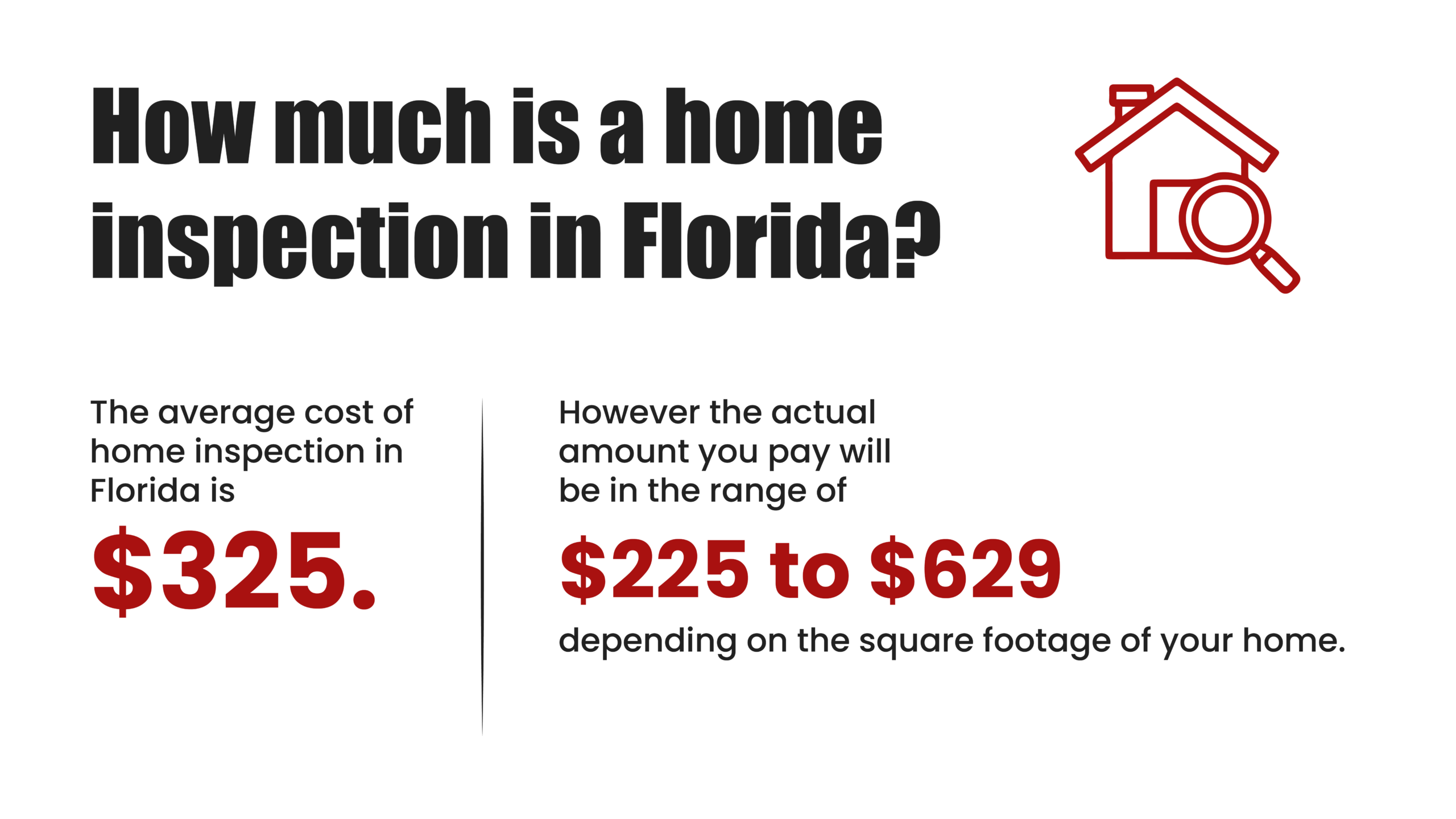
Among all things housing, mobile homes are the trendsetters. And for good reasons, as these homes offer all the features of a traditional home but on a shoestring budget. 

In fact, a mobile home can be as good as the most premium villas out there, thanks to the limitless personalization options. 

So if you’re looking to buy one such prefab home, get ready to be a part of a 22 million-strong coast-to-coast community who’ve made these houses their homes. 

However, there’s a catch. 

A comprehensive home inspection by following a reliable mobile home inspection checklist is a must-have when buying these homes. And this is all the more essential when buying a used home. 

You see, like with a regular home, there can be a lot of structural and other issues in mobile homes that are hard to detect by the naked eye. Meaning even though a home looks perfect from the outside, it might have several underlying problems.

As such, it’s important to hire a licensed home inspector and get all the checklist items inspected thoroughly. 

Now, if you’re wondering what this checklist looks like, you’re at the right place. Read on as we’ve dwelled upon every aspect of mobile home inspection and more.

What is a mobile home in the first place? 

Mobile homes are value for money

Before we get into the nitty gritty of mobile home inspection, it’s important for you to understand what these homes precisely are. 

To put it simply, a mobile home is a prefabricated home that is built in a factory, unlike regular homes that are constructed on-site. Once built, it is transported to your property, where installation experts attach the different parts, such as the wall and roofing panels and set up the entire structure. 

And this is exactly why a mobile is also called a manufactured home, with both terms being used synonymously.  

Also, contrary to conventional houses, a prefab home is made with lighter materials and usually has a smaller HVAC system. 

Note: A mobile home is different from a trailer home

While trailer homes are smaller and narrower, mobile or prefab homes can be as large as a traditional family home. Similarly, mobile homes serve as permanent residential spaces, while trailers are meant for short-term use.


Why get a mobile home inspected? 

An in-depth inspection of manufactured homes at the time of purchase and at regular intervals is a smart move that goes a long way to ensure overall safety. 

Moreover, when buying a pre-owned mobile home, an inspection ensures that you not only invest in the right place but make the most out of it. 

You see, while a home may look in top shape from the inside out and might even be priced at a premium for the same reason. However, it can still have some inherent problems that can range anywhere from minor plumbing woes to severe electrical or structural faults. 

Worse, you can’t detect these problems from the naked eye, which only lets them amplify over time and pose serious safety hazards to the residents. 

By hiring a seasoned mobile home inspection team, you can detect all the hidden issues with precision. And this, in turn, will allow you to make a well-informed decision on your purchase. 

Bonus: Always include a home inspection contingency clause in your contract

Looking to buy a pre-owned mobile home? 

We suggest you include a home inspection contingency clause in the purchase contract. 

This contract allows you to conduct a detailed inspection as per the used mobile home inspection checklist. 

Also, it lets you renegotiate the entire purchase agreement, including the pre-agreed cost. Meaning you can either ask the seller to fix the problems flagged in the inspection or reduce the cost of the property. 

Moreover, you can also roll back your purchase offer and back out of the deal if the inspection flags issues in the property. 

After all, buying a home calls for a fat cheque investment. And you want it to be full-proof, don’t you? 

Mobile home inspection checklist: Here’s what you need to lookout for

Mobile home inspection checklist

Now that you’ve seen why it’s so crucial to get a mobile home inspection, you might be wondering how you can get such homes inspected. 

So let’s have a look at the prefab home inspection checklist in detail and see what needs to be examined and why. 

1. Home foundation inspection

While a foundation inspection is an essential component of any home inspection checklist, it becomes even more important in manufactured homes. 

Why? 

Well, one of the major differences between a conventional and a mobile home is the foundation, which in the latter’s case is quite peculiar. 

Unlike regular home buildings, a mobile home is built upon a chassis, which is then integrated into the foundation. 

Talking about the mobile home foundation itself, it can be anywhere from concrete blocks on crushed rocks to a pier and beam-based foundation. 

So when it comes to inspecting the foundation, there are a few things you should keenly observe, including: 

  • The condition of the chassis 

To start with, you can have a look at the chassis of the home and try to spot signs of damage, such as rust, cracks, curls, etc. If you don’t detect these signs, it means the chassis is in good condition and can support the home’s structural systems for years.

  • The condition of the foundation 

Whether the home has a concrete or a pier and beam foundation, a close examination is necessary as no foundation is immune from damage. 

Look for signs such as cracking, spalling, seepage, etc. Also, make sure you check whether or not the frame anchors or tie-down straps have loosened. 

Additionally, you should also conduct a strength test of the foundation to see if it can handle the weight of the home. That’s because a weak foundation can start sinking into the ground in no time, more so in conditions such as wet weather and soft soil. 

  • Local code compliance

Lastly, it’s essential to check if the foundation of a prefab home complies with the local codes. 

While some municipal laws allow for concrete-based foundations, others permit pier and beam foundations. However, it is possible that some mobile homes aren’t compliant. 

Thus, we suggest you check if the foundation complies with the local laws, as the legal consequences of non-compliance can be severe. 

2. Flooring inspection 

Another major area of inspection in manufactured homes is the flooring. 

These homes have a frame-based flooring system, which is made up of either wood composite decks or plywood sheets placed atop floor joists. And although the floors have built-in protection systems such as moisture barriers and floor coverings, they’re still exposed to wear and tear. 

Furthermore, the fact that mobile homes aren’t constructed on a regular foundation means that the bottom portion of the flooring isn’t protected from the elements. 

So you should look for signs of flooring damage such as soft spots, waviness, seeping or pooling water, holes, etc. Also, it’s clever to check whether or not the flooring meets the HUD specifications for quality and rigidity. 

3. Water damages 

Mobile homes are highly vulnerable to water-induced damage. And that’s especially true for the wet and humid weather that lays bare these homes to a lot of waterborne issues. 

Water damage can manifest in different ways, including leaking or staining roofs and windows, mold in wall cavities, gutters overflowing, etc. Similarly, mobile homes with metal roofs may exhibit signs like rusting and cracking, which are also water damage symptoms. 

All of these damages can lead to severe structural woes and, in worse cases, could even lead to partial or total structural collapse. Add to it the several CDC-identified health risks that it poses, and you’ve got a serious problem at hand. 

As such, we can’t overstate the importance of looking for these damages during the inspection and flagging them to the seller. 

4. Electrical systems 

Mobile home fire infographic

Did you know that about 13 percent of all household fire accidents are caused by electrical failures or malfunctions? 

To put it straight, you can’t ignore the electrical components of a mobile home during pre or post-purchase inspection. 

In fact, the importance of electrical safety inspection is such that it’s a part of both mobile and trailer home inspection checklists. 

However, given the complex nature of electrical inspection and the risks it carries, we suggest you leave it to licensed professionals and don’t try to carry out the inspection yourself. 

You can, nevertheless, look for certain signs of electrical damage or failure, such as damaged or hanging wires. Similarly, you can also look at the breaker panels and check if they comply with the local codes. 

A lot of mobile homeowners prefer DIY electrical repairs, making extension cords and hanging wires commonplace. Be on the lookout for such things, as they are clear signs of electrical safety risks.

5. Doors and windows 

The doors and windows can provide signals about how structurally sound a mobile home is, apart from determining insulation levels and moisture resistance. 

And that’s exactly why we have a door and window inspection as an essential mobile home inspection checklist item. 

Firstly, you can check the sealings on doors and windows. The easiest way to do so is to see if daylight or artificial light penetrates through the sealants. 

If the sealing is damaged, there’s a good chance that the home’s interior space is exposed to mold and mildew. 

Secondly, you should inspect the windows and see if they’re well insulated. More so since mobile homes have single-pane windows, and chances are that they’ve not been insulated properly. 

Thirdly, and most importantly, see if the doors and windows align and close properly. If they don’t, it’s a sign that the home’s functional or structural systems are fragile and the home is sinking. 

6. Vapor or moisture barrier inspection 

A vapor barrier is considered the first line of defense in mobile homes. And rightly so, as this barrier prevents damage to the home’s surface from elements beneath the ground. 

As we saw earlier, manufactured homes lacking a traditional foundation have their underside exposed to elements, thus making the vapor barrier critical. 

You can inspect the vapor barrier by looking for signs of declamation, sagging, etc., as these issues hint at potential wood subfloor damage or mold infestation. 

Nonetheless, most of these issues are common and can be easily remedied by changing the vapor barrier. 

7. Wall inspection 

A wall inspection in a mobile home involves a close examination of all the walls inside out. Herein, you can begin by simply walking across all areas of the home and pushing the walls at places to check whether they’re wobbling. 

Similarly, you can look at the type of sidings used in the wall to develop an understanding of potential damage. 

For instance, while wooden siding walls have leakages at seams and joints, those with metal sidings have potential leakages at doors and windows. 

Note:

A load-bearing wall is essential in double-wide mobile homes. So if you’re buying one such home, don’t forget to check whether or not it has a proper load-bearing wall.


8. Ceiling and roofing inspection

Although it seems hard, inspecting the ceiling and roofing in mobile homes is simple. All you’ve got to do is visually spot issues such as stains, sags, etc. 

In the same way, you can look for signs of corrosion and rusting in metal roofing shingles. 

Note:

Sagging in the ceiling is a sign of serious structural problems and poses a major safety hazard. So much so that such a ceiling can even collapse.


9. Septic inspection 

Inspecting the septic tank isn’t usually a part of a used mobile home inspection checklist unless you’re planning on staying put at the same property. 

Also, a septic inspection involves examining the septic tank as well as the sewer lines through a thorough inspection procedure. As such, this should be left to the expertise of home inspection service providers

Mobile home inspection checklist: Things to consider 

  • Closely examine new/DIY additions 

When buying a used mobile home, it’s essential that you carefully analyze the add-on sections. 

Why, you might wonder? 

You see, unlike traditional homes, manufactured homes usually aren’t as big and spacious. So it’s common for homeowners to build additional sections, mostly using DIY methods and techniques. 

The problem is that most of these home additions are done on the foundation designed to support the original structure. Also, DIY construction can have its own faults and might not be in accordance with safety norms. 

As such, it’s important you analyze two things in particular: 

  • First, whether or not the additional sections are built on a separate foundation. 
  • Second, the DIY construction has followed all the local codes and passes safety tests. 
  • Look for DIY electrical work 

Beware of DIY electrical works in used mobile homes infographic

Like we discussed earlier, many mobile homeowners prefer DIY electrical work over hiring a professional electrician. And this can involve rookie mistakes, faulty installation, use of unsafe aluminum wires, absence of GFCI protection, etc. 

So you should be on the lookout for such electrical systems in particular. 

  • Some factory-made homes are easily damageable 

A common problem with a lot of manufactured homes is the lack of sturdiness. Unfortunately, mobile home inspections often fail to take into account this factor. 

While not a part of the home inspection checklist, factoring in the strength of the home is essential, as a highly sturdy mobile home will stand strong in extreme weather events. 

Conclusion 

Whether you’re buying a mobile home or residing in one, regular inspections in line with a mobile home inspection checklist are a prerequisite. That’s because not only do these inspections ensure you invest in the right property, but they are also critical for occupants’ safety. 

Looking to conduct a thorough inspection in one such manufactured home?

You can get in touch with us!

At Florida Property Group, we are Southern Florida’s most seasoned home inspectors. And we specialize in all mobile home inspection checklist items and more. 

In short, we’re the one-stop shop for all your home inspection needs. 


Manufactured Home Inspections in Manatee and Sarasota Counties

Florida Property Group inspects manufactured and mobile homes throughout Ellenton, Palmetto and Englewood. Depending on accessibility, these inspections may include visible foundation supports and anchoring components, under-home moisture barriers, additions, electrical and plumbing systems, roofing, HVAC equipment and signs of moisture or deterioration.

Review our home inspection services or schedule a manufactured-home inspection.

Nate Standifer

Nate Standifer

Nate Standifer is co-founder of Florida Property Group and a Florida-licensed home inspector with 15+ years of experience across telecommunications, low-voltage electrical inspections, and residential property inspections. An InterNACHI Certified Professional Inspector®, he and the Florida Property Group team complete approximately 1,500 inspections annually across Bradenton, Sarasota, Lakewood Ranch, and surrounding Southwest Florida communities.

InterNACHI Certified • RASM Member • SUPRA Access
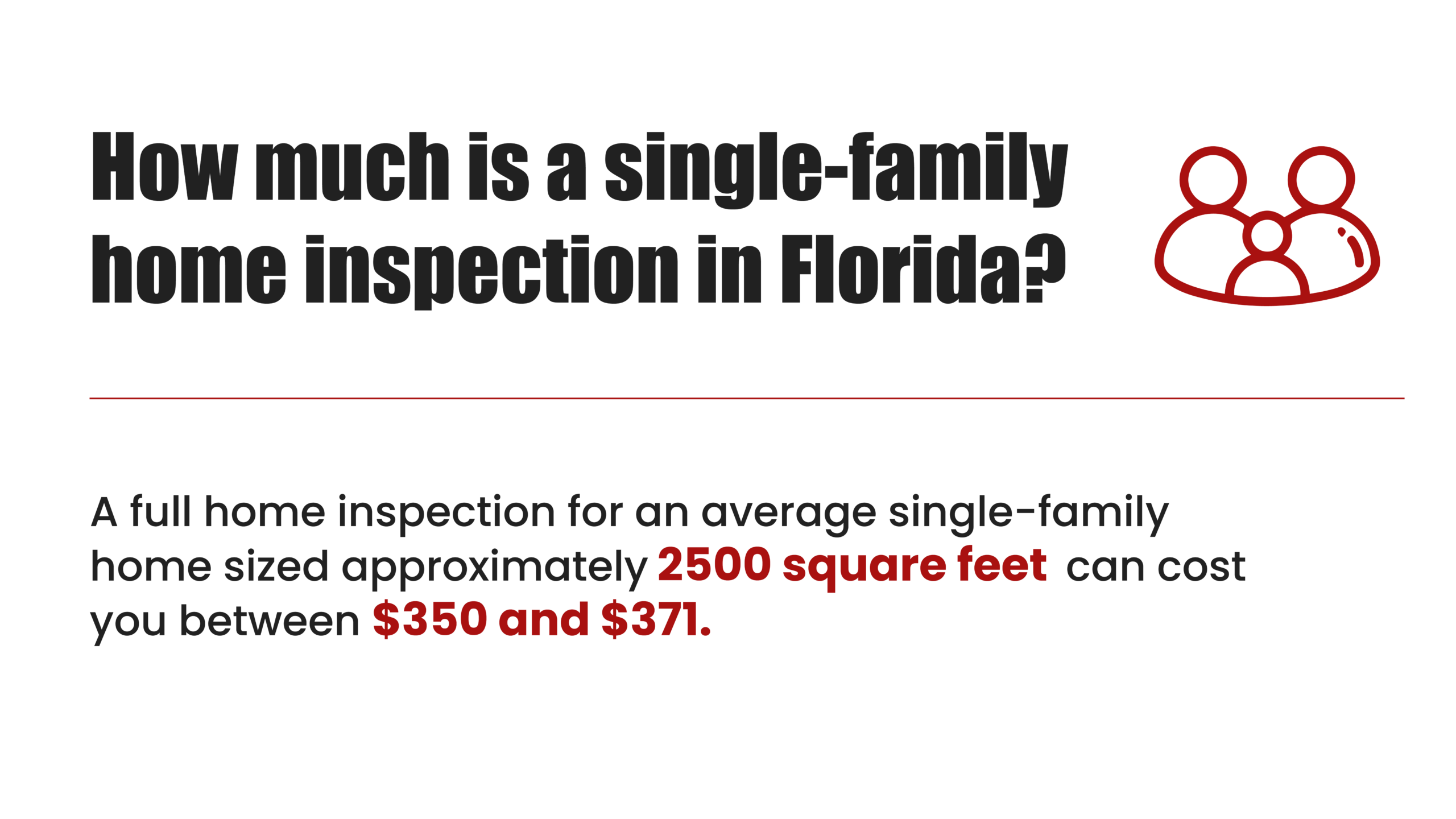
A home inspection is a comprehensive examination of a property’s condition and safety. An inspector, such as a licensed home inspector in Bradenton and Sarasota, will assess the condition of the structure, heating and cooling systems, electrical and plumbing systems, roof, windows, and more. The goal of a home inspection is to identify any major problems or potential issues with the property so that the buyer can make an informed decision about whether to move forward with the purchase.

The inspection process typically takes a few hours and includes a thorough examination of the property’s interior and exterior. The inspector will check the walls, ceilings, floors, and windows for any signs of damage or wear and tear. They will also inspect the heating and cooling systems to ensure they are in good working condition and free from any potential safety hazards. The electrical and plumbing systems will also be checked for any potential problems, and the roof will be examined for any signs of leaks or damage.

Home inspectors are licensed professionals who are trained to identify potential problems in a home. They will provide a detailed report of their findings, including any issues that need to be repaired, replaced, or updated. The inspector may also make recommendations for future repairs or upgrades.

Appraisals

An appraisal, on the other hand, is an evaluation of a property’s value. The purpose of an appraisal is to determine how much a property is worth in the current market. Appraisals are usually required by lenders to make sure that the loan amount is in line with the property’s value. The appraisal helps the lender determine if the property can be used as collateral in case the borrower defaults on the loan.

The appraisal process involves the appraiser visiting the property and examining various factors that contribute to its value. This includes the size and condition of the home, its location, and comparable sales in the area. The appraiser will also take into account any upgrades or renovations that have been made to the property, as well as any potential issues that could impact its value.

Appraisers are trained professionals who are licensed by the state. They are experienced in determining the value of properties, and they use their expertise to provide an accurate estimate of the property’s value. An appraisal report will provide a detailed analysis of the property’s value and include an estimated market value.

KEY DIFFERENCES

  1. Purpose: The main purpose of a home inspection is to identify any problems or potential issues with a property, while the main purpose of an appraisal is to determine the value of the property.
  2. Professional: Home inspections are performed by licensed home inspectors, such as a home inspector in Bradenton and Sarasota, while appraisals are performed by licensed appraisers.
  3. Report: A home inspection report will provide a detailed analysis of the property’s condition and safety, including any necessary repairs or upgrades, while an appraisal report will provide a detailed analysis of the property’s value and an estimated market value.
  4. Cost: Home inspections typically cost between $375 and $500, while appraisals can cost anywhere from $300 to $800 or more, depending on the value of the property.

Conclusion

In conclusion, both home inspections and appraisals play important roles in the home buying process. It’s important to understand the difference between the two and to make sure you have both a home inspection and an appraisal performed when buying a home. This will help you make an informed decision about the property and avoid any potential problems or misunderstandings.


Nate Standifer

Nate Standifer

Nate Standifer is co-founder of Florida Property Group and a Florida-licensed home inspector with 15+ years of experience across telecommunications, low-voltage electrical inspections, and residential property inspections. An InterNACHI Certified Professional Inspector®, he and the Florida Property Group team complete approximately 1,500 inspections annually across Bradenton, Sarasota, Lakewood Ranch, and surrounding Southwest Florida communities.

InterNACHI Certified • RASM Member • SUPRA Access